Not So Fast: DOT Won’t Fix the Deadliest Parts of Canal Street First
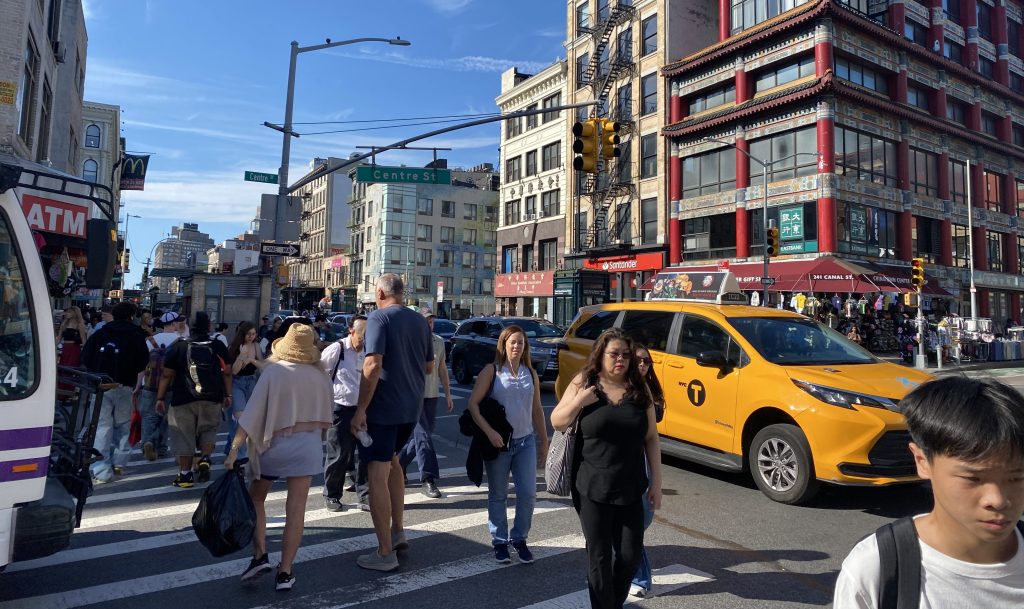
The Mamdani administration apparently won’t redesign the most-congested and dangerous parts of Canal Street this year after some locals complained about plans to repurpose parking for wider sidewalks.
The Department of Transportation recently told local leaders that its focus this year will be on adding pedestrian and bike safety elements to Canal Street west of Broadway, where its proposal has faced less opposition than on the busier and deadlier eastern segment of the strip.
As a result, residents and visitors to the busier part of Canal Street will continue to be crammed into tiny foot paths while the minority of people in cars get six lanes. According to DOT’s own data, the most crash-prone sections of Canal Street are on Broadway and the eastern half of crosstown thoroughfare, with 190 people killed or seriously injured by drivers over five years, compared to 122 people on the western half.
“Canal Street is a blood-pressure-raising corridor. If I had my preference it should start on the eastern side,” said Wellington Chen, the executive director of the Chinatown Partnership. “I guess it’s because the people were making a ruckus on the eastern side of Canal. They have no solution to offer, so that is what is happens; other people go first and we may not get around to you.”
Chen’s comments referred to a group of local opponents who’ve slammed DOT’s plan for eastern portion of Canal Street in Chinatown because it calls for repurposing of curbside parking spots for wider sidewalks on blocks often dominated by sidewalk vendors.
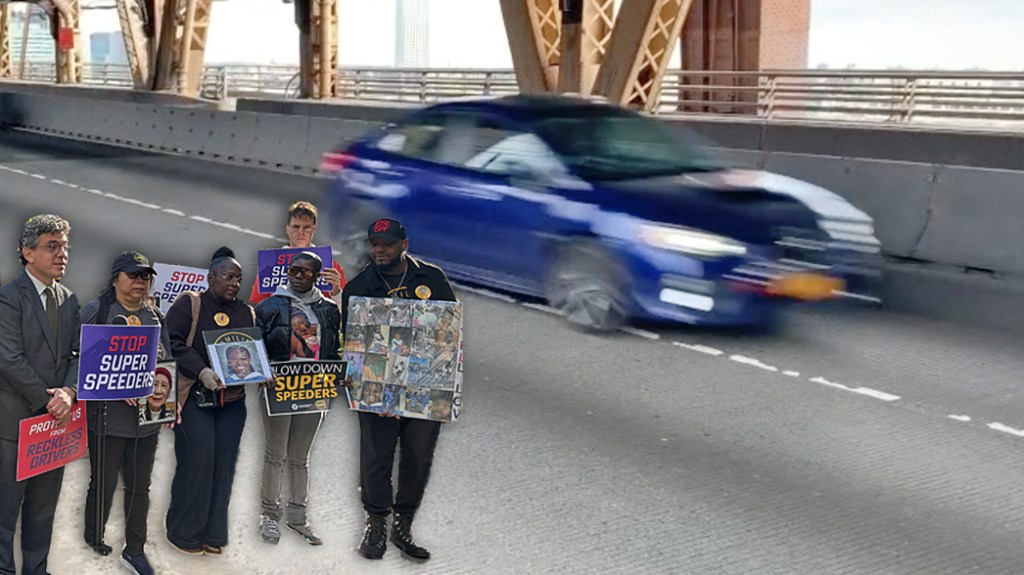
A year ago, a speeding driver coming off the Manhattan Bridge slammed into and killed 55-year-old cyclist Kevin Cruickshank and 63-year-old May Kwok, and within 24 hours a second driver smashed into a food truck injuring two others. Now, after months of silence from DOT about years-in-the-works safety fixes, officials will finally present an update to Manhattan Community Boards 2 and 1 on Tuesday and Wednesday of next week.
The decision to start with the less-dangerous phase of the project flies in the face of Mayor Mamdani’s pledge to speed up safety redesigns where “they’re most needed,” rather than the usual trench warfare that privileges bad faith, car-first complaints.
“When you talk about Mamdani and his legacy, tackling those problems, that’s what Canal needs, that’s what the community needs,” said Joseph Tedeschi, a Chinatown resident and advocate for more space on Canal. “The community has been waiting decades. It seems to me just a failure of our government, it’s a disappointment.”
Community Board 3, which covers the eastern end of Canal, won’t have a meeting about Canal until September, according to its District Manager Susan Stetzer, who told Streetsblog that DOT was considering “a lot of information.”
“They’re phasing it, and that [portion west of Broadway] is all that’s being covered right now,” said Betty Kay, who chairs Community Board 1’s Transportation and Street Activity committee. “We were told that’s the portion that would be done at this time. We have no dates of anything that’s east of that.”
More space, less danger
DOT’s two-phased redesign covers Canal Street from the Manhattan Bridge opening at the Bowery, to the Hudson River at West Street [PDF] and aims to improve safety and capacity for pedestrians, who make up about two-thirds of people on the corridor but have to squeeze into 10 percent of the public right-of-way.
The proposal, which DOT released last year, expands pedestrian space along the clogged sidewalks east of Broadway and turn the the current eastbound bike lane on Grand Street two-way, closing a gap in the area’s bike network, as Streetsblog reported in September.
DOT reps previously said the changes might take several years to complete, due to the project’s scope, but didn’t say where the work would start. Now, it is clear that it will start on the western stretch of Canal, not the more-dangerous eastern stretch.
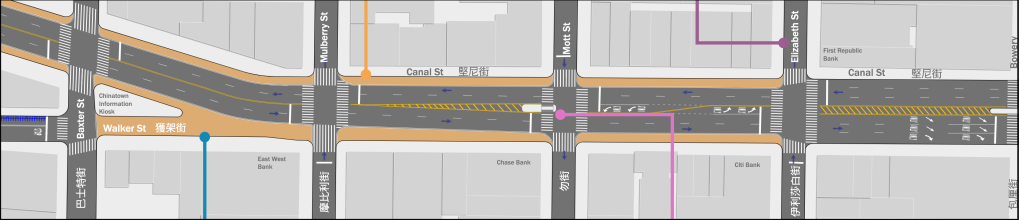
On the seven eastern blocks between Broadway and Elizabeth Street, DOT wants to replace the curb lanes on both sides with full-length painted sidewalk expansions, so-called “Super Sidewalks” that the agency previously rolled out in Midtown in 2023. Those curbside lanes are supposed to be for moving traffic during rush hour and loading zones in the middle of the day, but are instead filled with illegal parking at all times. (DOT’s proposal conspicuously stops short of Elizabeth Street, where cops from the local police precinct park their cars illegally with abandon.)
The agency also wants to close off a slip lane block of Walker Street east of Baxter Street, creating a larger plaza around the Chinatown information kiosk and reducing cut-through traffic coming from the West Side:
The western portion of the project that will now move forward sooner includes a two-way expansion of the currently east-bound Grand Street bike lane, which will connect to a short new two-way cycle path on Canal Street, from Sixth Avenue to Hudson Street, before continuing on Watts Street to the Hudson River Greenway.
The agency also plans to add painted curb extensions at corners, mostly on the south side of Canal Street from Broadway to West Broadway.
At a raucous DOT feedback session with community boards 1, 2 and 3 late last year, some locals slammed DOT for repurposing the part-time curbside parking east of Broadway to make more room for pedestrians, which business owners said – without evidence – would snarl traffic and make it harder for people to get to the corridor.
However, DOT had already done a series of surveys and outreach since the project started in 2022, and its feedback showed a whopping 80 percent support for its efforts.
The potential for a more pedestrian-friendly Chinatown became clear during the Ticker-Tape Parade celebrating the Knicks NBA Championship win last month, when Mayor Mamdani banished cars from Lower Manhattan.
Government leaders and experts have long promised to improve Canal Street without results.
Former Mayor Bill de Blasio promised a “comprehensive” study of it as part of the 2021 rezoning of SoHo and NoHo. The New York Metropolitan Transportation Council, a regional planning body, looked into the corridor for nearly a decade from 2002-2010, and its Canal Area Transportation Study, or CATS, recommended the city expand space for pedestrians, ban left turns, and set up smarter parking regulation.
Reached for comment, a rep for area City Council Member Chris Marte did not comment directly on the proposed changes to Canal Street.
“We look forward to seeing next week’s presentation by DOT, and hope that the two-way bike lane along Grand Street that was previously discussed remains in the plan,” said Marte spokesman Simon Kostelanetz.
A DOT spokesman said the agency didn’t want to hold up the upgrades west of Broadway as it continues to “process input” from the Chinatown section.
“We look forward to delivering transformative safety upgrades along the entirety of Canal Street starting this year,” said Vin Barone in a statement. “We are beginning on the western portion of Canal and Grand streets after making adjustments based on public feedback we’ve received. We are still working through input on the eastern portion and look forward to continuing future, exciting public space and safety upgrades on that end of the corridor.”

Read More:
Streetsblog has migrated to a new comment system. New commenters can register directly in the comments section of any article. Returning commenters: your previous comments and display name have been preserved, but you'll need to reclaim your account by clicking "Forgot your password?" on the sign-in form, entering your email, and following the verification link to set a new password — this is required because passwords could not be carried over during the migration. For questions, contact tips@streetsblog.org.