Analysis: Mamdani Is Out Of Excuses For Failing To Restore Bedford Avenue Protected Bike Lane
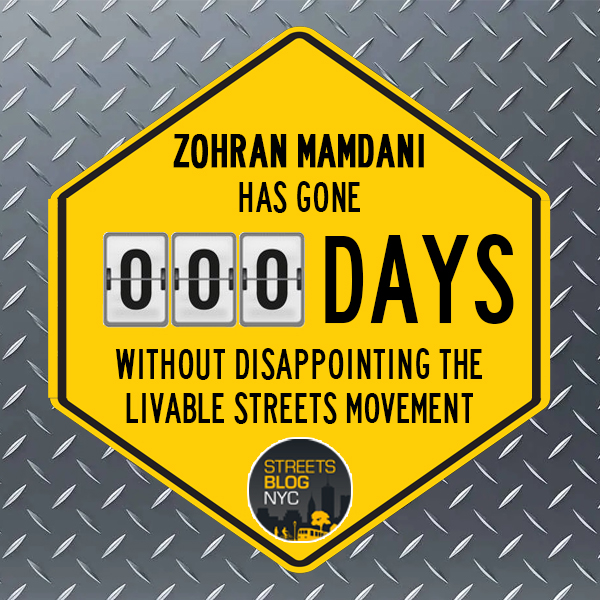
Why has Mayor Mamdani not restored Bedford Avenue’s protected bike lane yet?
As a candidate, and as mayor, he promised he would reverse his predecessor’s decision to un-protect three blocks of the protected bike lane between Willoughby and Flushing avenues.
Then last week, there was an election in which voters selected the preferred candidate of the bike lane supporters.
And even the bike lane’s staunchest opponent says he wants to find a safety solution.
And, lest we forget, he promised!
Yet for some reason — we’ll get to that reason soon — the three most-dangerous blocks of the Brooklyn roadway remain an exception in Mayor Mamdani’s methodical championing of street safety projects that the previous administration abandoned for politically connected donors or religious communities that vote as a bloc.
But those special interests were rocked by the victory of Assembly Member Claire Valdez in the Democratic primary for the neighborhood’s Congressional seat. Valdez was Mamdani’s pick for the seat, and she defeated Brooklyn Borough President Antonio Reynoso, who was endorsed by Satmar Hasidic leaders … the same community leaders who got then-Mayor Eric Adams to remove the protected bike lane between Willoughby and Flushing avenues.
Reynoso’s defeat by the bike-lane supporting Valdez shows that Hasidic power is waning, which gives Mamdani an opening — especially since a key Satmar leader told Streetsblog that he’s ready to talk.
That leader is Moshe Indig. Since taking office, Mamdani — who was not the choice of the city’s Orthodox Jewish community, to say the least — has cozied up to Indig, a Satmar rabbi and community leader. The bromance, such as it is, works two ways: Indig takes to Twitter to defend the mayor from unfair accusations of anti-Semitism from the right-leaning press, and in return, Indig has a friend at City Hall.
One, for now, who hasn’t done anything on Bedford Avenue.
But the writing is on the wall, even if the fresh kermit is not yet on the street. After last Tuesday’s primary where his candidate was defeated, Indig told Streetsblog that he is open to coming up with a solution that is safe for both cyclists and the 2,000 children that are bused to that area of Bedford Avenue from within the community.
“Bikers should be able to ride safe, and kids should be safe, everybody should be safe,” he said. “We would love to sit down and try to come up with a solution to make everybody happy. I would love it.”
This is a big change. How big? Let’s review the history of the Bedford Avenue safety project:
For years, activists have been calling for a protected bike lane on Bedford Avenue from Crown Heights clean through to Williamsburg, with local Council Members Chi Ossé (D-Bedford-Stuyvesant) and Lincoln Restler (D-Williamsburg) leading the most-recent charge.
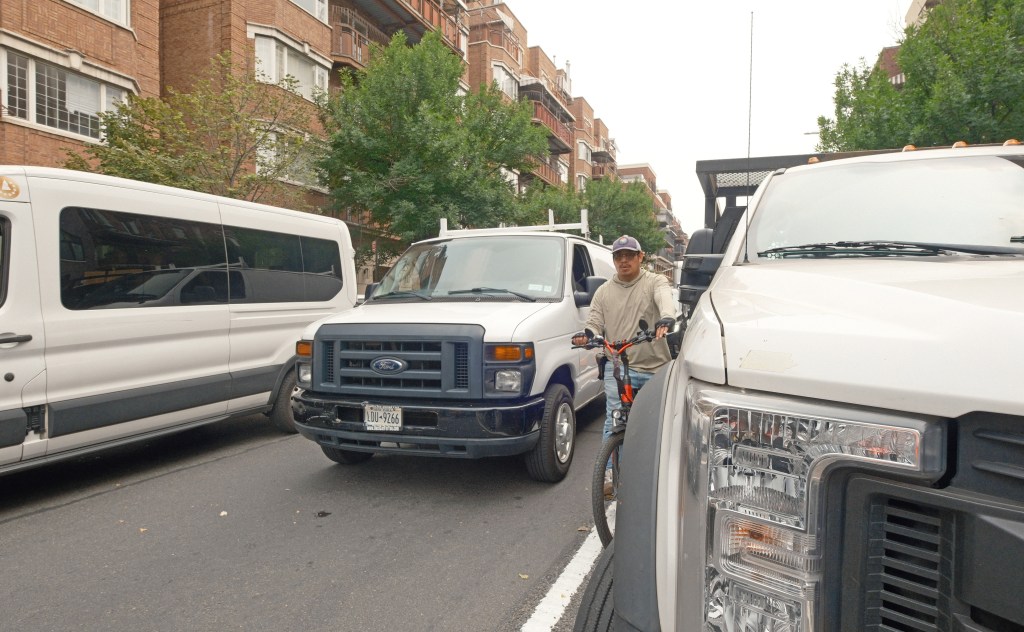
Success came when the Department of Transportation under then-Mayor Eric Adams finally installed in November 2025. But immediately after installation, the Satmar Hasidic community spoke out about the portion of the bike lane between Willoughby and Flushing and, using political connections (Adams ran exceptionally strongly in Hasidic Williamsburg and Crown Heights in the 2021 election), got Adams to hold a town hall meeting with Hasidic leaders, where Indig and others object to the safety measure. Days later, Adams, who was struggling in his re-election campaign at the time, undid that portion of the bike lane and restored the previous unprotected design where car drivers frequently double park, forcing cyclists into traffic.
Mamdani has explicitly said he’d do things differently.
When he was running for mayor, he told Streetsblog he would have the “political will” to change the streets. He said he would restore Bedford Avenue to its formerly protected state. And at the Transportation Alternatives’ annual gala last month — which celebrated the McGuinness pledge — he said, “No longer will we wait for a New Yorker to get hurt before we take action.”
And as mayor, Mamdani has undone a lot of the Adams-era damage. He ended the Adams push to increase criminal summonses for cyclists who break minor traffic laws, he will finish the protected bike lane on Ashland Place and McGuinness, and he is putting a bus lane on Fordham Road in the Bronx.
But there’s that glaring omission in the heart of Brooklyn. And advocates are frustrated.
“We’re counting on the Mamdani administration to build the protected bike lanes that Central Brooklyn needs, down Bedford Avenue, up Franklin Avenue, and across major east-west connectors so New Yorkers are safe biking around the neighborhoods they call home,” said Ben Furnas, executive director of Transportation Alternatives.
And one plaintiff in the lawsuit to restore Bedford’s protection was less diplomatic.
“Mamdani promised, and the city has the authority to do it now,” said Baruch Herzfeld, who, with his son, Rafe, sued the city. “Every day it is missing people still bike there, just less safely. He should act now: the community will support a practical safety compromise.”
When asked by Streetsblog if the mayor would recommit to finishing the job on Bedford, a spokesman looked only to the future.
“The mayor is proud to have restarted many street safety projects that were paused, cancelled or curtailed by the previous administration, and we will have more projects to announce in the weeks and months to come,” said spokesman Jeremy Edwards before adding a suggestive, “Stay tuned!”
Restoring the protected bike lane is not just about fulfilling a political promise, it’s about safety. The DOTs original redesign of a full protected bike lane on Bedford Avenue was based on decades of research by the department. In an exhibit shared with the court during the Herzfeld suit, DOT said that removing the bike lane would “reduce overall safety along the corridor.” And the department observed a 47-percent reduction in injuries on Bedford between Dekalb and Flushing after the protected infrastructure went in.
Since removing the protected portion of the bike lane, safety has declined. As city statistics reveal, in the seven months when there was a full, uninterrupted protected bike lane on Bedford, there were 31 reported crashes, injuring nine cyclists. But in the seven months after the protection was removed on the northernmost three blocks, there were 34 reported crashes on the stretch, injuring 13 cyclists — a 44-percent increase in cyclist injuries, albeit a small sample size.
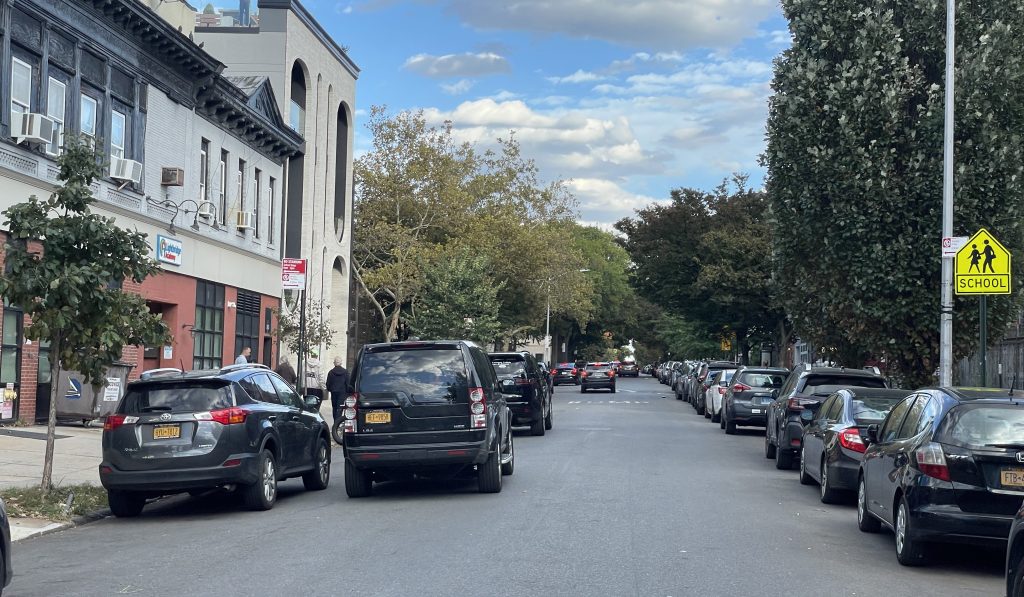
On June 7, a three-car collision showed how dangerous the roadway has become. A driver maneuvering around illegally parked cars on both sides of Bedford Avenue was hit and had his car overturned when the driver of another double-parked car nudged into him.
Indig doesn’t think the corridor is safe, either, but he does not think it would be fixed with a bike lane, a proven traffic-calming measure. Then again, his opinion is clouded by the thick windshield between himself and other users of Bedford Avenue.
“We all know Bedford Avenue is a very busy avenue. It’s almost like a highway,” he said. “Putting up this bike lane is like putting up a bike lane in the middle of the BQE. Every day in the rush hours, you have the morning and the afternoon cars backed up for I don’t know how many blocks.”
Indig’s resignation to “highways” cutting through his community is quite common in the Hasidic section of Williamsburg. After 10-year-old Yitty Wertzberger was hit and killed by a driver on nearby Wallabout Street on her way to school, Streetsblog indeed found many members of the Satmar community who want safety for the many children in the community, but members of the sect don’t view cars as a threat to their children, despite the reams of statistical evidence of harm caused by the drivers of 3,000-pound steel-encased machines racing through the neighborhood.
“Some people take every accident and they want DOT to stand on their head,” Simon Weiser, a longtime member of Brooklyn Community Board 1 once told Streetsblog when we asked why he wasn’t outraged by the death of Wertzerger or teacher Matthew Jensen on nearby McGuinness Boulevard.
“They redo the whole street because somebody got killed.”
In the case of Bedford, it’s looking like it’ll have to come to that.
Correction: An earlier version of this story citied an 85 percent increase in cyclist injuries, that number is 44 percent.

Read More:
Streetsblog has migrated to a new comment system. New commenters can register directly in the comments section of any article. Returning commenters: your previous comments and display name have been preserved, but you'll need to reclaim your account by clicking "Forgot your password?" on the sign-in form, entering your email, and following the verification link to set a new password — this is required because passwords could not be carried over during the migration. For questions, contact tips@streetsblog.org.