Opinion: To Save Summer Streets, Lose The Cops, Not the Security
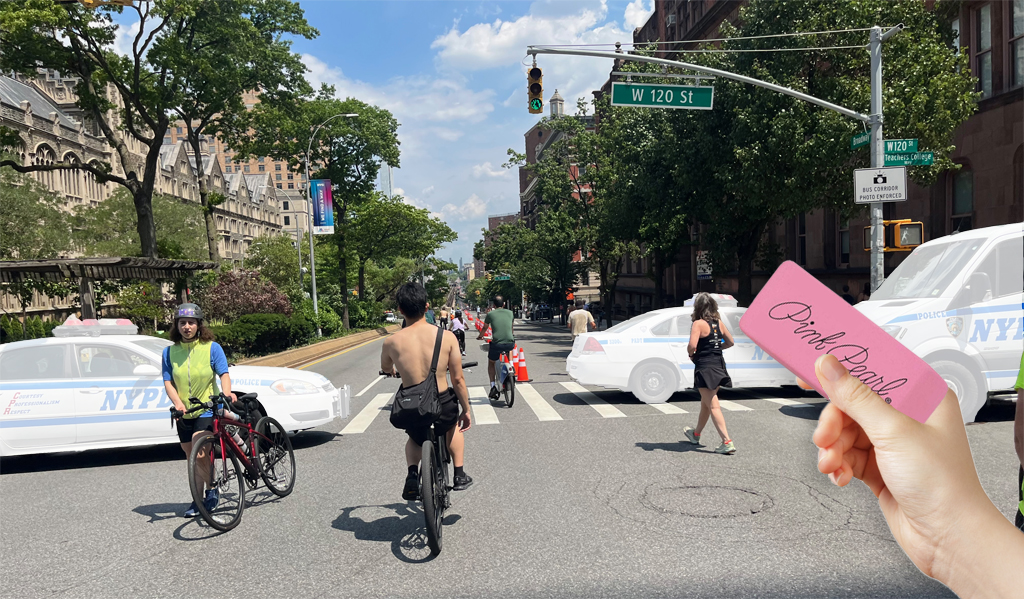
After navigating the extraordinary number of NYPD vehicles blocking intersections along the first Manhattan Summer Streets of 2026, I was among the people calling for the city to roll back the new security measures.
A week later, after only modest improvement, I think that is the wrong fight.
The police vehicles have unquestionably made Summer Streets worse. Even with improvements to the vehicle positioning at the second iteration of the event, NYPD deployed enough vehicles to dramatically narrow the space available to people walking, running and biking at most intersections, creating the exact kinds of bottlenecks a car-free event is supposed to eliminate.
But the political reality is also becoming clear. The NYPD says the measures are intended to protect crowds against vehicle ramming attacks. Once city officials have identified a security measure that they believe is necessary to prevent a catastrophic attack, asking them to remove it simply won’t work.
Fairly or not, the officials responsible for rolling back that protection would be the people called to account if something horrible happened afterward.
So instead of debating whether Summer Streets needs physical protection from vehicles, we should ask a different question: How can the city provide that protection without ruining the joy of Summer Streets?
The answer starts with getting police cars out of the way.
The NYPD already uses concrete barricades as part of its security toolkit and the city should use those barriers to replace patrol cars along the Summer Streets route. Unlike an SUV parked across an intersection, purposefully positioned barriers could stop unauthorized vehicles while creating more space through which people can move.
Concrete, of course, has a drawback: moving hundreds of heavy barriers into place and removing them again requires considerable labor and equipment.
But that drawback points toward an opportunity.
Currently, Manhattan Summer Streets operates for just eight hours, from 7 a.m. to 3 p.m., on three Saturdays in August. If the city is going to undertake the work of installing substantial physical protection along a dozen miles of Manhattan streets, it makes little sense to dismantle it at the close of a single eight-hour window.
At a minimum, the city should install the barriers ahead of Saturday morning and keep them in place through Sunday afternoon. That would require additional setup and removal labor, but replacing police vehicles and other barriers — let alone the officers required to staff them — would reduce NYPD costs and would offset the installation expense. The same investment would then buy New Yorkers dramatically more car-free time, a commodity of incalculable value to tens of thousands of people.
But concrete is just a temporary solution beyond which the city should already be looking. Purpose-built mobile anti-vehicle barriers can provide protection while taking up less space and requiring less labor to deploy. Companies already manufacture systems specifically for temporary events and street closures. New York City should competitively evaluate these systems rather than assume that hundreds of police cars — and officers on overtime — are the only way to secure an intersection.
None of this requires choosing between security and great public space; it requires treating security as a design constraint.
Summer Streets has succeeded for nearly two decades because it lets New Yorkers experience what our avenues can become when they are not set aside solely for the movement and storage of cars. The worst possible response to new security requirements would be to slowly suffocate that experience with police vehicles, rising operating costs and ever-narrower passages until the event becomes a shell of itself.
New security requirements do not have to mean worse Summer Streets. They can be the reason we finally build a bigger, better version of it.

Read More:
Streetsblog has migrated to a new comment system. New commenters can register directly in the comments section of any article. Returning commenters: your previous comments and display name have been preserved, but you'll need to reclaim your account by clicking "Forgot your password?" on the sign-in form, entering your email, and following the verification link to set a new password — this is required because passwords could not be carried over during the migration. For questions, contact tips@streetsblog.org.