Opinion: The Case for Letting the BQE Fail
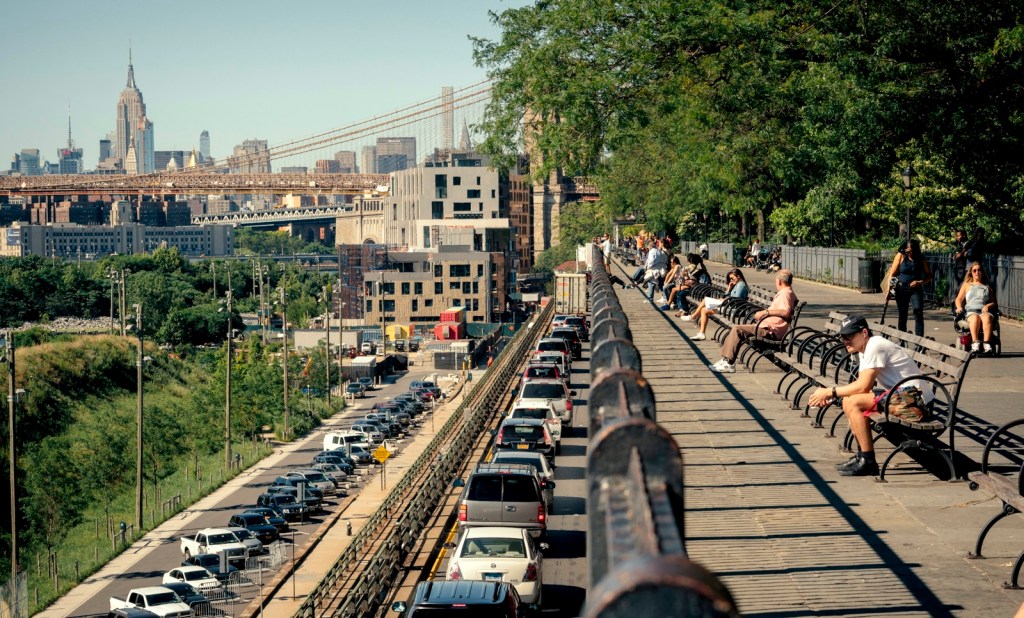
Nobody knows what to do about the Brooklyn-Queens Expressway’s triple cantilever. The decaying structure, which carries highway traffic beneath the Brooklyn Heights Promenade, has outlived its 50-year lifespan by two decades. Residents of Brooklyn Heights defeated a proposed fix because it would have shut down the promenade for several years and cost upwards of $4 billion. Eric Adams spent the last months of his abbreviated mayoralty begging the federal government for help.
To buy time, the city has limited traffic, installed weight sensors and fastened steel mesh sheets at weak points along the triple cantilever’s underbelly to prevent crumbling concrete from falling onto the windshields of drivers below. The highway continues to shake and groan of old age.
Half a century ago, city officials and local activists reached a similar impasse around the future of the old West Side Highway, another elevated structure built by Robert Moses. Today, a movement in favor of tearing down the BQE altogether — and not just the triple cantilever, but rather the whole stretch from the Verrazano to the Kosciuszko — is gaining momentum. All that space, the argument goes, could be used for something better: a mix of housing, parks and transit that reconnects severed neighborhoods back into the street grid.
The argument deserves to be taken seriously. Indeed, the same strain of community organizing that saved the promenade could bring down the BQE for good. The only caveat: the BQE, like the old West Side Highway, would have to fail first.
New York City constructed the original West Side Highway between 1929 and 1951. By the mid-seventies, however, the edifice had become geometrically obsolete and started to deteriorate. According to a 1974 study, it had “narrow ramps, sharp curves, left-handed entrances and exits, and a crumbling roadbed,” which “posed serious hazards.”
After a decade of patchwork repairs, it all ended one December morning in 1973, when an overloaded dump truck tore a hole through a weak segment between two aging steel girders and plunged onto Gansevoort Street below. The highway closed that day. After years of debate, the city finally demolished the entire structure by 1989.
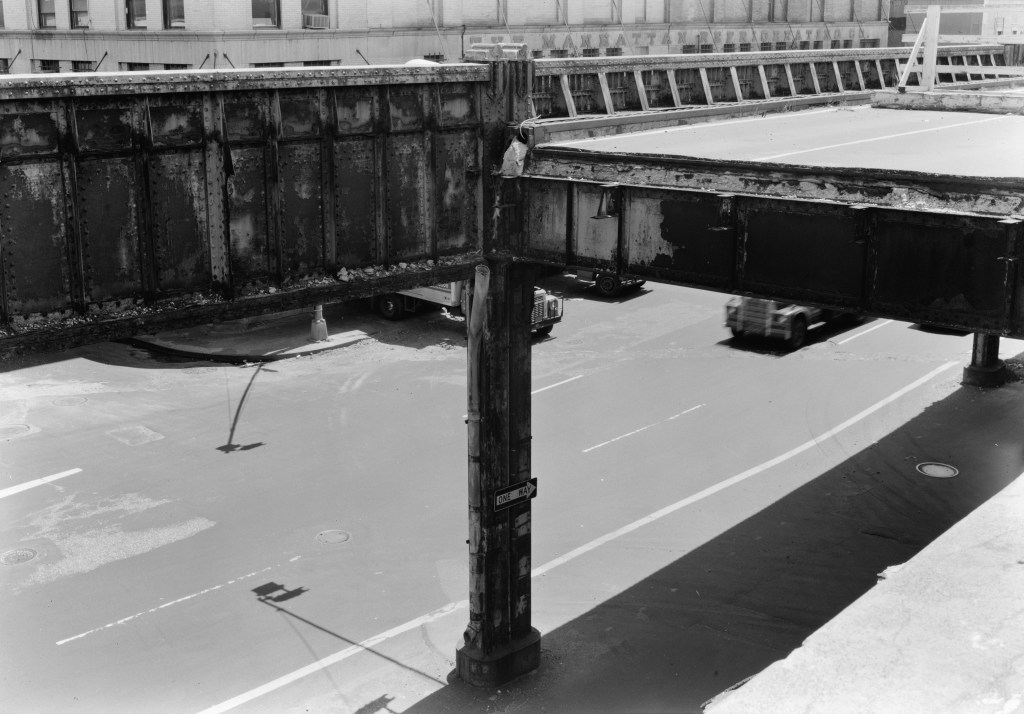
Well aware of the highway’s decline, Moses’s Triborough Bridge and Tunnel Authority conducted two studies in 1957 and 1964. Both offered extravagant and expensive expansions as remedies, neither of which were built. These studies eventually culminated in an ambitious, $2.1 billion megaproject (around $17 billion in today’s dollars) known as Westway. The plan called for burying the West Side Highway in a new offshore landfill between 40th street and the Battery in order to open up space for parks, interchanges, residential buildings and commercial developments.
Westway quickly gained popularity among power brokers from New York to Albany to Washington. “Mayor Koch was for it, Gov. Cuomo and President Reagan were for it,” said one of the lawyers who fought Westway in court. “So were the unions, the banks and the real estate industry.”
But Westway would meet its match in the same anti-highway urbanist swell that successfully stopped the Lower Manhattan Expressway. Even though it would be constructed on new landfill, mostly underground, it was still an expansion project: it would have funnelled more cars onto Manhattan streets and diverted billions of federal dollars away from mass transit. “It was branded a waste of government funds, an environmental disaster, a giveaway to developers,” recalled the New York Times in 1984.
In a bizarre twist, Westway eventually died not for any of the above reasons but because of a bureaucratic slip-up. In 1982, Judge Thomas P. Griesa ruled in favor of a coalition of complainants, including the Sierra Club and NYC Clean Air Campaign, that the Army Corps of Engineers had conspired with New York State Department of Transportation and the Federal Highway Administration to distort and downplay the effects of the proposed 243 acres of offshore landfill on the “highly significant and productive habitat” of a local striped bass population.
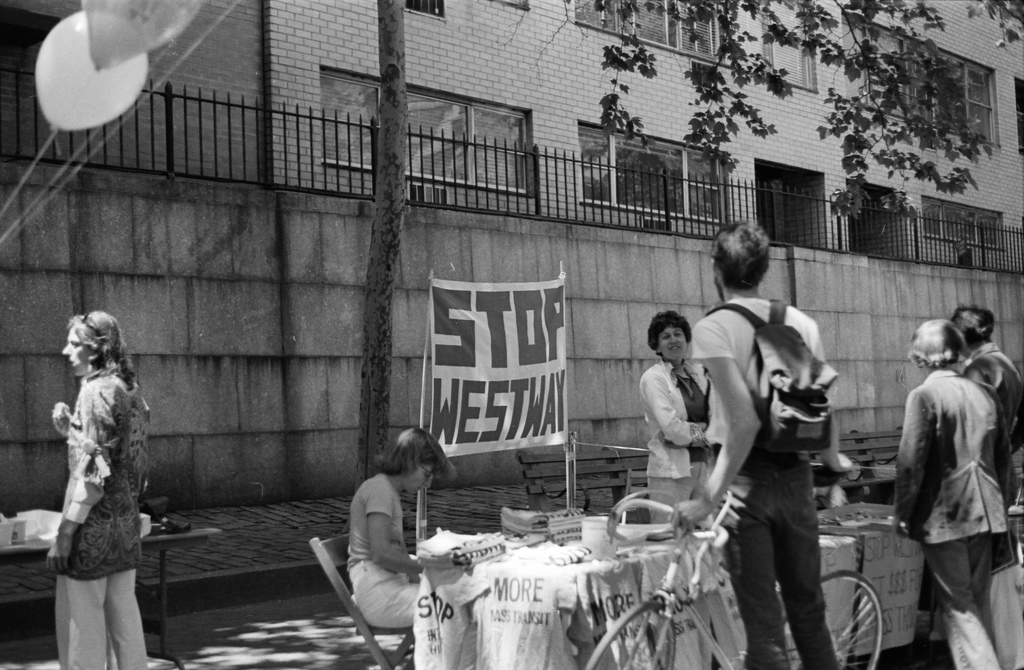
But while Westway planners and anti-Westway organizers battled in court and newspaper opinion sections, the West Side Highway sat there, shuttered and disintegrating — the result of the city’s understandable wish to attach the costs of its demolition to whichever large-scale, federally funded project would replace it.
For 16 years, the old West Side Highway became a place where people sought peace and quiet. The photographer Jan Staller described a “contemplative or spiritual quality” to nighttime Manhattan, out on the West Side Highway. The park was already there, right on top of the old viaduct; residents appropriated what was once the most dangerous, congested road in the five boroughs and turned it into a little ribbon of urban tranquility.
What would happen if the BQE met the same fate as the West Side Highway?
Adjacent neighborhoods might get used to a life without the highway’s constant background din and its miasma of particulate matter from brakes, wheels and exhaust. Residents from Gowanus to Williamsburg might flock to the space on foot or on two wheels. It would, informally, extend the existing promenade both north and south. And like the old West Side Highway, it would seem absurd to spend several billions of dollars getting it back up and running again.

Read More:
Streetsblog has migrated to a new comment system. New commenters can register directly in the comments section of any article. Returning commenters: your previous comments and display name have been preserved, but you'll need to reclaim your account by clicking "Forgot your password?" on the sign-in form, entering your email, and following the verification link to set a new password — this is required because passwords could not be carried over during the migration. For questions, contact tips@streetsblog.org.