Mamdani’s NYPD Gave Thousands of Criminal Bike Summonses Until Mayor Ended Adams-Era Crackdown: Stats
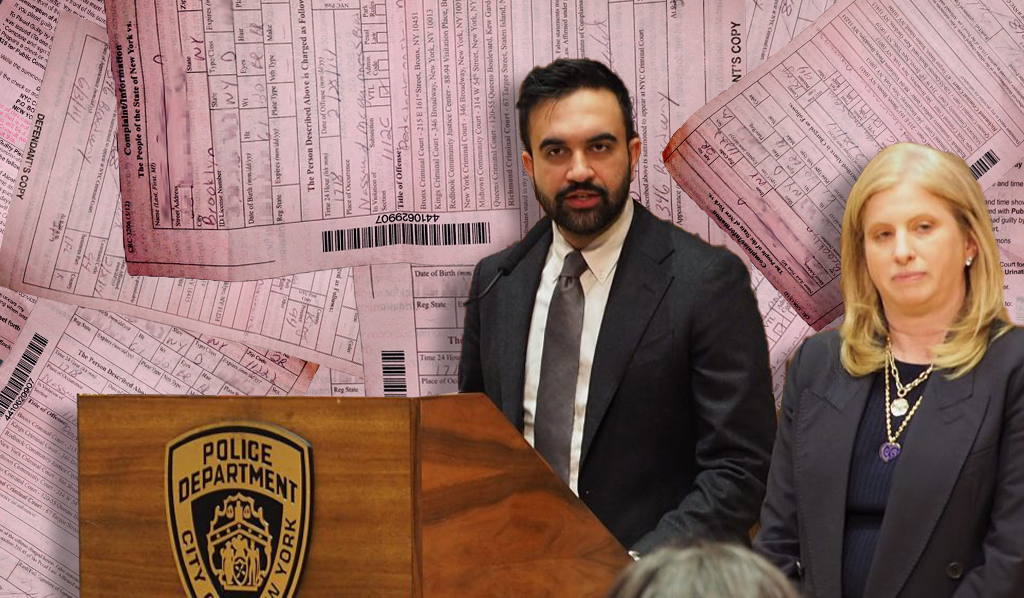
NYPD officers gave out thousands of criminal summonses to cyclists and e-bike riders this year, until Mayor Mamdani finally fulfilled his campaign promise to call off the Adams-era crackdown nearly three months into his term.
In late March, Mamdani ordered police to end their practice of dragging cyclists and e-bikers to criminal summons court for low-level moving violations — the same infractions that led to normal traffic tickets for motorists — but in the three months before the new mayor convinced Police Commissioner Jessica Tisch to play ball, roughly 40 New Yorkers per day were getting caught up in the dragnet, according to new data.
Advocates praised the mayor for ending his predecessor’s nearly year-long spree, but slammed the enforcement blitz as a massive setback for street safety and sustainable transportation in the Big Apple.
“It was always backward policy to give out criminal summonses to New Yorkers on bikes, when car drivers only receive traffic tickets for the same infractions, and we’re glad that Mayor Mamdani has reversed the previous administration’s mistake,” said Ben Furnas, executive director of Transportation Alternatives. “New York has the potential to become a world-class bicycling city — we should be making it easier and safer for New Yorkers to get around by bike, and we’re encouraged that the new leadership of DOT is committed to making that a reality.”
So far this year, NYPD officers issued 3,595 criminal summonses, or C summonses, through March 31, according to quarterly stats released last week by NYPD and analyzed by Streetsblog.
The number dropped about 21 percent from the previous quarter in late 2025, when cops gave out 4,526, a decrease that is likely weather related due to the cold and multiple storms in the new year. But this year’s figure was still more than 8,000 percent above the mere 44 C summonses during the first quarter of 2025, before Adams launched the blitz in late April last year, which Streetsblog first exposed and has covered extensively since then. Mayor Mamdani officially ended the policy about 11 months later on March 27.
And NYPD confirmed that it is following the mayor’s directive.
“The Department recently changed its policy so that low-level traffic infractions on a bike or e-bike are no longer enforced using criminal summonses,” an agency spokesperson said in a statement without providing a name. “The NYPD will continue to ensure traffic safety by enforcing the law within the guidelines of our Department’s policy.”
The granular data show a deeply uneven enforcement pattern that persisted into the new administration at City Hall, and advocates said that it was not about creating safer streets at all.
“It’s clear this wasn’t about safety, this was about punishment,” said Queens-based attorney and safe streets activist Peter Beadle. “No one is touting huge safety statistics that they can correlate to this action and we’re back to doing what we should have been doing during the Adams administration, building out [street redesign] projects.”
A whopping 91 percent of criminal summonses this year went to people of color even though they comprise just 69 percent of the city population.
Advocates for the city’s 80,000 delivery workers, many of whom are immigrant New Yorkers, commended Mamdani for ending the sweep, but said the city should have never pursued the punitive policy in the first place.
“This initiative represented a political choice to exercise social control over Black and brown New Yorkers instead of addressing the structural causes of street safety,” said Ligia Guallpa, the co-founder and executive director of the Worker’s Justice Project and Los Deliveristas Unidos. “The result was racist enforcement, plain and simple.”
The vast majority of criminal summonses to cyclists — 80 percent — were for going through red lights. Many of those could end up being void, since a state judge recently ruled that New York’s Finest have been wrongly giving out those summonses by neglecting to note whether a “walk” sign was on before the traffic signal switched to green. Cyclists have been allowed to cross with the “walk” sign since late 2019.
There were six reported criminal summonses in the four days between the stated end and the latest date with available data, March 31. A Manhattan cyclist riding the wrong way uptown was slapped with a criminal court summons for “disorderly conduct” on April 17, so it is also possible that some officers are using a workaround to continue harsher enforcement against bike riders well past the mayor’s deadline for reverting to traffic tickets.
A representative for the NYPD, who did not provide a name, told Streetsblog in an email, “Since the start of the policy change on March 27, the NYPD has issued a B-summons [traffic ticket] 97 percent of the time. For the 3 percent where a C-summons [criminal summons] was issued, it has been corrected.”
And about the specific disorderly conduct ticket, the department defended its officer’s action.
“For this specific incident, the officer at the time determined the incident fit the charge of disorderly conduct, and a judge will make a final determination,” the representative said in an email.
Bike lawyer Steve Vaccaro said he has still been getting calls from people who got criminal summonses after the policy supposedly ended.
The attorney didn’t expect the Finest to adapt quickly, given the their track record of ignoring a six-year-old law allowing cyclists to ride through a red light as long as they have the “walk” sign.
“Forgive me for being skeptical that NYPD stopped issuing summonses to criminal court for traffic violations,” Vaccaro said. “People are getting those summonses.”
A crackdown in review
Former Mayor Eric Adams and his hand-picked Commissioner Tisch launched the bike blitz on April 28, 2025, upgrading a half-dozen moving violations from traffic tickets to criminal summonses, or pink summonses, named after the color of the ticket paper.
The offenses included reckless driving, operating under the influence of alcohol or drugs, driving the wrong way, disobeying a red light, and failure to stop at a stop sign. But the criminal punishment strategy extended well beyond those to violations such as wearing two headphones, too many people riding on a bike, and stopping past a painted stop line.
Tisch justified the policy as a way to rein in “out-of-control” e-bikes and mopeds only, but the crackdown quickly ensnared people riding regular bikes, too.
Through the end of March, the NYPD issued 19,039 of those C summonses, including 15,444 during Adams’s tenure and the remaining 3,595 under Mamdani.
The nearly 20,000 tickets represent a more than three-fold increase over the total amount of criminal summonses NYPD issued before the crackdown, according to the open data set going back to as far back as 2006. We’ll say that again: the Adams bike enforcement spree tripled two decades’ worth of recorded criminal summonses in less than a year.
The data reveal that officers gave summonses mostly to people of color since last spring, with 40 percent going to Hispanic New Yorkers, followed by nearly 30 percent to Black people and 15 percent to white.
The stats also show that cops heavily relied on giving out red light tickets, issuing nearly eight in 10 summonses, or 15,202, for that offense, followed by 11 percent for going the wrong way on a one-way street, and seven percent for disobeying a pavement marking.
Red-light tickets are low-hanging fruit for police officers, because they can post up at a busy intersection and pick off cyclists en masse – such as at the Williamsburg Bridge’s confusing Manhattan entrance.
That strategy indicates that the deployment was about racking up numbers, not creating safer streets, said one cycling attorney and street safety advocate.
“What we did not see is NYPD issuing summonses for dangerous behavior, what we saw was the same old traditional fish-in-a-bowl, gotcha summonsing, including lots of summonses for cyclists following the LPI rule,” said Vaccaro.
Location data reveal that cops enforced the top five most common violations mostly in Manhattan, the South Bronx, northern and western Queens, and in western and central Brooklyn.
The results
The NYPD has never provided data showing that its crackdown led to any safety benefits — but there was never any hard data to back up the blitz’s supposed safety objectives to begin with. In fact city data revealed that e-bike crashes – already responsible for just 0.4 percent of pedestrian injuries the year before – declined in the lead-up to policy.
It turned out, the entire effort was fueled mostly by vibes and “community” complaints – including Tisch’s own mother.
Meanwhile, Streetsblog’s reporting revealed a haphazard roll-out on the ground, including cops pulling a taser, beating up a teen, slapping that Brooklyn mom with double tickets, and entrapping riders by jumping in front of them.
People caught up in the dragnet had to go take hours off from work to attend an in-person court hearings, only to get lectured by judges before jurists largely dismissed the tickets anyway. Police officers, meanwhile scaled back their ticketing against car drivers.
There was plenty of community opposition, however, including from the city’s usually car-focused community boards and the NYC Bike Messenger Association organized a critical mass protest.
Mamdani ran on ending the reactionary practice, but kept Tisch on as top cop. After assuming office, Hizzoner repeatedly sidestepped reporters’ questions about the future of the enforcement bonanza – before finally announcing in March that the NYPD would stand down.
The news set off predictable hysteria among conservative media that the new mayor was enabling lawlessness, even though he merely re-equalized law enforcement for cyclists and far more dangerous car drivers after a nearly year-long experiment.
City Hall spokesperson Sam Raskin referred a Streetsblog request for comment on the new data back to the mayor’s announcement in March.
Methodology: Streetsblog arrived at the numbers by filtering out only the NYPD’s C summons data sets types of infractions that the Department of Motor Vehicles says cyclists can receive. The NYPD’s statistics on NYC Open Data often don’t specify which mode of transportation people used, but given those surged right after April 2025, and the fact that motorists continued to get regular traffic tickets, it is safe to assume most of the increase in criminal summonses went to cyclists and e-bike riders.


Read More:
Streetsblog has migrated to a new comment system. New commenters can register directly in the comments section of any article. Returning commenters: your previous comments and display name have been preserved, but you'll need to reclaim your account by clicking "Forgot your password?" on the sign-in form, entering your email, and following the verification link to set a new password — this is required because passwords could not be carried over during the migration. For questions, contact tips@streetsblog.org.