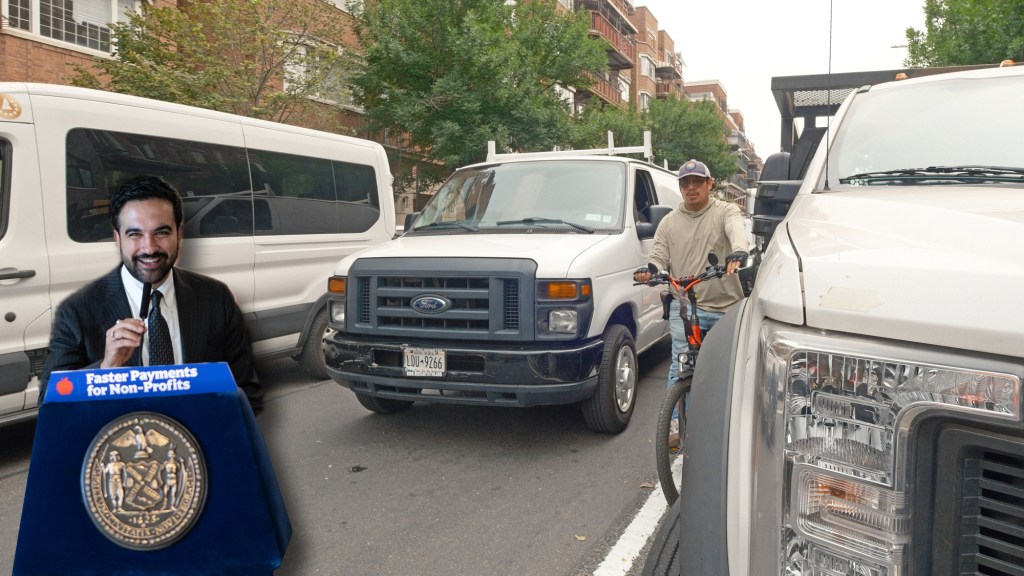
Bushwick Panel Opposes NYPD Cycling Crackdown — But Board Chair Slams Newbies
A Bushwick community board voted to call out the NYPD’s ongoing criminal summons policy for cyclists after months of deliberation — but now the board’s longtime chairman wants to toss the resolution for procedural reasons, but also slammed its supporters as newcomers who don’t represent “the community.”
It’s the latest in an ongoing New York battle over who gets to complain about the city’s many problems — and who gets to identify what those problems even are.
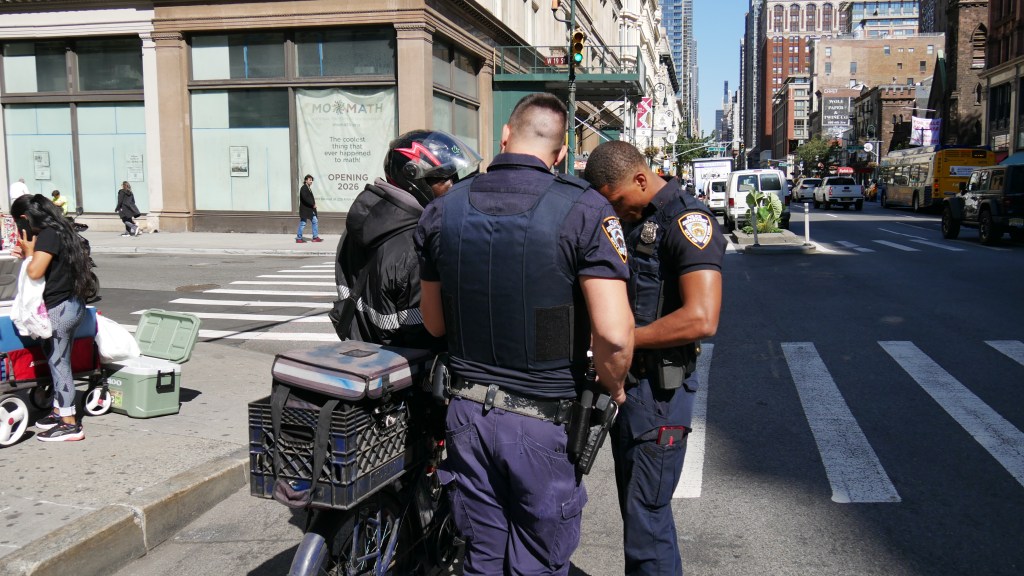
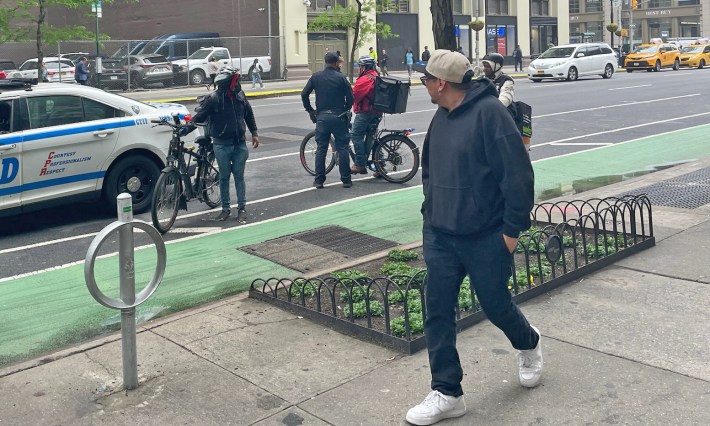
It all started last spring, when NYPD Commissioner Jessica Tisch ordered cops to slap cyclists with criminal summonses for moving violations that would result in a regular ticket for car drivers. The move forced members of the largely immigrant delivery workforce into the criminal justice system, and potentially threatened individuals’ applications for asylum.
This different burden for drivers and for cyclists is not just bad for deliveristas, but bad policy by the NYPD, which now has to “divert attention and resources from more serious public safety concerns,” according to the tightly reasoned, linguistically measured resolution, which past last month.
“Should somebody riding a bike have to take a day off work to go to court when someone driving a car can just mail in a fine? That’s not fair,” Jason Gers, a member of the Community Board 4 Transportation Committee, told Streetsblog. “A lot of the people who are really being targeted by this are immigrant delivery workers for whom missing a day of work … means losing money that they’re using to feed their families. It puts them in the criminal justice system that can make them vulnerable to being deported. People have this blindness to vehicular crime and vehicular violation because they’re used to it.”
The board passed the resolution in December after discussing it for six months. It passed without stated opposition, though Board Chairman Robert Camacho had tried to table the resolution.
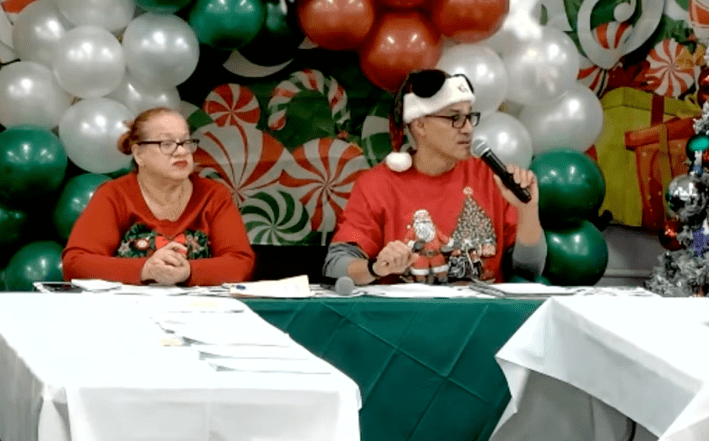
But in the days since, Camacho said he resents the resolution — as well as his neighbors’ concerns for the city’s delivery workforce, much of which hails from Latin America and Africa.
“I am Latino, so I don’t need nobody to be fighting for me, especially people that just got here,” Camacho, who first joined the board 42 years ago, told Streetsblog.
Camacho put his anger into a Jan. 5 letter to Brooklyn Borough President Antonio Reynoso, describing himself as “deeply concerned about recent board behavior, the precedent it sets, and how it impacts community representation.” He accused board members of passing the resolution “without engaging the community.”
Gers denied that.
“This measure had robust discussion including feedback from many board and community members,” he said. “Camacho expressed his opposition multiple times and yet this vote still passed the board unanimously. He is now trying to overturn the legitimate will of this board. It’s disrespectful and a waste of his board members’ time.”
The board’s letter to NYPD called on the department to provide concrete data justifying the criminal summons policy and for enforcement against cyclists to be equal to enforcement against drivers, who are far more dangerous on city streets. The letter echoes the work of Manhattan community boards 4 and 7, which called last summer for the policy to stop.
The criminal summons policy, which advocates have slammed as harassment and antithetical to increasing safety for pedestrians and cyclists, was the brainchild of the Adams-Tisch partnership.
Tisch based the policy on alarmist public comments, including those from her own mother, rather than data, the department admitted to Streetsblog last year.
But the policy has continued under Mayor Mamdani, even though he pledged to end it.
This leadership vacuum makes resolutions like that from CB4 all the more important for opponents of the policy.
Transportation Chair Ben Tocker said he tried to make it clear to Camacho that the point of the resolution was not to defend cyclist who break traffic laws, but to promote fairness in enforcement between two-wheelers and car drivers. To address Camacho’s concerns, the committee at first agreed to write “e-bikes” out of the resolution before reversing course after a survey revealed more than half of members preferred the original language.
“Nobody is trying to make this recommendation to the PD because we want to be able to run lights with impunity. That was never the case,” said Tocker. “It’s just a concern about ICE. We don’t feel like people should be deemed as criminals more so than vehicle drivers doing the same thing.”
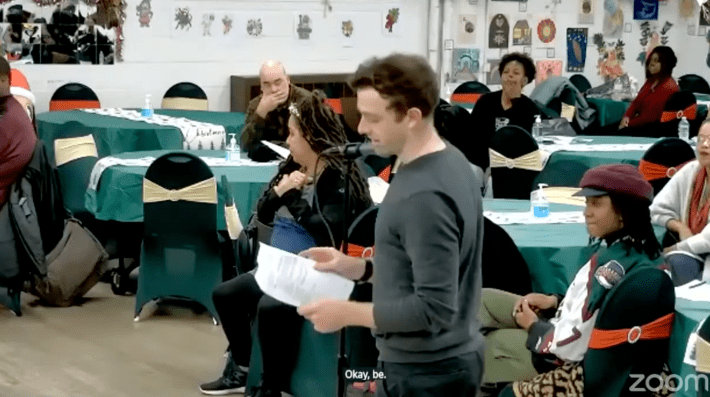
The extent of Camacho’s objection to the resolution became fully clear at the board’s next meeting on Jan. 21, when members asked why the board office had not yet sent the letter to the NYPD. Camacho said he was appealing the vote on procedural grounds and admitted he had asked the borough president’s legal department to determine if the resolution “is compliant with the board’s charter-mandated responsibilities.” He claims, without evidence, that a community board cannot make policy recommendations unless an elected official or outside organization asks it to do so.
What is the community board’s role?
Tocker conceded that the board doesn’t typically make policy recommendations without being asked to do so, and that he was hesitant to work on this type of resolution. But board members felt very strongly about the criminal summons policy amid the current immigration climate, he said.
“We did something a little unorthodox. Community boards are not supposed to take stands and make policy recommendations,” said Tocker. “This is one thing where enough people on our committee are just plugged into the news and we care about this, and we felt like this is something that impacts enough people that we should bring it up.”
Asylum-seeking immigrant delivery workers make up the most visible group of e-bike riders in the city. Immigration lawyers have warned that the NYPD’s criminal puts vulnerable immigrants into the criminal justice system, which could in turn affect their asylum applications.
“Being deemed a ‘criminal’ doesn’t mean the same thing as it used to, and we have to be mindful of that,” said Tocker. “And as community board members, at the very least, we can look around on the margins and see where we can be improving things and looking out for folks.”
Camacho insisted that the board does not speak for the community on this issue — which calls into question the very purpose of the institution he has chaired for years. In a long conversation with Streetsblog, he said his objection to the recommendation is deeper than just an issue with procedure, but is really about his concern that new board members don’t share his view of the community where he has lived for decades. (It’s worth noting that voters overwhelmingly approved an eight-year term limit for community board members in a citywide referendum in 2018; that limit will kick in for Camacho next year.)
Beyond his distrust of the newcomers, Camacho insisted that fighting a particular police policy should be left to advocacy groups and elected officials.
“We’re supposed to be about community. Our city charter mandates the quality of life in this community. We have organizations like Make The Road, Churches United For Fair Housing, we have people in DSA, Democratic Socialist of America,” Camacho said. “They could do protests and fight and change it starting through our elected officials and fighters. They know how to do that very well. The community boards do not do that.”
But nothing in the city charter limits the board’s jurisdiction to matters brought to it by members of the public, elected officials or government agencies, nor does it prevent the board from opining on matters it deems important. Members of the public can attend board meetings to contribute their views to the discussion.
“This is very new to CB4,” Celestina Leon, the board’s district manager, said of the type of resolution that was passed. “It doesn’t mean we can’t do new. … [The transportation committee] is primarily newer members that are navigating all of this.”
Borough President Antonio Reynoso did not respond to Streetsblog’s request for comment.

Streetsblog has migrated to a new comment system. New commenters can register directly in the comments section of any article. Returning commenters: your previous comments and display name have been preserved, but you'll need to reclaim your account by clicking "Forgot your password?" on the sign-in form, entering your email, and following the verification link to set a new password — this is required because passwords could not be carried over during the migration. For questions, contact tips@streetsblog.org.