Upper West Siders Beg DOT For A ‘Low-Traffic Neighborhood’
Another community wants the Mamdani administration to keep killer drivers — and their pollution, noise and quality-of-life crimes — off quiet residential streets.
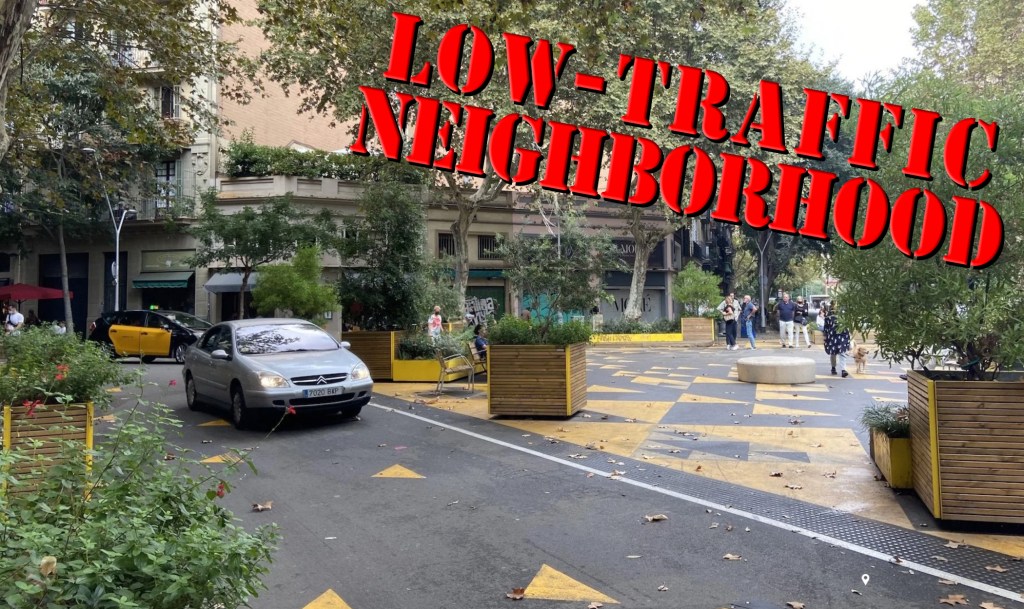
Manhattan Community Board 7 on the Upper West Side narrowly passed a resolution on Monday night asking the Department of Transportation to pilot a small “low-traffic neighborhood” configuration — a traffic-calming strategy gaining steam in neighborhoods where residents are fed up with outside drivers using their streets as cut-through highways.
The resolution, which had unanimously passed the transportation committee in March, passed the full board in a 19-14 vote.
“Low traffic neighborhoods represent a paradigm shift in how we think about our streets and what we prioritize,” Carl Mahaney, the director of StreetopiaUWS, told Streetsblog.
The resolution, presented by Mahaney to his neighbors, specifically asks DOT to create an LTN, as they are often known, in a way that prioritizes areas around libraries, medical centers, schools and senior centers.
An LTN improves the quality of life and safety for everyone on the street and prevents drivers from using local roads as shortcuts to different areas, such as Central Park.
“I knew a guy who prided himself on being able to get off the West Side Highway and make all the lights going to Central Park on West 88th Street by going fast,” said Ken Coughlin, a co-chair of the board’s transportation committee. “This [resolution] doesn’t block any access to any particular block; you could still get there, but maybe you couldn’t floor it from Riverside Park to Central Park.”
Only about 27 percent of households in the district own a car, according to DOT, and a whopping 74 percent of drivers in the district are just driving through the neighborhood and aren’t residents or stopping to see loved ones or shop at a local business, according city data included in Mahaney’s presentation.
LTNs have rapidly expanded in London and have led to reductions in traffic and crashes, according to researchers. Most important: more people walk and socialize on the street, which not only boosts the economy but also reduces crime.
The configuration helps everyone in the zone. Air quality improves with fewer emissions and LTNs boost active travel, leading to increased life expectancy and fewer sick days. Even car drivers benefit.
“Even if somebody in that neighborhood needs to drive out of it and they can’t drive in a certain direction, maybe they have to take a slightly more circuitous route, they’re still likely saving time in the long run, because there’s less traffic overall,” Mahaney said.
LTNs can also lead to more parking for residents as outsiders are directed to different streets. And in London, emergency response times either slightly improved or stayed the same.
Local businesses also benefit when more people are moving at a human pace rather than flying by on four wheels. An LTN could help restore the Upper West Side to how it was before cars, with folks strolling around, chatting with neighbors and checking out shops, rather than driving through without interacting with the outside world.
“The goal is really just to create safer streets in a designated area without any really negative effects,” Mahaney said.
The Manhattan CB7 vote is not a one-off; it comes after four other community boards across the city passed similar resolutions: Brooklyn Community Boards 6 and 7, Queens Community Board 6 and Manhattan Community Board 9, which is just north of Manhattan CB7.
The resolution is now in DOT’s hands. The agency told Streetsblog it would review the resolution.
Monday’s debate was not without its contentiousness. In advance of the board meeting, the pro-car group, E-Vehicle Safety Alliance, sent out a conspiracy-filled email beseeching members to protest the “aggressive” plan to calm residential roads by reducing cut-through traffic.
“Remember, 27 percent of car owners means over 400,000 cars needed for family, and work,” the email stated. “Each car can hold three-to-five people. This is over a million residents who are in need of parking. … Six-hundred-thousand cars enter Manhattan every day, many owned by our essential workers who cannot afford to live here.”
Several members of the public and board members criticized the plan at the meeting, claiming it would needlessly impede commercial traffic and that it doesn’t make sense in such a dense neighborhood with both commercial and residential areas. Data show that freight comprises only a small percentage of the neighborhood’s traffic.
“I strongly oppose this project … which would make it more difficult for people who reside here,” said Richard Asche, the board’s vice-chair. “It would be an inconvenience, it would be an expense, and it serves no useful purpose whatsoever.”
Mahaney couldn’t disagree more, saying that LTNs provide “really only upside.”
“In exchange for a potential slight inconvenience [to drivers], you get just a lot safer streets and just a reimagining of streets, what streets can be,” he said. “Not places to sort of like drive through … but places for people to live their lives.”

Read More:
Streetsblog has migrated to a new comment system. New commenters can register directly in the comments section of any article. Returning commenters: your previous comments and display name have been preserved, but you'll need to reclaim your account by clicking "Forgot your password?" on the sign-in form, entering your email, and following the verification link to set a new password — this is required because passwords could not be carried over during the migration. For questions, contact tips@streetsblog.org.