AT THEIR LIMIT: Boards Covering 1M New Yorkers Want Reduced Car Speeds
A bottom-up push for safer, slower streets has hit a big milestone.
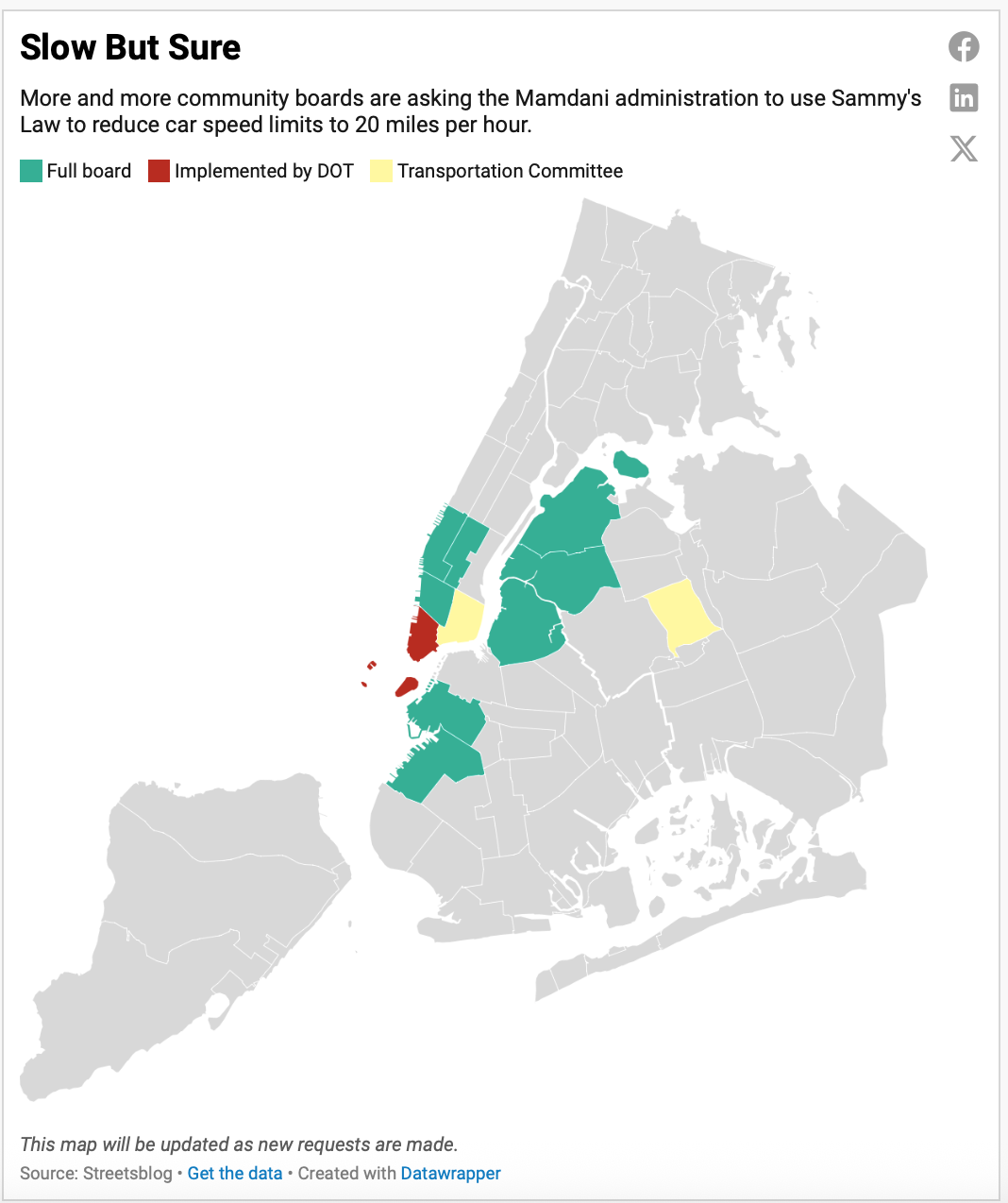
Eight community boards across New York City, representing more than 1 million residents, have asked the city Department of Transportation to designate their districts as “slow zones” with 20-mile-per-hour car speed limits. The push comes as Mayor Mamdani and the City Council bicker over who can implement the 2024 state law that allows the city to reduce speed limits below the statewide 25-mph minimum.
The effort for slower streets crossed the milestone on March 19 after Manhattan Community Board 2 unanimously passed a slow zone resolution.
“My community board puts safety and quality-of-life above someone getting somewhere fast in a car,” said Janet Liff, a member of Manhattan CB2. “It just sends a very clear message what our priorities are.”
Board members also said Manhattan’s whole congestion pricing zone, everything below 60th Street, should be a slow zone, though CB2 covers only 14th Street to Canal Street on the West Side of Manhattan.
Research has shown that slower car speeds can mean life or death for crash victims. There is a 45-percent chance of serious injury for a pedestrian when a driver hits them at 30 mph. That chance drops to 5 percent when the driver is piloting the car at 20 mph.
In addition to Manhattan CB2, slow zone requests have been approved by Manhattan, CB4 and CB5, Brooklyn CB1, CB6 and CB7 and Queens CB1 and CB2. Meanwhile, the transportation committees of Manhattan CB3 and Queens CB6 have also passed resolutions.
“It’s clear that New Yorkers are asking for lower speeds on their streets and I think this is really good momentum for us to continue working towards making the whole city safe,” said Alexis Sfikas, an organizer for Families for Safe Streets, which has been tracking and encouraging the push.
DOT spokesman Vin Barone previously told Streetsblog that the agency will review the community boards’ slow zone requests. The agency didn’t immediately respond to more recent questions.
The board-by-board strategy has gained momentum, but advocates have pointed out that it can’t produce the same impact as wider implementation. Progressive community boards that ask for slow zones are more likely to already support efforts to rein in the deleterious effects of cars. Elected officials representing car-heavy districts that need slower speed limits the most because of bad road design are less likely to push for the law’s implementation.
Under the previous mayor, state lawmakers passed the speed limit bill — dubbed “Sammy’s Law” in honor of Sammy Cohen Eckstein, was was killed by a speeding driver on Prospect Park West in 2013 — but the Adams administration implemented it sparingly, creating small slow zones in a few locations and 20-mph speed limits on a few short road segments.
Mayor Mamdani announced on March 16 that he plans to use Sammy’s Law to reduce speed limits in front of 800 public school buildings by the end of this year. Advocates applauded this move, but the announcement fell short of what they say is possible.
Both Council Speaker Julie Menin and Mamdani on the campaign trail showed strong support for reducing the speed limit to 20 mph. But in office, the Mamdani administration has said the City Council must pass a law to reduce the speed limit citywide; Menin says the mayor already can reduce the speed limit in specific locations to 20 mph.

Read More:
Streetsblog has migrated to a new comment system. New commenters can register directly in the comments section of any article. Returning commenters: your previous comments and display name have been preserved, but you'll need to reclaim your account by clicking "Forgot your password?" on the sign-in form, entering your email, and following the verification link to set a new password — this is required because passwords could not be carried over during the migration. For questions, contact tips@streetsblog.org.