Manhattan Panel Pans DOT Plan for Unprotected E. 17th St. Bike Lane
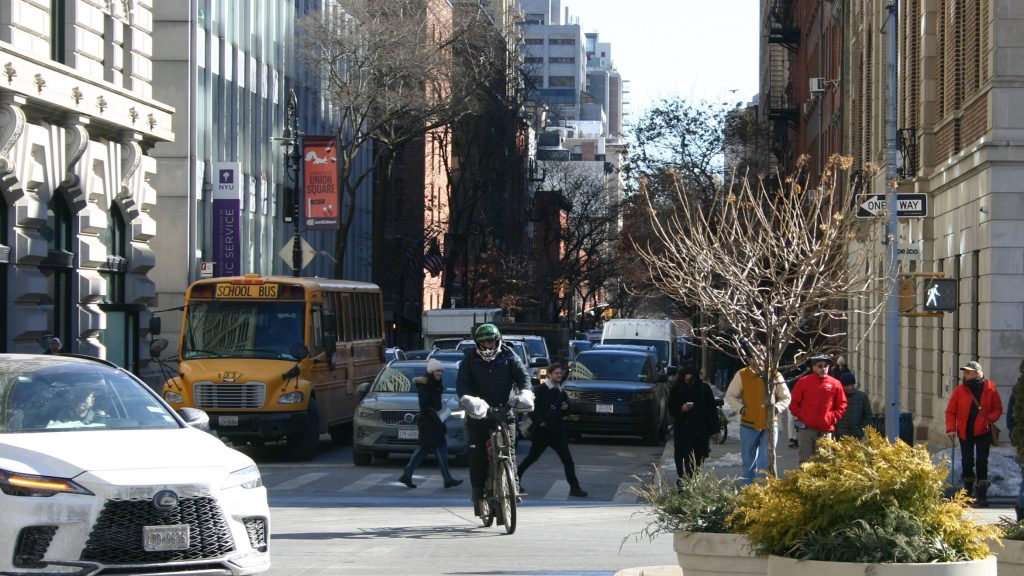
A Manhattan community board wants the Department of Transportation to go further than its plan for an unprotected bike lane on E. 17th Street from First Avenue to Park Avenue in Gramercy.
Manhattan Community Board 6, which covers the east side from 14th to 59th streets, overwhelmingly passed a resolution on Feb. 12 supporting a protected bike lane over DOT’s unprotected proposal.
“If we’re going to be putting down new bike lanes, we should get the job done right and get the full protection and the full safety benefits of a bike lane, not a half measure,” Jason Froimowitz, the chair of the board’s transportation committee, told Streetsblog.
DOT told the board in November that it planned to add a conventional bike lane that would preserve all existing car storage on the stretch of road during a resurfacing project this summer. But board members wanted a protected bike lane, even if it meant eliminating parking spaces.
“We feel that the safety of people is more important than the parking,” said Barak Friedman, a member of the board.
Froimowitz added that the board was intentional in actively encouraging the sacrifice of parking for safer street infrastructure.
The agency responded, saying it needed to conduct a feasibility study before adding a protected bike lane, a study that could take significant time to complete. Still, a resolution calling for a protected bike lane unanimously passed the board’s transportation committee and the full board voted 35-4, with three abstentions, for a protected bike lane, as long as DOT completes a feasibility study before the resurfacing starts in the summer.
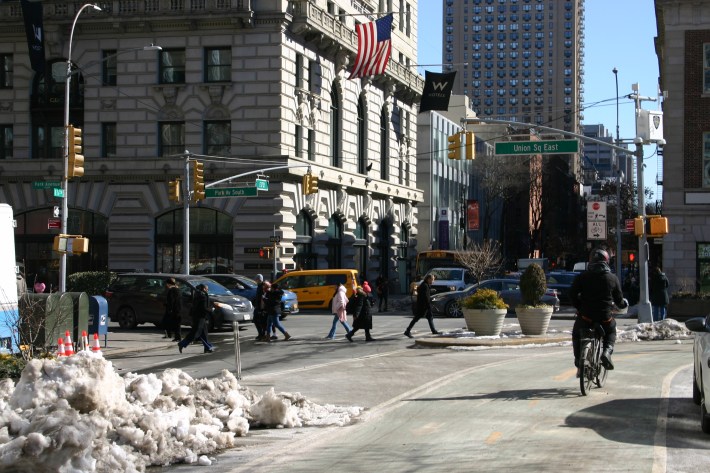
If DOT adds a protected bike lane to E. 17th Street, a one-way westbound road, it would be a welcome addition for cyclists traveling west.
The only current westbound crosstown protected bicycle lanes in the area are on 29th and 13th streets. Union Square Park has a protected bike lane on the north and east sides, but the bike lane stops abruptly at Park Avenue South. This leaves cyclists traveling west along E. 17th Street to the park to ride into a busy four-lane road, swerving through traffic or riding along the pedestrian crosswalk.
Friedman said he tries to avoid the stretch of E. 17th Street without a bike lane as he doesn’t feel safe cycling there.
“You always feel like there could be a car kind of breathing down your neck and it’s just (a) very unpleasant experience and less safe; they can get behind you, start honking and then try to push you to the side and then you’re in danger of a parked car opening a door on you,” he said. “It’s super important to us that the bike lanes be protected.”
From January 2022 until December 2025, this stretch of E 17th Street saw 76 reported crashes, injuring 40 people, including 13 cyclists, nine pedestrians and 16 motor vehicle occupants.
Protected bike lanes typically cut total injuries by 14.8 percent, and serious pedestrian injuries or deaths by 29.2 percent, according to DOT data. Unprotected bike lanes have considerably less impact, and actually led to an increase in cyclist injuries where DOT installed them from 2005 and 2018.
A DOT spokesman said the agency will review the letter, and is “happy” to see community board support for additional bike infrastructure.
Froimowitz said he felt that DOT suggested to the board that it “likely wouldn’t be able to do the protected bike lane over the summer.” This led to the board adding the caveat that it accepts the unprotected bike lane as a temporary measure if DOT hasn’t completed its study by the summer road resurfacing.
“We didn’t want to delay the installation of a traditional bike lane if that can be done sooner,” he said. “But we also, as soon as possible, wanted to see a protected bike lane.”

Read More:
Streetsblog has migrated to a new comment system. New commenters can register directly in the comments section of any article. Returning commenters: your previous comments and display name have been preserved, but you'll need to reclaim your account by clicking "Forgot your password?" on the sign-in form, entering your email, and following the verification link to set a new password — this is required because passwords could not be carried over during the migration. For questions, contact tips@streetsblog.org.