Budget Crunch: Advocates Push Mamdani For Massive Fair Fares Expansion
As free buses are being debated across the frozen tundra of Albany, transit advocates and their allies closer to home are pressing Mayor Mamdani to commit to an expansion of the Fair Fares program that would bring free bus and subway fare to over one million New Yorkers.
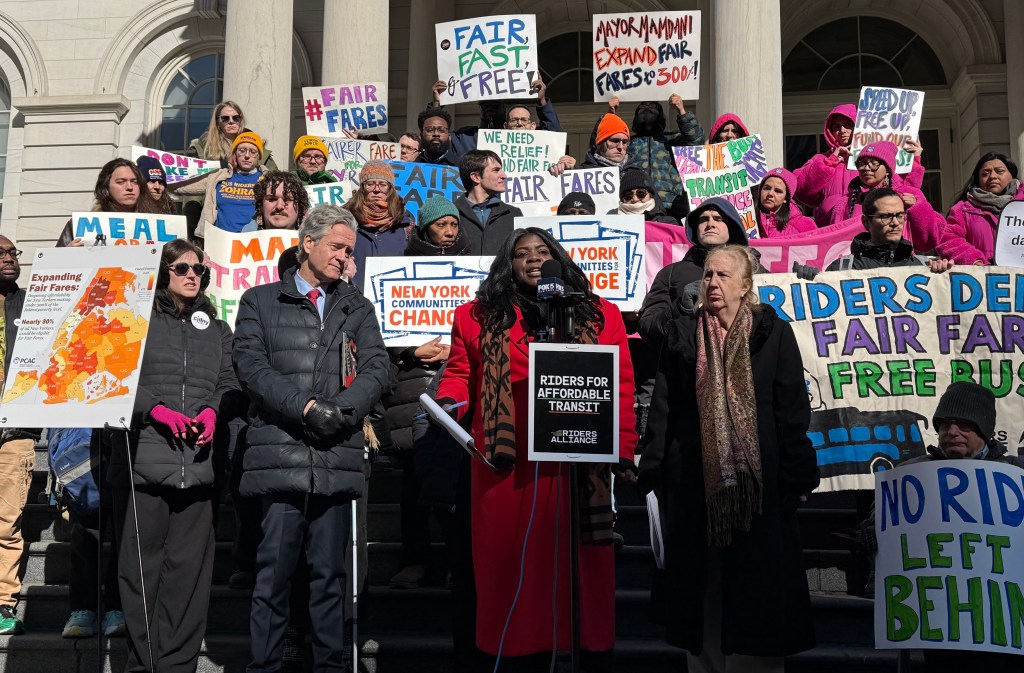
A coalition of transit and economic justice organizations rallied on Wednesday at City Hall to increase the benefit from the existing half-priced fares for individuals making $23,475 or families of four making $48,225 to providing completely free transit for people at those levels and half-priced fares to individuals and families of four making double those amounts.
And beyond the higher eligibility thresholds, the groups also want to improve usage rates for the discount fares by automatically enrolling people who are eligible for the programs.
Given that Mayor Mamdani won the election with a relentless focus on affordability and by highlighting free buses as a key component, advocates say this is as good a time as ever to seize the momentum and bring free fares to all New Yorkers whose household incomes are 150 percent of the federal poverty level ($15,650 for individuals and $32,150 for a family of four) and half-priced fares to people at 300 percent.
“We want to expand the program,” said Riders Alliance Senior Organizer Danna Dennis. “We are looking to make sure that New Yorkers who are at minimum wage, New Yorkers who have a nine-to-five, folks who are working full-time, part-time are qualified. Currently, that just isn’t the case. We’ve been on a slow track to improving the program, but we think this is our time. It needs to happen.”
Even with automatic enrollment, the Fair Fares expansion would be cheaper than free buses, which is projected to cost $1 billion. Backers of the Fair Fares expansion say it would cost about $421 million at most (program usage would be projected to be about 50 percent, even with automatic enrollment, as recipients don’t swipe in every day).
The idea was first proposed in a report from the Permanent Citizens Advisory Committee to the MTA, the Riders Alliance and the Community Service Society called Universal Affordable Transit, which pitched extending transit discounts to a new tranche of New Yorkers and give completely free transit to people currently enrolled in Fair Fares.
The higher eligibility thresholds would double the number of New Yorkers who get transit discounts, according to the report.
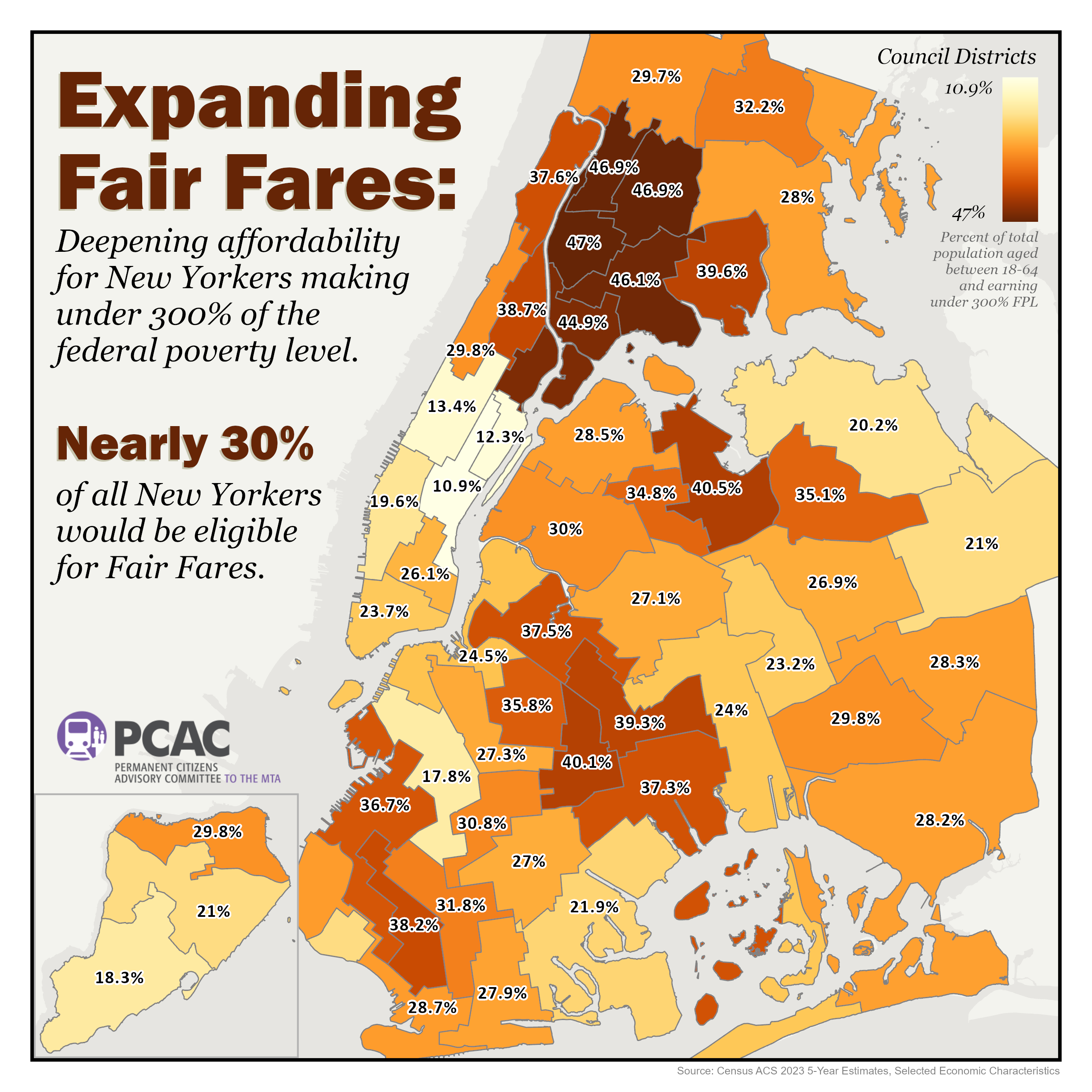
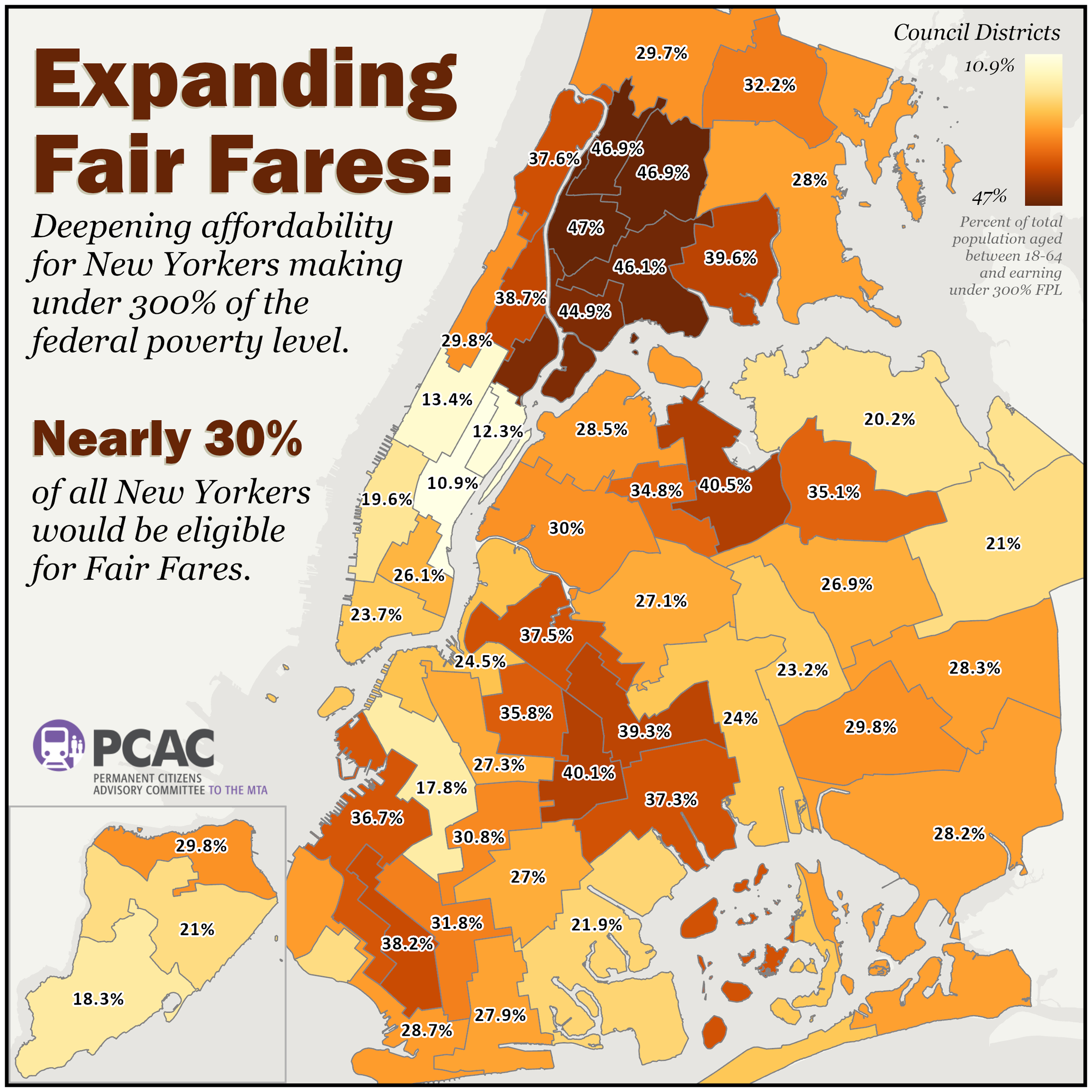
Slightly over one million New Yorkers would be eligible for the free transit version of Fair Fares, and another million would be eligible for the half-priced version. The expansion would be felt citywide, where 30 percent of individuals and families of four earn less than $46,950 and $96,450 respectively — aka 300 percent of the federal poverty level.
Automatically enrolling people in the program would also greatly reduce the barriers for people to actually use the transit discounts. Currently, only about one-third of New Yorkers who are eligible for Fair Fares actually use the program — partly because New Yorkers who are eligible for other poverty-assistance programs that use income verification still must apply separately for Fair Fares, a bureaucratic hassle.
Automatic enrollment would be especially useful then for the Fair Fares users who come in at 150 percent or less of the federal poverty level, since they are more likely to be taking advantage of an income-based assistance program. The report on the program’s expansion pointed to a similar transit discount program in Philadelphia that used automatic enrollment that resulted in a 63-percent participation rate by the second year of the program.
This kind of Fair Fares expansion would be a monumental shift in the way people pay for transit in New York City, but it still wouldn’t realize Mamdani’s vision of simply walking onto a bus regardless of income level. But backers of the Universal Affordable Transit proposal pointed out that people who use Fair Fares are much more likely to use the discount OMNY card they get to take the subway over the bus.
“People will still need to take the subway, it’s where two-thirds of Fair Fares rides are taken right now,” said PCAC Associate Director Brian Fritsch. “If you’re going to deliver affordability for the people who need it most you need to do both, to get around the city you need a more comprehensive approach.”
The biggest hurdle for an expansion is a $2-billion budget deficit this year and a yawning $10-billion gap next year. A spokesperson for Mamdani pointed to the looming budget apocalypse as a hinderance to the expansion.
“The administration is reviewing the Fair Fares proposals, as we work to close the $12-billion Adams Budget Crisis caused by years of under-budgeting essential services,” said spokesperson Sam Raskin. “The mayor shares the advocates’ goals of making public transit fast, reliable, and affordable.”
But advocates for the Fair Fares expansion say that this program is itself a kind of fiscal stimulus, with the Universal Affordable Transit report making the case that Fair Fares recipients travel from their homes to “Midtown, the Financial District, Downtown Brooklyn, Flushing, and other key business and economic hubs.”
“People with low incomes tend to spend the money that they save, and that money moves through the economy,” said Riders Alliance Director of Policy and Communications Danny Pearlstein. “More trips overall means more economic activity, because people are going out into the world, doing work, going to school, getting their health taken care of, and generally, doing things that make the city’s economy stronger. So it’s an investment in New Yorkers, and it’s investment in New York.”
The City Council is going to be a partner in budget talks, and during the Adams administration it was the Council embracing the expansion of Fair Fares that won raises in the eligibility threshold. Some Council voices are committed to going even father, and see this new expansion as something that can help people now while the mayor continues to lobby Albany for free buses.
“The mayor has talked about free buses, but it wouldn’t be this year,” said Council Member Gale Brewer (D-Upper West Side). “So this might be an interim step.”
Advocates for the expansion made a similar point, that the mayor has a proven, ready-to-go program while he pushes for his larger agenda in the state capital.
“The expansion of Fair Fares is a really smart investment. The costs are relatively modest that can be delivered right now,” said Fritsch. “To get people immediate relief from transit costs this could be a first step, so it merits some serious consideration.”

Streetsblog has migrated to a new comment system. New commenters can register directly in the comments section of any article. Returning commenters: your previous comments and display name have been preserved, but you'll need to reclaim your account by clicking "Forgot your password?" on the sign-in form, entering your email, and following the verification link to set a new password — this is required because passwords could not be carried over during the migration. For questions, contact tips@streetsblog.org.