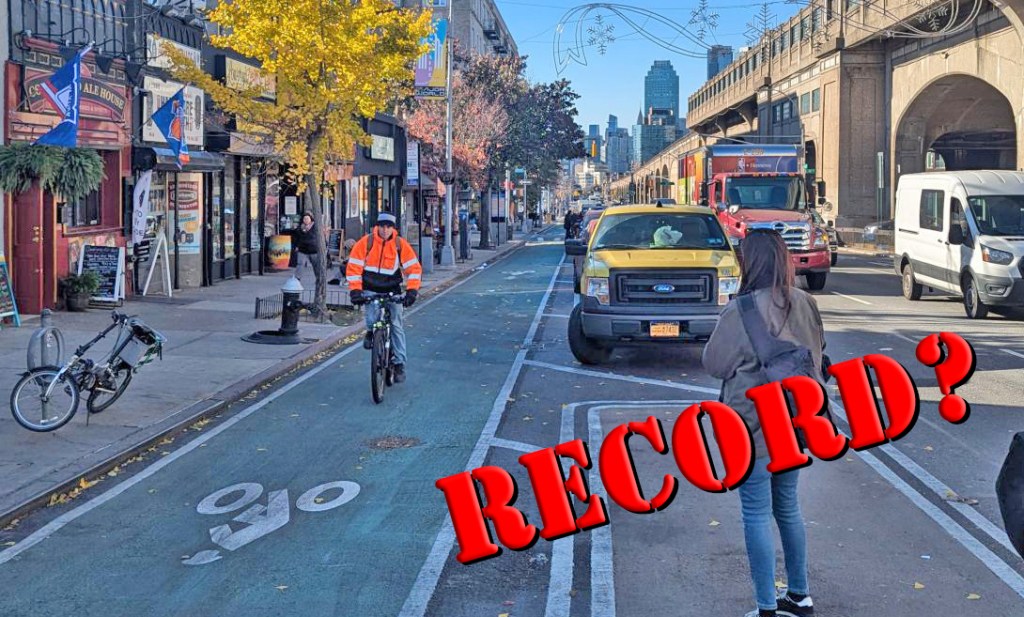
The DOT built a record number of protected bike lanes between 2022 and 2024, the agency boasted yesterday. But it pales by comparison to what the agency was legally required to build. Plus other news.
Streetsblog provides high-quality journalism and analysis for free — which is something to be celebrated in an era of paywalls. Once a year, we ask for your tax-deductible donations to support our reporters and editors as they advance the movement to end car dependency in our communities.
If you already support our work, thank you! If not, can we ask for your help?This year’s fundraiser includes a special gift for our biggest supporters. Don’t miss out.
Together, we can create a more livable, walkable, bikeable, equitable and enjoyable city for all. Happy holidays from the Streetsblog team!
Imagine that — another record!
In what has become an end-of-year tradition of the Adams administration, city agencies put out press releases simultaneously yesterday touting their “record” achievements — in building bike lanes, in spurring housing, in collecting compostables, in reducing the number of shootings, in creating jobs, etc.
Problem is, this administration doesn’t actually put these records on the record.
Case in point: The Department of Transportation’s end-of-year self-congratulatory missive yesterday said, “Over the past four years, the agency installed a record number of protected bike lanes.”
But the press release left out the basic facts: How many bike lanes? And how many miles — which is no small omission, given that the Adams administration was under a legal requirement to construct 180 miles of protected bike lanes in its four years. (Nor did the agency mention the record miles of protected bike lanes it removed, by the way, or how it allowed the Drug Enforcement Administration to steal a block of the protected bike lane on 10th Avenue for parking.)
So we spent an hour or so going back and forth with the DOT press office attempting to get the numbers that could back up the agency’s simple claim to have built a record number of protected bike lanes.
Believe us, we’d rather be riding in DOT’s protected bike lanes rather than fact-checking the agency’s claims (though with the city’s slowclearingafter the three-inch snowfall on Sunday, we couldn’t anyway). But when an agency makes a claim, it should be able to back it up.
And, eventually, it did, claiming that DOT built 26.3 miles in 2022, 31.7 miles in 2023 and 29.3 miles in 2024 — record highs for a three-year period (unless you’re using Jehiah Czebotar’s tracker, which still gives former Mayor Bill de Blasio the crown).
But let’s give Mayor Adams the record! But for the prize, he should get a lawsuit, not a gold medal, given that the numbers DOT emailed over yesterday are 42.7 miles fewer than the city was required by law to build over those three years.
And if TA’s tracker for 2025 is close to accurate (and DOT indicated it is), the Adams Administration will end up nearly 80 miles short of the legal requirement of 180 miles of protected bike lanes. Coupled with the failure to meet the requirement to build 110 miles of dedicated bus lanes (which obviously wasn’t mentioned in the DOT press release), these “record” achievements don’t fully impress.
Numbers aren’t everything, of course. But press releases needn’t be so lavish with the praise when taxpayers aren’t getting everything they paid for. (The Times also covered the mayor’s habit of exaggerating his achievements, while Hell Gate focused on some of the mayor’s odd parting shots.)
In other news:
Speaking of DOT, the agency apparently told WPIX that it would reduce the speed limit on another 250 road segments next year, but there was no public announcement.
A hit-and-run driver injured two cops in Brooklyn. (amNY, NY Post)
The Financial Times is all in on City of Yes, but our friend, architect John Massengale, raised concerned about a loss of affordable units.
Finally, there was a lot of crazy news that came out of Mayor Adams’s last press conference (before he heads off on yet another overseas trip), but not much was crazier than Deputy Mayor Randy Mastro celebrating his creation of a bike speed limit by putting a speedometer in an Adams administration time capsule — when what he really should have done was worked much harder to lower the speed limit for car drivers, who cause virtually all of the death and injuries on our roadways. (Oh, yes, did we mention: the Adams administration buried a time capsule so that its alleged achievements, though not Ingrid Lewis-Martin’s appearance on “Godfather of Harlem,” can be remembered for all posterity?)
Randy Mastro, first deputy mayor, puts a speedometer in the time capsule to celebrate the 15 mph speed limit for electric bikes. pic.twitter.com/FwAKaL4kNO
Tabloid legend Gersh Kuntzman has been with New York newspapers since 1989, including stints at the New York Daily News, the Post, the Brooklyn Paper and even a cup of coffee with the Times. He's also the writer and producer of "Murder at the Food Coop," which was a hit at the NYC Fringe Festival in 2016, and “SUV: The Musical” in 2007. He also writes the Cycle of Rage column, which is archived here.
Streetsblog has migrated to a new comment system. New commenters can register directly in the comments section of any article. Returning commenters: your previous comments and display name have been preserved, but you'll need to reclaim your account by clicking "Forgot your password?" on the sign-in form, entering your email, and following the verification link to set a new password — this is required because passwords could not be carried over during the migration. For questions, contact tips@streetsblog.org.
President Trump sort of inadvertently made an argument for banning horse carriages from Central Park on Thursday when he critiicized the City Council's 40-7-2 vote to end the Central Park horse carriage industry with an ill-conceived analogy to cars.
The city's much-anticipated program to require speed-limiting devices inside the cars of repeatedly reckless drivers will launch next year, though questions remain.