Streetsblog provides high-quality journalism and analysis for free — which is something to be celebrated in an era of paywalls. Once a year, we ask for your tax-deductible donations to support our reporters and editors as they advance the movement to end car dependency in our communities.
If you already support our work, thank you! If not, can we ask for your help?This year’s fundraiser includes a special gift for our biggest supporters. Don’t miss out.
Together, we can create a more livable, walkable, bikeable, equitable and enjoyable city for all. Happy holidays from the Streetsblog team!
Grocery delivery giant Instacart makes nearly all of its deliveries by car, court documents revealed — adding traffic, pollution and the potential for road violence to city streets.
Just one out of every 10 orders placed through Instacart are small enough to be delivered by “two-wheeled vehicles” — like an e-bike or moped — while a whopping 99 percent of “shoppers … registered on the platform [have] a full-sized motor vehicle available for shopping,” the company said in a Dec. 2 lawsuit filed against New York City in an attempt kill a new minimum pay standard for its drivers.
While the company has not disclosed how many “batches” its workers deliver in the five boroughs on a given day, month or year — or how many workers it sends out into the streets — the Department of Consumer and Worker Protection estimated that 20,000 grocery delivery workers citywide make poverty wages.
And as Instacart’s business grows, so do personal car trips.
Vehicle Miles Traveled in New York City increased 16 percent from 2005 to 2023, according to a recent report from Open Plans, which shares a parent organization with Streetsblog. Private driving, which includes Instacart delivery since workers are private contractors in their own vehicles, makes up the vast majority of VMT in New York City — 80 percent versus 10 percent for FHVs and 6 percent for freight.
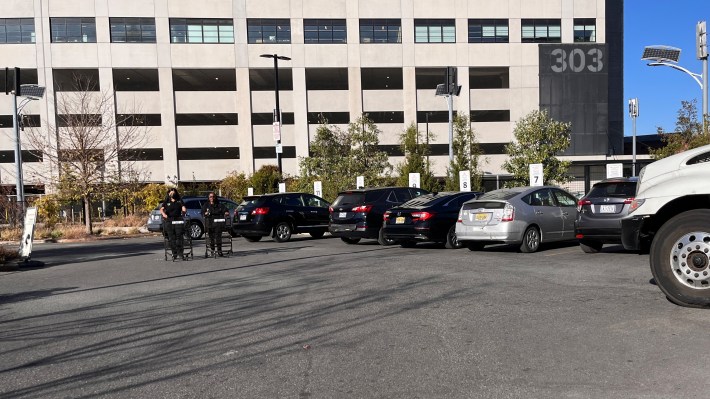
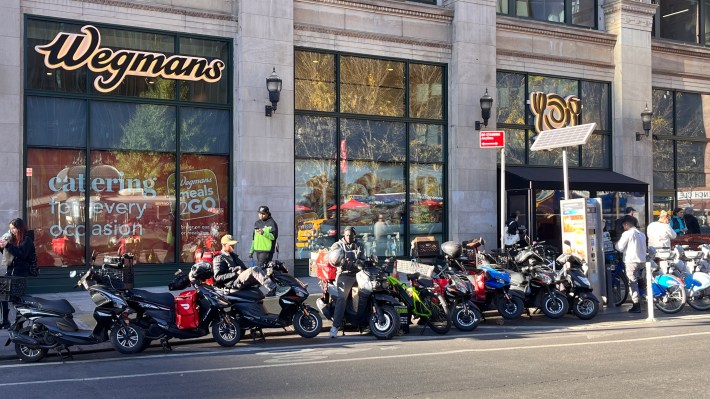
The Wegmans at Brooklyn Navy Yard has 14 spots for cars to pickup Instacart orders. Photo: Sophia Lebowitz
Instacart’s rise and its reliance on contracted workers driving private cars may explain the perplexing rise in personal car trips, at least in part.
“We know private car VMT is going up, but it’s kind of hard to explain,” said Talya Schwartz, a senior strategist at Open Plans, who worked on the report. “[Instacart] could be contributing.”
If Instacart’s business model is to blame for the rise in personal vehicle VMT in the city, no one is tracking it. That is a major problem, Schwartz said.
“Uber and Lyft are under the [Taxi and Limousine Commission] so they have to report certain data. The city is tracking their impact,” she told Streetsblog. “I don’t think we are tracking at all the impact of [grocery] delivery workers on VMT.”
Instacart has extensive data on where its drivers travel while signed onto the app, but the city doesn’t require the company to share any of that information. Advocates and the city have pushed companies to use smaller vehicles to make deliveries and some grocery companies, such as Amazon subsidiary Whole Foods, have done so in parts of Manhattan.
“As we want to transition the city’s delivery fleets to micromobility, eventually what we will need to do is tell businesses that some percent of their deliveries will have to move to sustainable modes,” Schwartz said. “If we aren’t regulating or measuring what exists now [with Instacart], how will we ask companies what their plan is? If we don’t know what the starting point is, it’s going to be very hard.”
Instacart’s inclusion in the minimum pay standard law would clarify the situation by requiring the company to submit monthly aggregate data to DCWP. The city would then know how many workers are sent out on deliveries each month, although the data does not specify what type of vehicle a worker uses.
Instacart’s big and growing business
Instacart has rapidly expanded with next to no regulation from the city — facilitating pick-up and delivery from 1,800 stores, according to the company.
The self-proclaimed “leading grocery technology company in North America” bet big on its partnership with Wegmans in 2020. When the cult-favorite grocery chain opened in the hard-to-reach Brooklyn Navy Yard, Instacart came to the rescue, expanding delivery operations into Manhattan and allowing more New Yorkers to skip their local grocer in favor of the big-box store across the river. Wegmans’ large parking lot features 14 car spots dedicated to Instacart pickup, and a warehouse-like operation where Wegmans employees pack Instacart orders and hand them off to drivers.
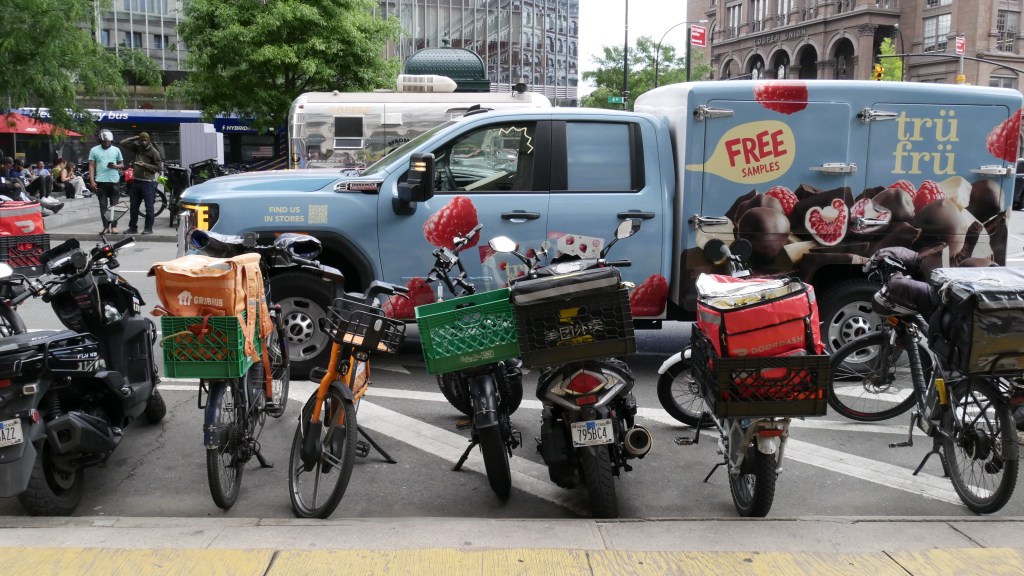
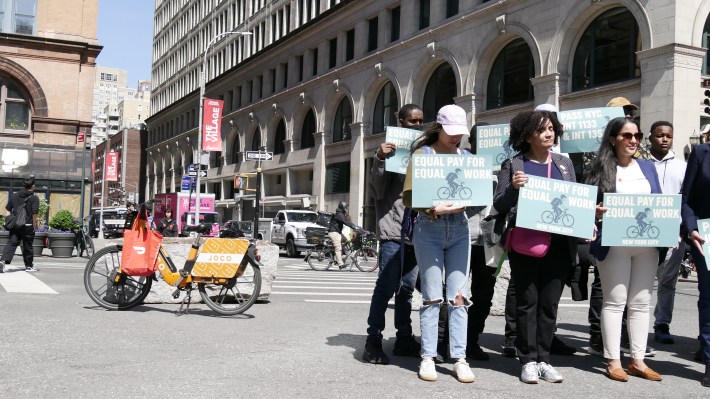
In 2022, Instacart started allowing workers to make smaller deliveries by e-bike or moped, making it a popular option for recently arrived African immigrants who were unable to get onto the restaurant apps, some of which have waitlists. Once these more visible workers started waiting outside of Wegmans and doing essentially the same job as the “deliverista,” immigrant rights groups began to advocate for their inclusion in the city’s minimum pay standard for delivery workers.
Delivery Workers ride past as advocates call on the City Council to close the “Instacart loophole.” Photo: Sophia Lebowitz
The 2021 law forced restaurant delivery apps — Uber, DoorDash, GrubHub, and Relay — to pay their workers $21.44 per active hour of labor. The law successfully raised wages and forced the companies to limit the amount of workers signed onto the app at a given time, something economists say is necessary to ensure those who are working are compensated fairly.
Instacart fought hard against having to pay a minimum wage as a bill made its way through the City Council to add its workers to the law. It paid for a lobbying campaign from Tusk Strategies, complete with an astro-turf group and multipleop-eds from Al Sharpton. The Council passed it over a veto from Mayor Adams.
Instacart continues to contest the law, however — this time in court, where it argues that having to pay its workers a standard wage would result in higher grocery prices. (Just this week, Consumer Reports revealed that Instacart uses AI-powered dynamic pricing to squeeze more out of customers wherever possible.)
Instacart’s filed its complaint last week, before DCWP’s first rule hearing this past Monday on the minimum pay expansion, which has yet to take effect. The company’s choice to sue the city before the city adopts the new rule distinguishes it from restaurant delivery apps, who sued after the city adopted the new rule.
The company’s suit aims to differentiate its business and workforce from the restaurant app delivery industry in order to make the case that Local Law 142, which would require them to comply with the minimum pay standard, is illegal on three levels.
On the federal level, Instacart argues that its workers should be considered “motor carriers” – hence the focus on car travel – and therefore the city can’t regulate the company’s prices and services. The company cites the Motor Carriers Act of 1980, which deregulated the trucking industry. The company also claims the new law would violate the dormant Commerce Clause, which is meant to stop discrimination of out of state commerce, because some workers make deliveries in more than one state in the tri-state area.
On the state level, the company argues the new law would “preempt” or conflict with state regulations, because the state already has a comprehensive framework for freelance workers.
And at the city level, the company says the new law violates the City Charter because the Department of Consumer and Worker Protection, not the City Council, will create the pay standard rule.
A Whizz e-bike among the many mopeds waiting outside of Wegmans in the East Village. Photo: Sophia Lebowitz
James Parrott, the director of economic and fiscal policies at the Center for New York City Affairs at The New School, said it doesn’t matter whether Instacart workers use cars or bikes — the city can and should regulate the industry.
“Even if the nature of the work was more distinct, the fact that [Instacart shoppers] are independent contractors managed by an app with algorithmic control over sending and accepting orders, all of that is very similar,” said Parrott, who consulted with the city on the original minimum pay law. “Even if it were some other non-food item, it would be very likely that the city could regulate the delivery.”
The city has until Dec. 26 to respond to Instacart’s complaint. People who organized to pass the original pay standard, and this recent expansion of the law, see the legal action as nothing but delaying the inevitable.
“[The lawsuit] is [Instacart’s] attempt to undermine the victory and undermine the current legislation. At the end of the day they will have to comply,” said Ligia Guallpa, the executive director of the Worker’s Justice Project. “This is just an expansion. If we have Uber, Grubhub, and DoorDash already complying, the [lawsuit] is just a plan to buy time, pretty much stealing the workers wages.”
Streetsblog has migrated to a new comment system. New commenters can register directly in the comments section of any article. Returning commenters: your previous comments and display name have been preserved, but you'll need to reclaim your account by clicking "Forgot your password?" on the sign-in form, entering your email, and following the verification link to set a new password — this is required because passwords could not be carried over during the migration. For questions, contact tips@streetsblog.org.
In their latest video, the current and former NYC public school students of the Joint Transit Association have some concerns about Mayor Mamdani's plan to rebuild the BQE.