MTA Boss Vows Congestion Pricing Will Happen
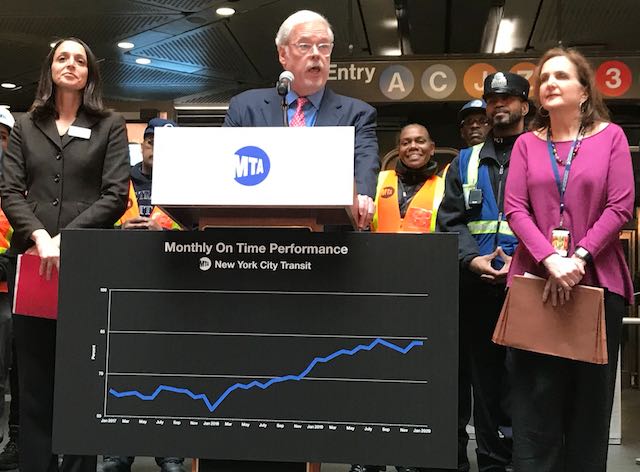
Conjuring New York Rangers legend Mark Messier, Pat Foye made a guarantee of epic proportions on Tuesday morning.
“Congestion pricing will happen,” the MTA’s head honcho told reporters when asked about the Trump administration’s Damoclean sword over the central business district tolling that was approved by state lawmakers last year.
Foye’s own Game 6 guarantee optimism comes as the federal government decides whether to delay congestion pricing a little or a lot by requiring the city and state to conduct a streamlined environmental review of the tolling plan, which could take a year, or a drawn-out environmental impact statement, which could take many years.
Congestion pricing requires federal approval because it’s illegal to put tolls on roads built with federal money — though some exceptions have been made for fees designed to reduce congestion. The federal oversight role was known months ago, but has started to raise greater fears as the clock ticks to the debut of congestion pricing, which was supposed to start in January, 2021.
As reported by Politico, Foye and DOT Commissioner Polly Trottenberg met with Transportation Secretary Elaine Chao last April to determine if New York would have to do an environmental assessment or the more-stringent environmental impact statement to appease their federal overlords. The difference in the studies is severe: according to Politico, the shortest assessment ever done by a federal agency took 637 days; the average Federal Highway Administration EIS took a whopping 2,691 days (just over seven years) — though those were mostly for road-construction projects.
Foye, however, was optimistic, telling reporters, “I don’t believe” that the Federal Highway Administration would kill the project that will fund such a huge piece of the capital plan, and that the MTA had been lobbying the feds to allow an assessment rather than a full-blown environmental impact statement.
But Foye also lamented that the environmental benefits of congestion pricing should exempt it from either an EA or EIS, given the many ways it will actually help the planet.
“In a just world, we’d get a categorical exclusion for congestion pricing because this is a huge environmental positive,” Foye said. “It’s going to fund mass transit to the tune of $15 billion. It’s going to reduce traffic and congestion, improve air quality, improve life for asthmatics, so from an environmental point of view it’s a huge positive.”
Advocates have previously suggested that the MTA and the city could help its own case by moving more quickly to appoint members to the Traffic Mobility Review Board, which could, if empaneled already, lay the groundwork for the required federal environmental review. The MTA would perhaps be able to survive a small delay to the car cordon, and thus to the money that would fund the 2020-2024 capital plan, but Rachael Fauss of Reinvent Albany previously said that any long-term delay would be disastrous.
“If $15 billion of the $51 billion in the capital plan doesn’t come in on time, all things seem to point to the MTA not being able to get all the money quickly and projects not happening, because otherwise it’d be forced to borrow and that’s not sustainable for them,” Fauss said.
As he has in the past, Foye said that the MTA Board is still considering appointees to the six-person board, but didn’t give a date for when the board would finally be appointed.
“If members of the public or journalists have suggestions we’re open to them,” Foye said.
For now, the MTA is in a holding pattern. A spokesperson for the FHA told Streetsblog that “it would be premature to speculate on when a decision on the environmental review would be issued.”
It would be particularly ironic if the federal government were to use the environmental review process to slow down New York’s major tolling project. Over the last three years, the Trump administration — and the president himself — has repeatedly decried environmental regulations for delaying what it believes are worthy construction projects. Earlier this year, the administration proposed changes to the National Environmental Policy Act — the first in more than three decades — to limit the scope of federal environmental impact review on highways, pipelines, bridges, telecommunications networks and other public infrastructure projects, a policy following through on his promise to cut regulations.
“I’ve been through it myself,” Trump told the American Farm Bureau Federation last month in Austin. “You want to build a building, and you fear it’s going to take 12 years to get permits. I say, ‘Twelve years?’ … But our proposals will limit the process to two years — and, in many cases, less than one year.”
The Trump administration’s hope of reducing environmental review is “one of its most serious attacks on environmental law yet,” the Sierra Club said.
Foye’s big guarantee in the face of the current federal purgatory left transit activists very cautiously optimistic.
“I’m glad they’re confident,” said Tri-State Transportation Campaign Executive Director Nick Sifentues. “I hope that confidence wins the day, because we’re still in a dual crisis mode: congestion and transit. But I’ll believe congestion pricing is actually happening when I pay the first toll.”

Read More:
Streetsblog has migrated to a new comment system. New commenters can register directly in the comments section of any article. Returning commenters: your previous comments and display name have been preserved, but you'll need to reclaim your account by clicking "Forgot your password?" on the sign-in form, entering your email, and following the verification link to set a new password — this is required because passwords could not be carried over during the migration. For questions, contact tips@streetsblog.org.