“Life Is Sacred” — How Bogotá Reduced Road Deaths and Homicides Together

Worldwide, about 1.25 million people lose their lives in car crashes every year. But enacting policy to reduce the bloodshed remains a difficult political challenge around the world.
Traffic safety “lacks political salience” and “is often subordinated to other priorities,” according to a recent report from the World Resources Institute [PDF]. Measures to prevent traffic deaths, the organization reports, are often seen as being in conflict with other goals, like reducing congestion.
But WRI’s review of campaigns in Nairobi, Mumbai, and Bogotá points to a way forward: Tying road safety to other issues that have broad public support.
Among these three cities, Bogotá has made the most progress. The city’s traffic fatality rate declined by roughly 50 percent between 1996 and 2006. Key to that result was an initiative to address traffic deaths and homicides in tandem. Anna Bray Sharpin at the World Resources Institute reports:
The 1990s was a turbulent decade for Colombia, with record levels of violence and homicide. Citizens demanded a government response. In Bogotá, a suite of enforcement, social marketing and education policies were enacted, under the banner “Life is Sacred.” As part of this program, the administration linked traffic deaths to wider problems of crime and murder in the city, and framed it as a part of a public health crisis.
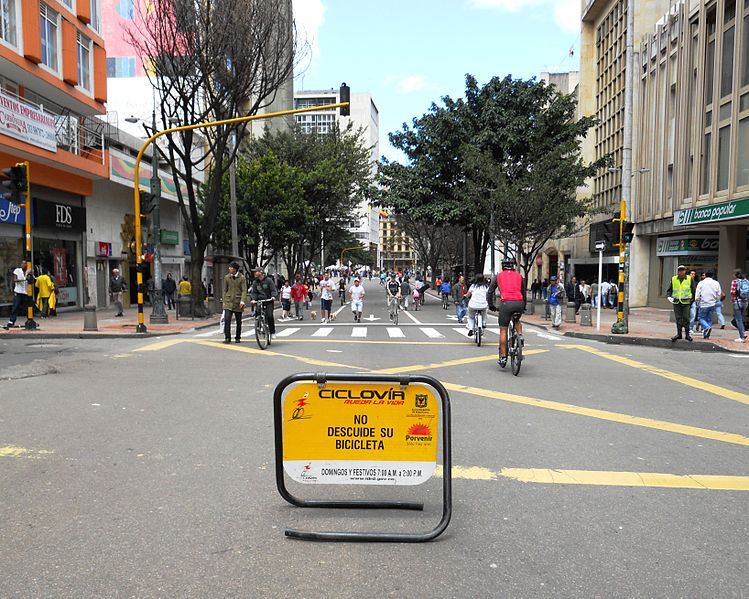
This approach galvanized public attention around “traffic violence.” Targeted social marketing and education programs encouraged people to expect safe and courteous behavior from their fellow citizens and promoted recognition of societal norms in public spaces, particularly traffic regulations. The resulting shift in perspective also generated increased support for changes to public transport and public space.
These programs had unexpected benefits for road safety. For example, one “Life is Sacred” policy set earlier closing times for night clubs to reduce alcohol-fueled violence. A welcome side effect was a reduction in drunk driving, which resulted in significant gains for road safety. It demonstrated that Bogotá’s actions to reduce violent crime could have an impact on traffic fatalities as well.
“Life is sacred.” It’s an ethic that we don’t live up to in North America either.
At Big Orange Bike, Charlotte Masemann, a professor at Carleton University in Ottawa, explains her exasperation at being treated as if she’s merely an annoying obstacle when she’s walking around her own neighborhood.
After being verbally abused by a male driver — he called her a “cunt” as she walked across a bridge — Masemann writes that car-centric streets have caused the social contract to fray:
If I can’t walk around my neighbourhood without the fear that my children or I will be abused, the state is not living up to its part of that contract. By creating a physical environment that favours the power of the person in a motorized vehicle over the person without one, the city is failing to honour the social contract. The state needs to address the implicit imbalance of power between the hegemonic car, which has the power of life and death, and the powerless pedestrian or cyclist, which does not.
Would framing traffic safety as part of a “larger socially resonant idea,” as the WRI recommends, save lives and prevent the type of harassment Masemann encountered?

Read More:
Streetsblog has migrated to a new comment system. New commenters can register directly in the comments section of any article. Returning commenters: your previous comments and display name have been preserved, but you'll need to reclaim your account by clicking "Forgot your password?" on the sign-in form, entering your email, and following the verification link to set a new password — this is required because passwords could not be carried over during the migration. For questions, contact tips@streetsblog.org.