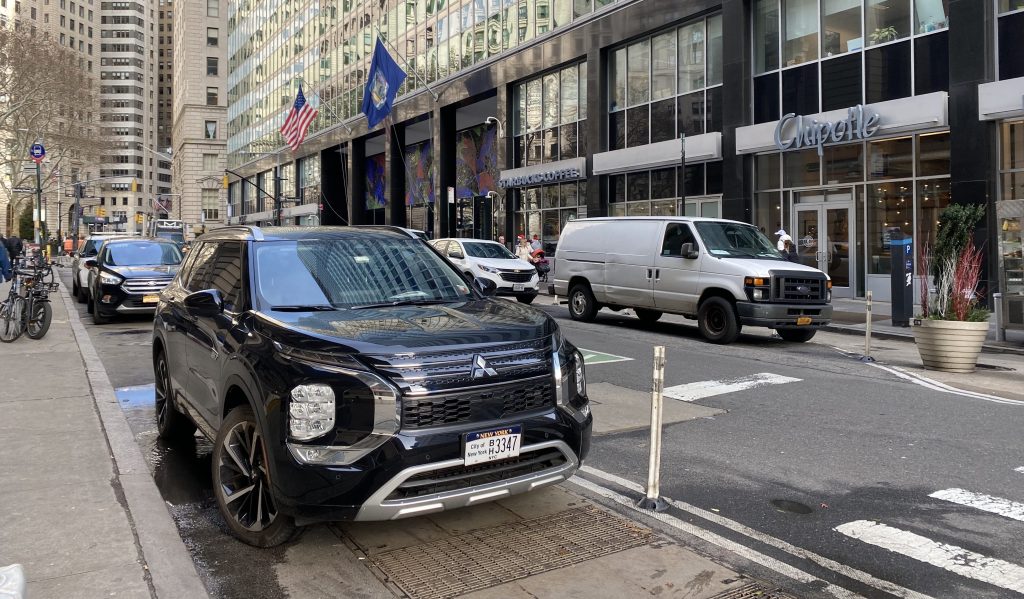
Cycle of Rage: DOT Issues Placards But Claims It Can’t Revoke Them For Reckless Driving
Pretty please, don’t drive like a sociopath.
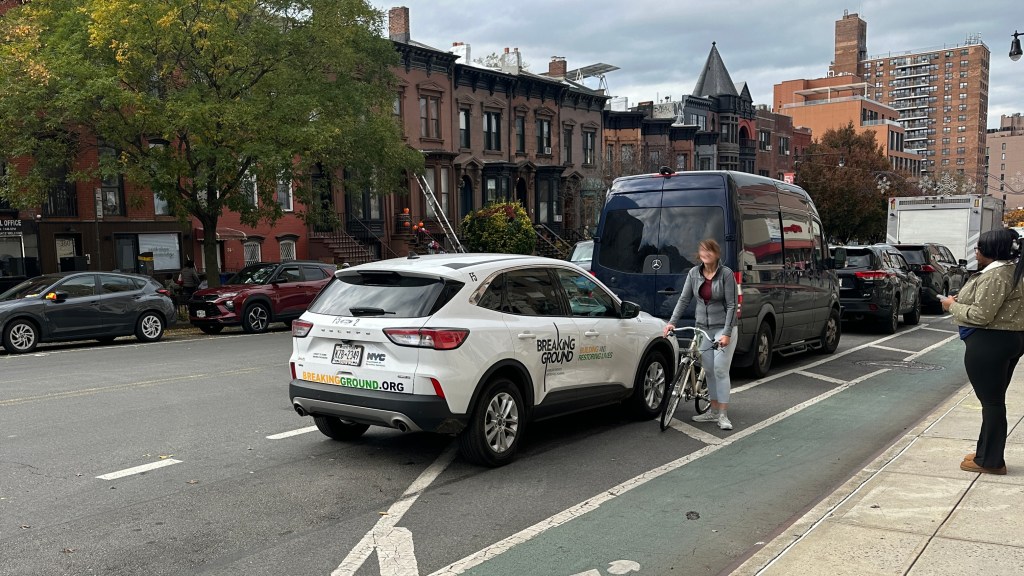
The Department of Transportation just told me that it will not revoke city-issued parking placards issued to 17 non-profit organizations whose employees who have repeatedly driven recklessly in cars bearing said placards.
In response to a bombshell report in these pages that revealed that 24 cars owned by the 17 non-profits had more than 16 speed-camera infractions in the last 12 months, DOT offered the ultimate bureaucratic shrug: There’s nothing we can do.
The same shrug applies to the hundreds if not thousands of cars with city-issued placards that are also being driven recklessly.
The agency lofted that preposterous punt on the grounds that section 19-166.1 of the New York City administrative code states that a parking placard “shall be revoked” in three situations:
- A car has three or more violations of rules regarding misusing parking placards.
- An organization violates the rule against making fake placards.
- The car has unpaid parking or traffic violations of more than $350.
I’m not a lawyer, but it’s clear the section doesn’t say that those are the only situations where a placard can be revoked. It seems plain to me — again, not a lawyer — that placards that get issued by the city can simply not be issued if the city so chooses.
I’m not the only non-lawyer who believes this. One activist who studies super speeders says the agency has broader powers to rein in the drivers that it knows are the most dangerous.
Jehiah Czebotar — again, not a lawyer — pointed out section 4-08(3)(ii) of the same code restates the three situations above, but adds a section that broadens the DOT’s power to revoke permits:
- (v) Revocation of an agency-authorized permit. The Commissioner or their designee may, at their discretion, revoke or suspend agency-authorized permits …
- (A) … where the Commissioner finds that the continued use of an agency-authorized permit is a danger to public safety.
Czebotar — have I mentioned that he’s not a lawyer — is convinced that DOT Commissioner Mike Flynn could act right now to revoke the placards of organizations whose drivers have proven reckless.
“DOT’s own data shows drivers that excessively speed and run red lights present a pronounced safety risk,” he said, citing this DOT study. “Recognizing that risk, [Flynn] must exercise his discretion and immediately revoke all agency-issued placards … ensuring that city-issued placards are not supporting dangerous behavior on our streets.”
To dot a few I’d, I called an actual lawyer, who backed up the legal reading by non-lawyer Czebotar.
“The administrative code doesn’t expressly say that those three situations are the only situations where a placard can be revoked,” said Michael Linhorst of Cornell Law School (and, full disclosure, Streetsblog’s lawyer in multiple battles with DOT and the NYPD). “DOT seems to be interpreting it as an exclusive list — that they can’t revoke for any reason other than the three in the list. … The [section section 4-08(3)(ii)] would give DOT a good argument that the three situations on the list are only examples, and that they can revoke for other reasons, too.”
Nonetheless, a DOT spokesperson said the agency would need specific authorization in the city administrative code to revoke placard privileges based on traffic violations themselves.
“Drivers who don’t follow the law, especially those that have been granted the privilege of using a parking placard, are selfishly putting the lives of New Yorkers at risk,” said Will Livingston, a DOT spokesperson. “DOT currently uses all methods within our authority to discourage placard recipients from driving dangerously and to discipline placard recipients who violate the law.”
The amount of undigested victuals stuck in my craw was so voluminous that I called another veteran lawyer, who, indeed, piled on.
“I would agree with your analysis,” said lawyer Daniel Flanzig, whose clients include injured cyclists and pedestrians. “It does look like the department has the right to revoke permits. … The three listed grounds (repeat permit misuse, fraud, more than $350 in unpaid tickets) are examples, not a complete list. The code sets a minimum, not a limit.
“The DOT has more room than its statement suggests, and if it wants to remove any doubt, it can write a dangerous-driving ground into its own rule,” Flanzig added. “Saying it needs ‘additional authorization through the city administrative code’ understates the authority it already has. I would also think that as a matter of public policy, that we would not want to reward scofflaws.”
Let’s get off the DOT’s back for a second because the larger villain here is the state legislature. As Streetsblog readers well know, the state legislature bars the Department of Motor Vehicles from adding points to the licenses of drivers who acquire camera-issued speeding and red-light tickets (even though just three of the same tickets written by cops would cause a license to be suspended). As far as the state legislature is concerned, as long as the $50 tickets are paid, they more or less disappear (though starting next year, the city can require the drivers with 16 or more speed-camera tickets in 12 months to install speed-limiting devices in their cars).
Because automated enforcement tickets don’t count on a driver’s license, drivers are able to accrue scores of them, hundreds even, like Staten Island cop James Giovansanti, without any punishment at all beyond the $50.
Richard Robbins, a street safety advocate, who wrote the non-profit investigation for Streetsblog last month, said he was disappointed that DOT is hiding behind the administrative code to “protect” reckless drivers.
“It is crazy that state law protects extreme recidivist speeders by specifically preventing speed- and red-light camera violations from being used for insurance purposes, when DOT’s great analysis finds that drivers of these vehicles are far more likely to seriously injure or kill on our streets,” Robbins said.
For now, Robbins called on the non-profit organizations to crack down on their own reckless drivers — a request that reveals yet another flaw of the city placard program: When Streetsblog asked DOT if it would address the non-profit organizations’ recklessness, the agency merely said that the organizations have a responsibility — DOT’s word — to document and discipline their drivers who commit traffic violations.
How is that documented? Is it ever documented? Has any driver for a non-profit ever been disciplined for driving recklessly with a city placard? The DOT refused to answer those questions.