Would A One-Way Conversion Fix Brooklyn’s Grand Street Or Make It Worse?
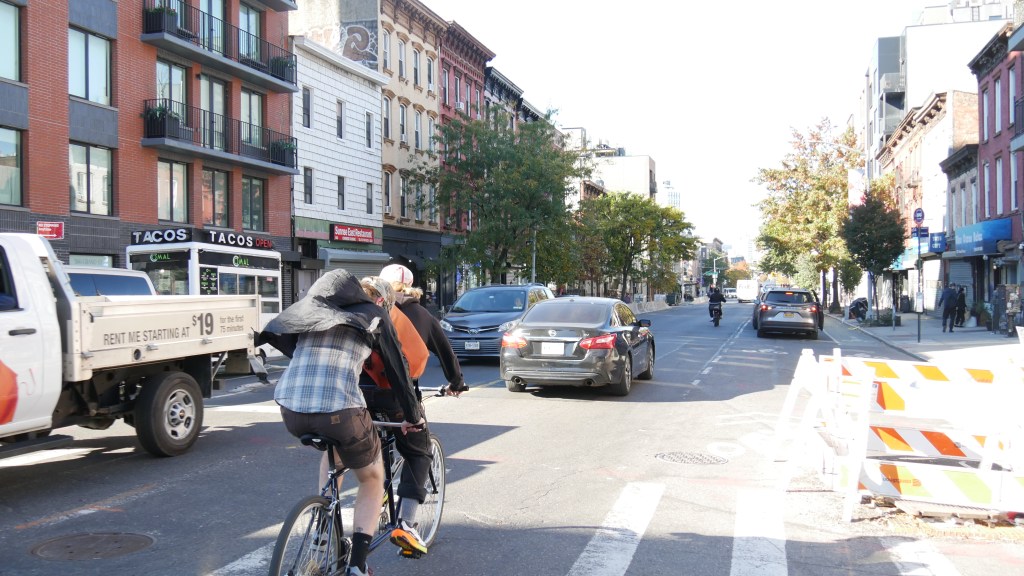
Grand in name only.
The frequently blocked Grand Street bike lane in Brooklyn is one of the worst in the city — but advocates are raising early concerns that a nascent proposal by the city could be worse than the current dysfunction.
The Department of Transportation has been soliciting feedback for a plan to convert Grand Street into a one-way eastbound street and nearby Metropolitan Avenue, also currently two-way, into one-way westbound with a new protected bike lane.
Street safety advocates in the area worry that converting the currently two-way streets to one-way will create two faster roadways, thanks to having two traffic lanes in one direction. A conversion without traffic calming on side streets, parking reform, a road diet and maintaining two-way bike infrastructure wouldn’t improve anything, one advocate said.
“I think the most likely outcome with a one-way is two travel lanes on both streets,” said Brent Bovenzi, an organizer with North Brooklyn Open Streets who lived on Grand Street for four years. “That would encourage more speeding, especially at night. And Grand Street has so many bars. I just don’t see how that’s going to make the street safer.”
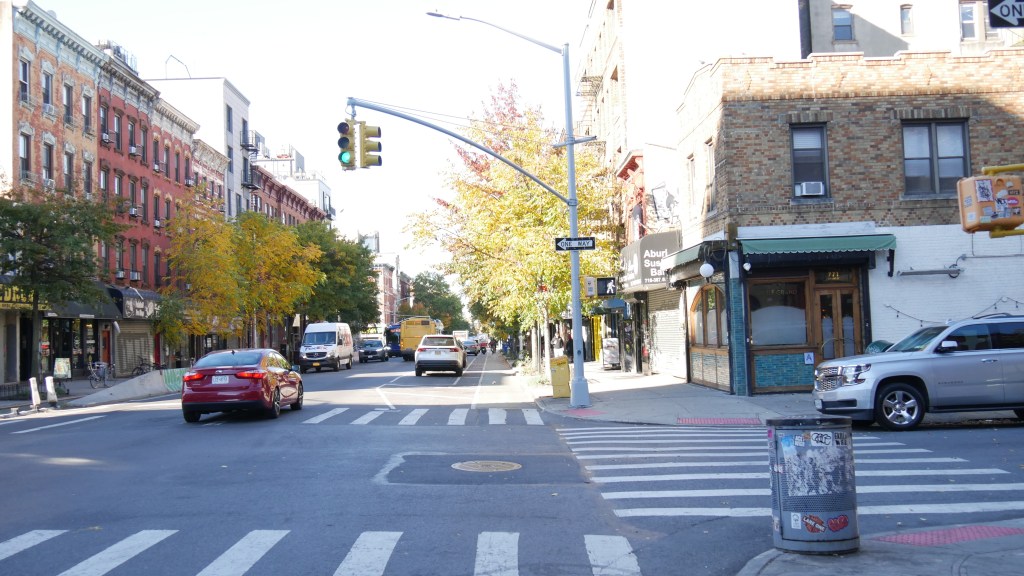
The idea of a one-way conversion of the two busy truck routes was first discussed formally at a Street Improvements Workshop in 2023. Industrial and manufacturing businesses in the area, who are represented by Evergreen Inc., want two-lane traffic on both streets, teeing up a future conflict with street safety advocates. Both streets are designated “local truck routes,” meaning trucks use them to get to inter-borough destinations.
“Both of those streets actually have manufacturers and industrial businesses directly on them. But more broadly those streets are truck routes,” said Leah Archibald, the executive director of Evergreen. “This really affects all of the businesses in the area because they do rely on trucks in and trucks out.”
Grand Street is a bustling commercial corridor. There are copious bars, coffee shops, grocery stores, clothing stores and gyms. Those who live in the area can pretty much get anything done on the street. One study suggests that two-way traffic could contribute to that vibrancy.
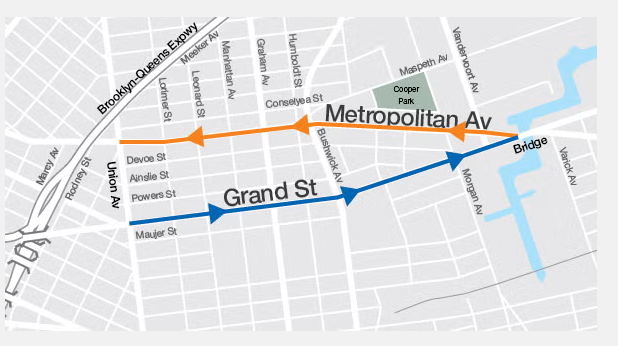
The study, conducted in 2017 by the Transportation Research Board, found that multi-lane, one-way streets have higher rates of traffic collisions and contribute to “degradation and erosion of community.”
Another 2019 study by researchers at Penn State and ETH Zurich found that two-way streets offer more redundancy to drivers which could come in handy if routes are blocked, and that two-way streets with prohibited left turns can be even more efficient. One-way networks, the study finds, are only the best option in “a few” scenarios because “they force vehicles to travel the longest distances on average.”
Grand Street’s high concentration of businesses means many will want a voice in the design process. Storefront businesses on the corridor between Union and Bushwick avenues are represented by the Grand Street BID, which is supporting a one-way conversion idea, for now.
“We’re really focused on safety and streets that work for everyone in East Williamsburg,” said Francesca Bruce, the Grand Street BID’s executive director. “I think that we are cautiously optimistic. We support [a one-way conversion] in theory because we haven’t necessarily seen a feasible alternative that accounts for all users.”
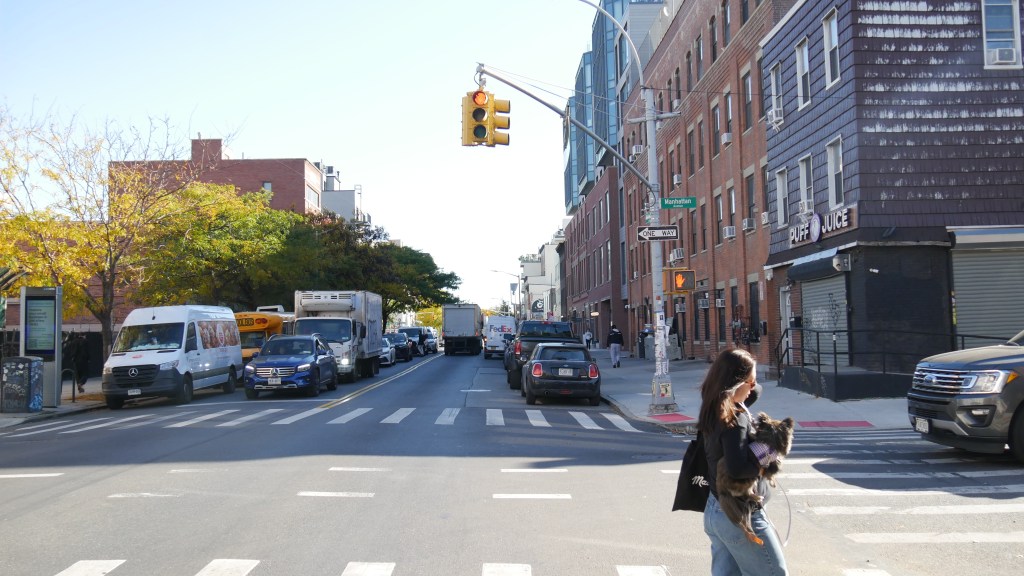
Eyes on Grand Street
All stakeholders Streetsblog spoke with said that Grand Street’s current design leaves much to be desired.
“Everyone agrees that what we have now is suboptimal,” said Archibald.
The eastbound side has concrete barriers, but breaks in the protection allow trucks and cars to double park, trapping cyclists in.
And the westbound side’s parking protected design is frequently blocked by construction and is much narrower than the new bike lanes that the DOT has been installing in Manhattan.
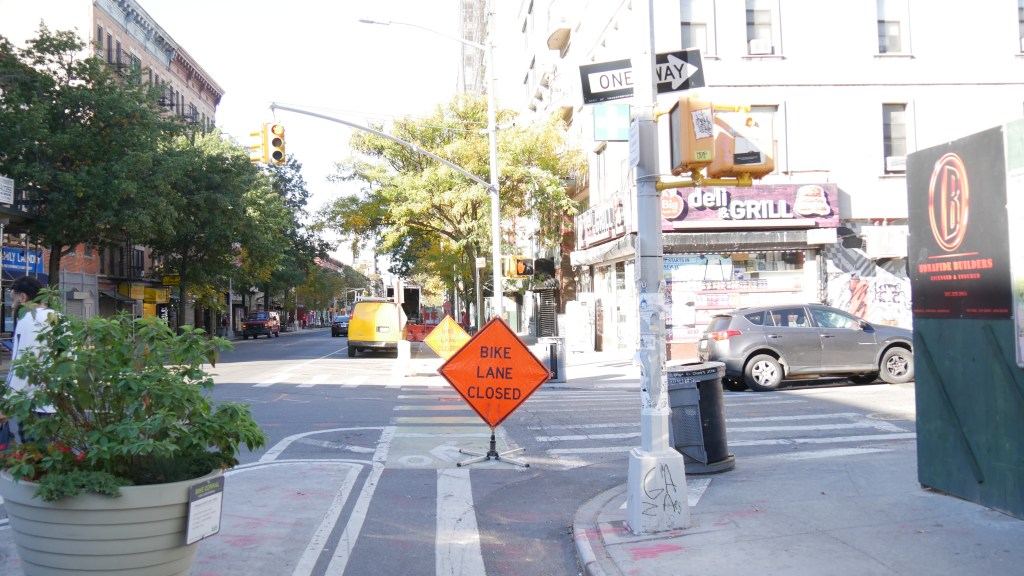
“It’s almost impossible to go from Union Avenue to Bushwick Avenue without having to leave the bike lane at some point,” said Bovenzi.
The further east, the worse it gets, with the lane essentially disappearing past Bushwick Avenue due to the industrial businesses using it as an extension of their garages.
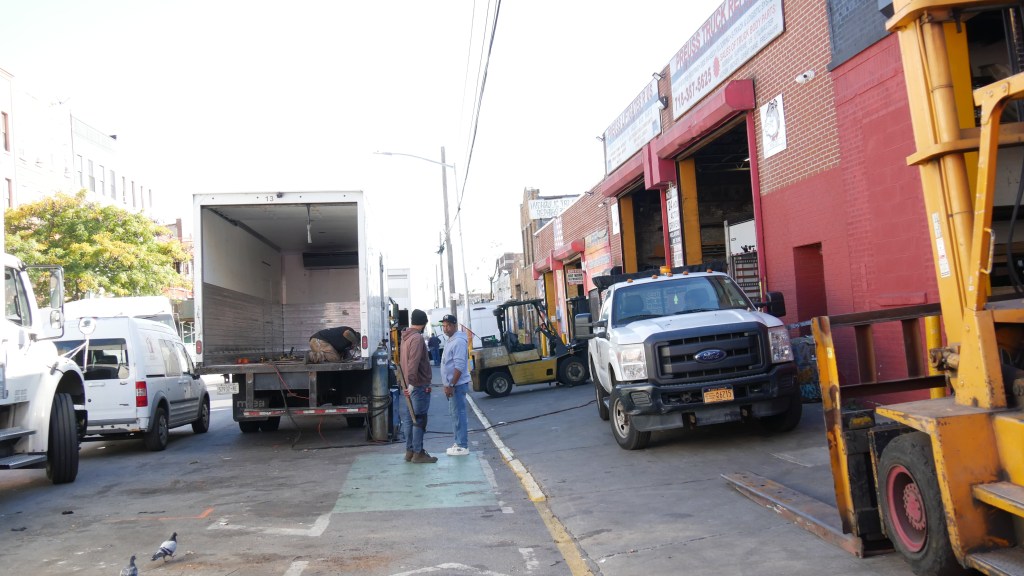
Grand Street is not only a mess for cyclists, but bus riders on the Q59 and Q54 routes are forced to crawl through traffic.
The city has classified both Grand Street and Metropolitan Avenue as “Vision Zero Priority Corridors,” which means they are especially dangerous. In 2025, there were 103 reported crashes on the Grand Street corridor DOT is studying, injuring 26 cyclists and eight pedestrians. On the corresponding stretch of Metropolitan, there were 50 reported crashes injuring two cyclists and five pedestrians.
Looking ahead
Bovenzi said that everything he has seen so far makes him worried that the DOT will still prioritize vehicle movement with its new plans. “The outreach crews, the teams from DOT that were on Grand and Metropolitan, they talked a lot more about improvements to traffic congestion than anything else,” he said.
He also noted that because of the density of restaurants on Grand, many delivery workers are riding up and down the corridor at all hours. If the bike lane was changed to one-way, it would likely encourage “salmoning,” or riding the wrong direction, from workers picking up food and those commuting from further east in Bushwick to Manhattan.
“If you move one of the bike lanes all the way to Metropolitan Avenue [four blocks away], people are not going to do that. People are going to salmon,” Bovenzi said. “You’re going to make it harder for delivery stuff. You’re going to make harder for any commuters that are beyond the L train commuting shed too, which is a whole lot of people.”
The DOT collected about 1,500 responses via a survey, which closed on Sept. 30, and got another 200 responses on a feedback map. The DOT also conducted focus groups, did on-street outreach and had feedback sessions with local stakeholders, a spokesperson told Streetsblog. The agency is now analyzing the results of the outreach and has not yet proposed any formal plan.
“DOT is working closely with the community to develop a proposed redesign of Grand Street and Metropolitan Avenue that improves safety and better protects New Yorkers on these streets, while providing more space for New Yorkers on all modes of transportation,” said spokesperson Will Livingston. “We are currently reviewing the feedback we’ve collected, and we look forward to sharing our findings in the coming months.”