Q&A: Central Park Conservancy Wants More Bike Lanes Around, Through the Park
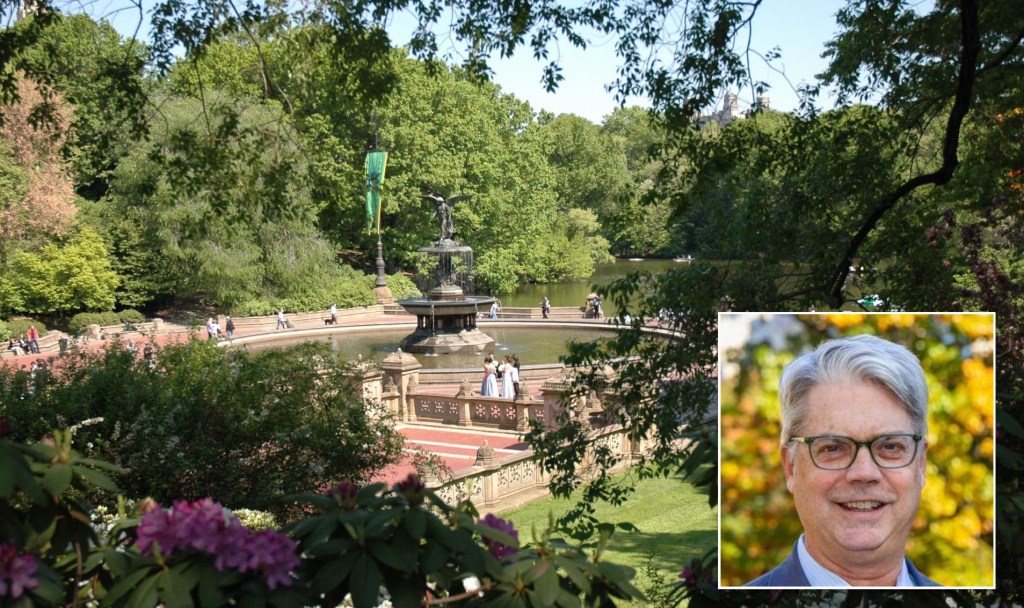
In late 1980, several philanthropists and politicians founded the Central Park Conservancy to rescue New York’s dilapidated backyard and reverse decades of the city’s neglect. Eighteen years later, the city officially delegated much of the 843-acre green space’s maintenance to the non-profit. The 400-employee organization has since acquired a central role in shaping the park — including the many roads, paths and trails that serve tens of millions of annual visitors.
In 2024, the group hired the consulting firm TYLin to find fresh ideas for improving safety in the park — a charged subject ever since former mayor Bill de Blasio banished cars from the Central Park drives in 2018. A recent pair of fatal crashes on East Drive revived scrutiny of the park’s design.
Streetsblog spoke with David Saltonstall, the conservancy’s vice president for government relations, policy and community affairs, to discuss how the park’s stewards are working to make it safer.
This interview has been edited for clarity and length.
Streetsblog: Could you explain the Conservancy’s role in managing the park, versus the city’s, and specifically its role in safety on the drive?
David Saltonstall: The Central Park Conservancy manages the park under a contract with the city. We have roughly 400 employees, 300 of them work in the park, cutting grass, raking leaves, pruning trees. So it’s a fairly robust maintenance contract, but our authority is quite limited in important ways, and certainly one of those ways is what happens on the drives and how the drives are striped and signaled — all of that is the domain of the Department of Transportation.
Three or four years ago, we began a serious conversation with DOT about redesigning the drives. Cars had gone away, what was left was a loop road that was very much laid out for cars, and not for people — whether they’re pedestrians, or bicyclists, or whatever they might be. I think everybody saw a need and an opportunity to rethink the drives in a way that was more reflective of how they are used today.
We undertook a study with TYLin as a private consultant and the Department of Transportation. We did an enormous amount of community outreach, every community board around the park, we did a survey, which I think got more than 10,000 responses, and we really tried to understand — as best we could — what was needed and what would make sense.
Then the changes started to happen. Principally, a two-year effort by DOT to repave and restripe the drives.
Streetsblog: My colleague Sophia Lebowitz wrote a story about the redesign, and she found that several recommendations were not fully implemented. How do you assess the redesign now that it’s been in place for a while, and what are the ways you can iterate on it or improve it?
Saltonstall: The recommendations in the study were always laid out as a near-term, medium-term, and long-term basis. I think we are essentially through the near-term phase, which was largely the repaving and the restriping, some work on the signals.
Now we’ve had a chance to live with the new design, see how it work, not just on paper but in real life. Our conversations with DOT are continuing and will continue. We want a park with zero collisions, obviously we are not there yet and the recent fatalities really should be a wake-up call for everybody that more work needs to be done.
Some of that is design interventions that might help to slow down some of the fastest people, because there are definitely too many people going too fast, too often, on the drives for our liking. Some of that is also public education and outreach and explaining to folks that the rules and that those rules exist for a reason.
Most of the time, those rules are rooted in safety, and trying to make sure that nobody is endangering anybody else, and that’s why we have a speed limit on the drives. That’s why there are rules about leashing your dogs when you cross the drives, and that’s why there is a rule that you’re supposed to yield to pedestrians all the time, especially in crosswalks.
We’re not there yet. As anybody who has been in the park knows, there are, frankly, too many bikers who are not respecting pedestrians in the crosswalk, and we really hope to to change that going forward.
Streetsblog: What was the Conservancy’s reaction to the recent fatalities? And, in light of them, has the redesign failed in some ways? Design is a major part of how people act in crowded spaces.
Saltonstall: First and foremost, I think we have a very human response when these things happen. I mean, it’s crushing to our staff. When these things happen, it makes us very upset. We care about the park a lot, and I think anybody who’s in the park can see that, and we have an enormous amount of dedication to maintaining the space.
It’s hard to say clearly that the design was the problem in either one of those [crashes] — and I’m not negating the fact that there are people [who] do go too fast too often. In one case there was a dog off-leash in a time and a place that that wasn’t supposed to be happening, and I don’t know how you solve for that from a design perspective.
Likewise, there was the other situation involving Richard O’Brien. It was very hard to know exactly what happened there. It happened in a place that was not a known hot spot, and wasn’t on a downhill. It wasn’t at a corner. It wasn’t at a place where those kinds of incidents sometimes happen.
We always look for lessons, every time there’s a collision, whether it’s a fatal collision or not a fatal collision. There is a constant conversation with DOT, right down to the intersection level as to things that could be done to make things better. We are by no means done with trying to improve the drives, but you know at the end of the day, our voice is one of advocacy, and it’s up to the DOT to actually execute on any changes.
Streetsblog: There’s an ongoing lawsuit about the speed limit. Do you think lap cycling, practicing for races, has a place in the park? Some advocates have called for dedicated times, such as early mornings.
Saltonstall: It’s a conversation that needs to be had, and I’m not sure what the answer to that is. There are permitted racing events in the park on weekends that look very different.
There are race monitors out there. There are separations created to make sure the bikers stay within a certain zone. And that’s different than what happens on a more casual basis too often in the park, which is large groups of riders going as fast as they can at a time of day that is not appropriate.
It might be that we really need to separate out the more formal permitted situations, versus really trying to find a way to crack down on the lap racing that too often endangers other people.
Streetsblog: Some of the medium- or long-term recommendations included bike lanes on the transverses. Streetsblog has written about putting protected bike lanes around the perimeter like those around Prospect Park. Where are these discussions at the conservancy? Do you support both of these ideas?
Saltonstall: We strongly in support of all of that. We would love to see bike lanes on the transverses starting at 86th Street.
We would love to see the entire park looped by bike lanes. We think that’s appropriate, and I think it would take a lot of pressure off the park because so many people use it just to get from one place to another safely, because it’s their best option.
Streetsblog: Your 2024 study’s renderings for the drive redesign showed much bolder markings than what ended up happening. Was there any discussion around that? Was there resistance against putting more green paint or continuous pedestrian markings on the drive?
Saltonstall: Some of that came down to just basic maintenance. That paint goes away pretty quickly. [We found] if you just created strong pedestrian islands at the crosswalks that were painted different colors, that would accomplish the same thing.
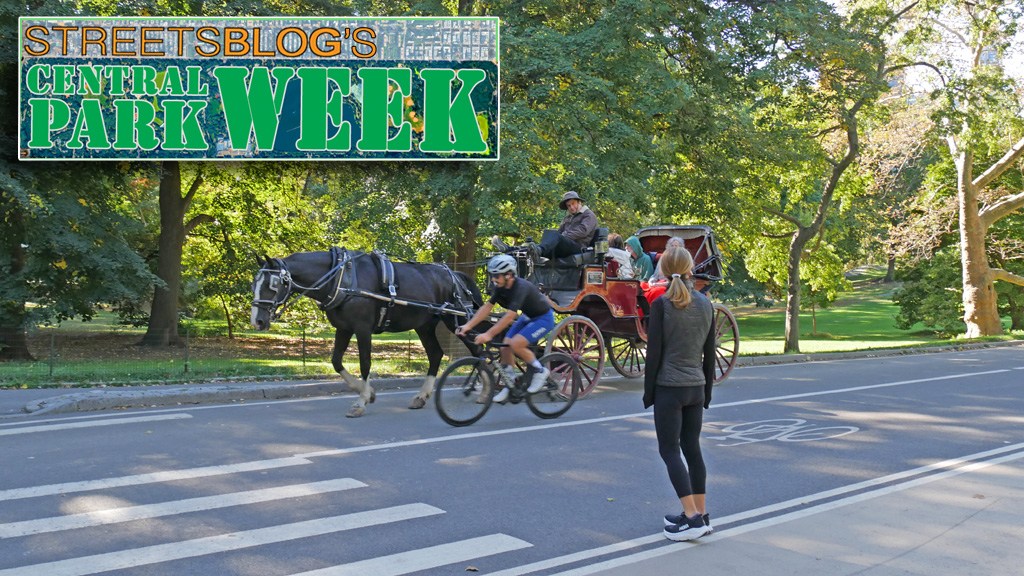
In terms of the green, I think they’ve tried to reserve it for some of the really trickier crossings. Unfortunately, a lot of it has been worn away by the horse carriages, which is a thing, but which will hopefully be mitigated going forward.
So I don’t think anybody was necessarily backing away from a commitment. Once you get to the place where you’re actually executing these things and thinking more about maintenance, some of it was deemed not totally necessary from a safety point of view or from an aesthetic point of view.
Streetsblog: More broadly, what are some of the design changes the Conservancy hopes DOT will tackle next, now that the near-term work is done?
Saltonstall: Certainly, the transverse roads would be great, and we continue to talk about that with them. I think the additional bike infrastructure around the park would really be great.
I know they are in the process of putting bike lenses in all of the overhead [traffic] signals. Bikers feel like: those are for the cars, they’re not talking to me. So putting a bike lens in all the signals is an ongoing process that DOT has committed to try and get done by, I think, the end of this year, early next year.
There are other things we continue to talk to them about, which are not quite ready for public consumption.
Streetsblog: On a personal level, what’s your relationship with the park? How often do you use it, and what parts do you enjoy most?
Saltonstall: I live uptown, I work at the Conservancy office on 56th Street. I bike most days to get to my job, and it’s absolutely the best part of my day every time.
I’m very familiar with how people use the drives, both as a pedestrian and jogger, and a biker. It’s a tricky ecosystem. Anybody who thinks they have all the answers, come talk to me: I can promise you that just about every possible solution has been thought through, and we’ve ended up where we are. That doesn’t mean things can’t always be better, that is a conversation is ongoing. At the end of the day, the park sees 42 million visitors a year.
People forget that e-bikes, especially, basically didn’t exist until five or six years ago and they’re growing exponentially. Sometimes it takes a minute for the infrastructure to catch up with how people are using city streets, and that’s where we are. But we would really like to make Central Park a model for how streets can be organized and how people can be taught to respect other folks.
Streetsblog: Is there anything about the recent discussion of the park that you think gets missed, or anything else you’d like to add?
Saltonstall: The park has been here for 150 years and it has evolved before. The drives weren’t paved until 1913. It was horses and buggies, and then it was cars, lots of cars for like over 100 years, and they finally went away, and now we are at a new place, and we are at the beginning of that stage.
The entire city needs to grapple with how folks get around in 2026, and it’s increasingly on bikes, or e-mobility devices, or on foot. This is not a Central Park challenge. It’s a challenge for everybody, and we want to play our role.
We think the park does offer an interesting laboratory to test things, but at the end of the day, I think this is about New York trying to tackle the latest transportation challenge in our midst, and we’ll get there, just like we’ve always gotten there before.

Read More:
Streetsblog has migrated to a new comment system. New commenters can register directly in the comments section of any article. Returning commenters: your previous comments and display name have been preserved, but you'll need to reclaim your account by clicking "Forgot your password?" on the sign-in form, entering your email, and following the verification link to set a new password — this is required because passwords could not be carried over during the migration. For questions, contact tips@streetsblog.org.