UPDATE: Mayor Mamdani Offers Bold ‘Vision Zero Reimagined’ But Details Are Few (And NYPD Reveals Its Priority: Bikes)
Could we finally be getting the steroids?
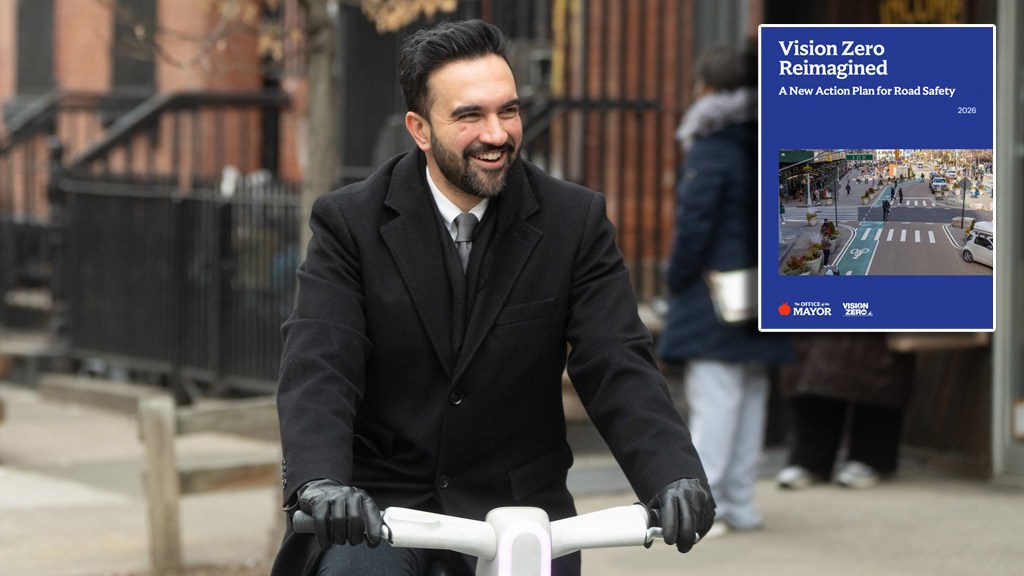
The Mamdani administration is “doubling down” on former Mayor Bill de Blasio’s signature issue, Vision Zero, with “ambitious new models of street safety” — including “establishing pedestrian-only and pedestrian-priority districts” — with a 104-page policy guideline that nonetheless offers few clear details implied by the policy’s sharp-eyed name.
And as with any action report in city government, Mayor Mamdani’s new “Vision Zero Reimagined: A New Action Plan for Road Safety” [PDF] to be released on Tuesday features some leftovers from prior action reports and press releases, but also some shiny new baubles long sought by advocates and provide a rejoinder to opponents of the mayor who once derided him as “de Blasio on steroids.”
“This plan marks a new era for Vision Zero in New York City,” Annie Levers, the director of the Mayor’s Office of Operations, told reporters in a pre-announcement briefing on Monday with the Department of Transportation. “This plan is proactive, not reactive. We’re making a full commitment to using every tool available to the city, while building the capacity to adapt as our streets evolve. … This plan also doesn’t exist in isolation, so it will complement and reinforce the city’s broader transportation agenda, including the Streets Plan and the Bus Action Plan [in] one connected effort [with] more than 100 commitments.”
Highlights of the document include promises to:
- Create “pedestrian-only” zones, a pledge that harkens back to one of then-candidate Zohran Mamdani’s boldest promises from before he was mayor.
- “Explore strategies to expand towing capacity” to get the cars of reckless drivers off the streets.
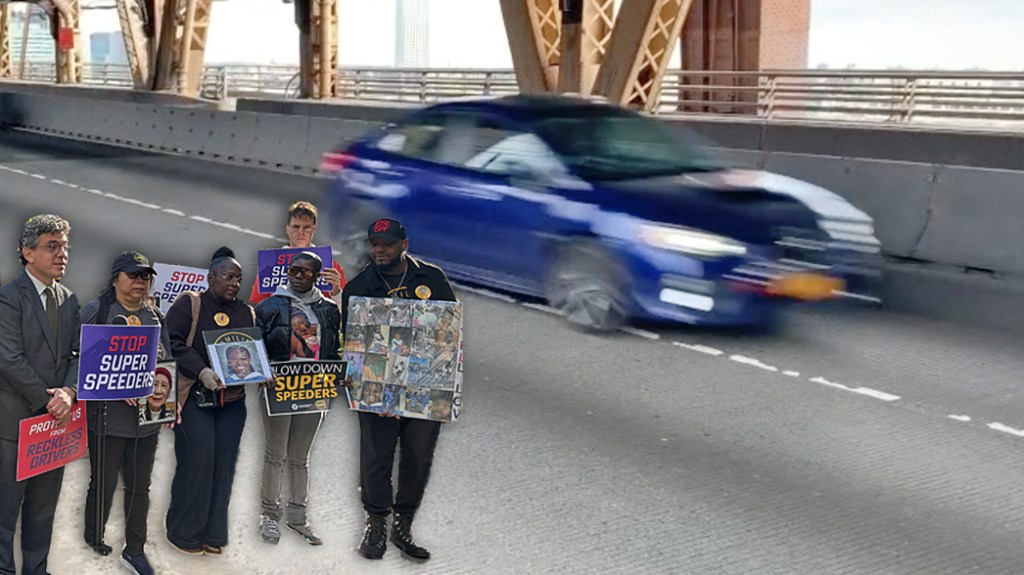
- Implement the state’s Stop Super Speeders legislation, which granted the city power to order the installation of speed governors inside the cars of the worst speeders.
- Complete safety redesigns on any untreated Vision Zero Priority Corridors over the next three years. There are nearly 200 citywide.
- Install hardened daylighting or better at a minimum of 1,000 intersections each year (a restatement of an existing promise).
- Expand implementation of 20-mile-per-hour speed limits (a restatement of an existing promise).
- Be more scientific about Vision Zero by “integrating health and crash data, … piloting advanced bus safety technologies, improving lighting and wayfinding, and making safety data more accessible.”
- “Create a citywide Vision Zero education strategy that embeds traffic safety into everyday learning [in the] public schools curriculum.”
- “Evaluate the benefits of imposing higher tolls for larger passenger vehicles” (a version of which already exists in Paris).
- Study creating a “mobility wallet” to subsidize transportation options such as subway, bus, Citi Bike, e-scooter share, and NYC Ferry for low-income New Yorkers.”
But specifics? That’ll have to wait. For instance, the officials were asked about pedestrian-only zones:
“We recognize that there are parts of the city that are dense and transit-friendly and very pedestrian-oriented, and there’s a lot of potential to rebalance the street space and to really give pedestrians more formal priority in those neighborhoods,” said one city official, speaking on background, at the briefing. “I don’t, unfortunately, have a lot of details that I can share quite yet.”
On super speeders, the city official said only that its implementation was delayed. “If I had to estimate, I would say that we’re probably over a year away from the program getting launched,” the official said.
And when they were asked about mobility wallets, officials offered more vague talk.
“Motor vehicles are still by far the most dangerous way to get around …. so anything we can do to give more New Yorkers more safe, affordable, convenient transportation options [such as] walking, transit, biking are safer, more efficient, space efficient, more environmentally friendly, that’s going to also help with safety,” the same city official said. “So the idea of the mobility wallet [is to see] how can we connect more lower-income New Yorkers with more of these options. … We’re committing to explore this idea.”
And on the idea of charging owners of large cars more to drive or park, this was the answer:
“There’s so much data that shows that those larger vehicles are more dangerous … so therefore, we would like to explore different ways we can kind of incentivize safer vehicles and disincentivize less-safe vehicles, which generally are larger,” said one city official. “Tolls are one way to do that. Maybe there’s other kinds of fees or fines that already exist where we can start to look at those kinds of incentives, because we know that those larger vehicles are significantly less safe when when they’re involved in a crash.”
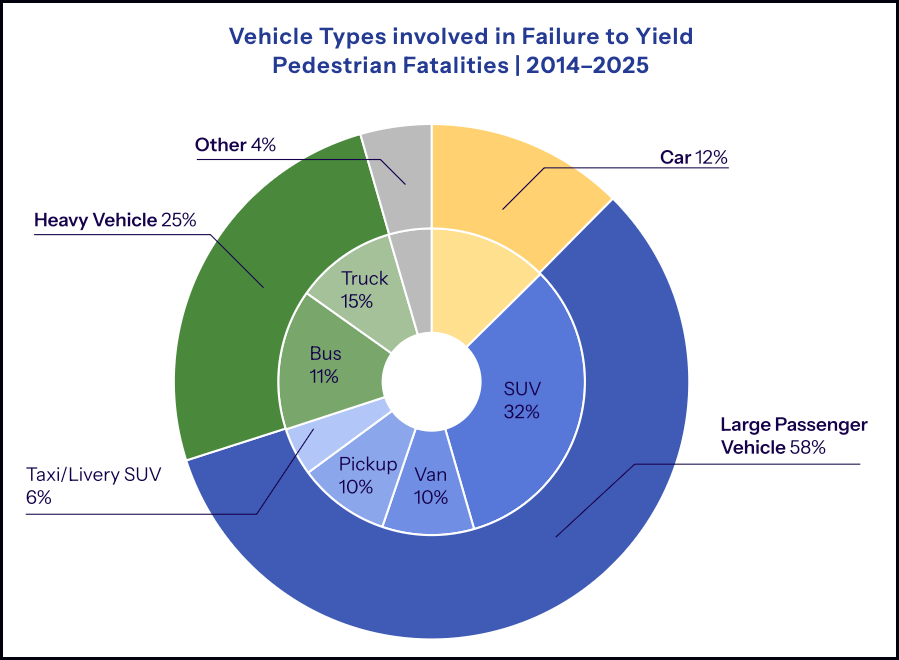
The city’s Vision Zero initiative, started by de Blasio in 2014, includes involvement of almost two-dozen city agencies, though DOT and the NYPD are the most-prominent. It has been a proven success, reducing annual road fatalities from 299 people, including 184 pedestrians, in 2013 to 210 (including 112 pedestrians) in 2025.
The main pillars of Vision Zero are the so-called “three E’s”: engineering (such as road redesigns), education and enforcement, involving, mostly the NYPD.
That last “E” could also stand for “evaporation.” Since the pandemic, NYPD response to reckless driving has been dramatically reduced. In 2019, the last full year before the pandemic, NYPD cops wrote 642,000 moving violations in seven Vision Zero categories. By 2025, summonses had dropped to 379,000 or a reduction of 41 percent.
And in 2019, cops wrote 81,612 tickets to drivers who failed to yield. In 2025, they wrote just 42,000 or roughly half as many.
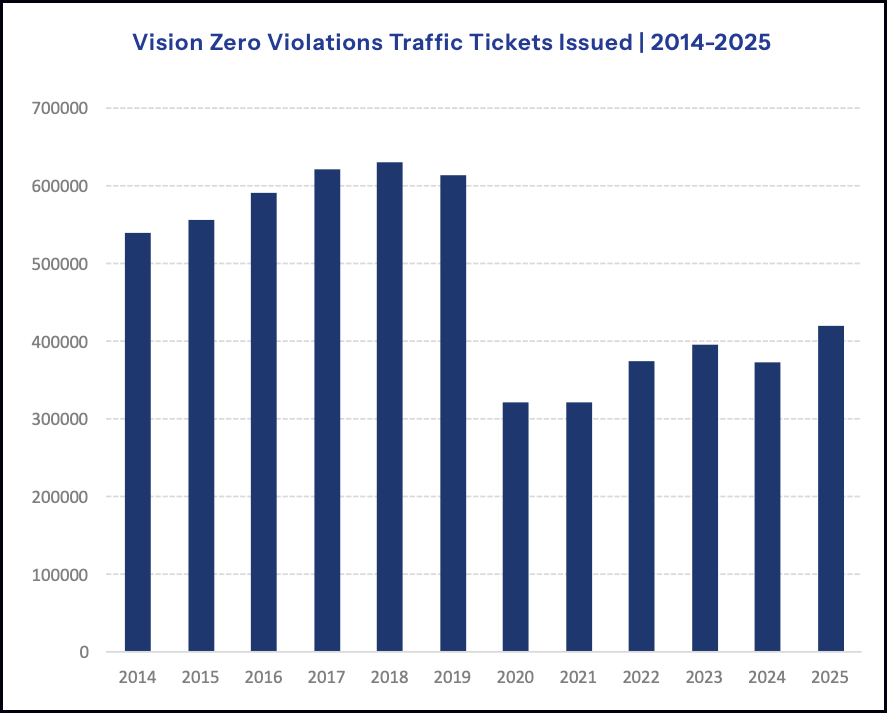
At Monday’s briefing, no member of the NYPD spoke to reporters, and a city official declined to answer Streetsblog’s question about how the Mamdani administration could possibly consider the NYPD a “Vision Zero partner” given the massive decline in police enforcement. (A city official said the NYPD would get back to us, but did after initial publication of this story — see details below.)
The latest Vision Zero report is the first one since 2021.
At the end of Monday’s briefing, one city official was asked to explain how 104 pages of ambitious but unspecified promises (and pictures) could possibly comprise “a new era for Vision Zero.” The official didn’t specify how, but vowed that streets would not only get safer but also, simply, better.
“When Vision Zero initially launched, we were reacting to a public health crisis [of 300 to 400 road fatalities per year],” the official said. “But we have learned a lot, and … this plan broadly reflects the mayor’s commitment to just make it easier for New Yorkers to get from point A to point B, … but also the commitment to sync this with the broader initiatives in the Streets Plan to make streets a nice place to walk around and to make everyone feel safe, and that includes the pedestrian-only districts, it includes school streets, it includes new toolkits to help the city engage more deeply with external advocates and in their community-engagement style. There’s a lot in here, and I think each recommendation reflects an updated commitment in a nuanced way.”
After initial publication of this story — and after an exchange of emails with City Hall, which pushed back on our initial characterization of the NYPD’s Vision Zero effort — the NYPD responded that it is taking Vision Zero seriously, citing the drop in fatalities since 2013.
On the agency’s specific enforcement effort, the statement revealed that the NYPD is prioritizing micro mobility, whose riders are responsible for a tiny fraction of crashes and an even smaller percentage of injuries to pedestrians.
“The Department’s enforcement strategy adapted to address the lethal challenge of new e-mobility devices,” wrote an agency spokesperson who did not provide a name. “In 2019, e-bikes, e-scooters, and mopeds were a relatively limited component of the city’s traffic-safety problem, accounting for seven fatalities [fact check: the victims were the cyclists]. Following the pandemic — and changes in law, policy and transportation patterns — the city experienced a significant increase in motorized two-wheeled devices. Since then, we have seen a rise in e-scooter, and e-bikes conditions with triple-digit-percent increases, so enforcement has shifted to address those issues. That growth was accompanied by major increases in injuries, fatalities, illegal operation and the use of unregistered vehicles. The below figures show that enforcement did not simply decline — it shifted toward risks that were not present at the same scale in 2019.”
The “figures” to which the NYPD spokesperson referred showed a rise in fatalities of e-bike and e-scooter users. It did not show “major increases in injuries [and] fatalities” to other road users. The statement continued:
“The Department is driving up summonses for dangerous e-mobility devices. New York City’s streets in 2025 were not the same as they were in 2019. The Department responded by progressively increasing device seizures, moving violations, point-of-sale enforcement and ghost-plate operations. Compared to 2019, there has been a 228-percent increase of moped, motorcycle, and e-bike moving violations and a 454-percent increase of seizures for moped, motorcycle, and e-bikes.”
The statement offered data to show NYPD has increased “moped, motorcycle, e-bike seizures” by 454 percent since 2019, and “moped, motorcycle, e-bike moving violations” by 228 percent over the same period, writing close to 94,000 moving violations to those users in 2025 — a figure that would represent roughly 23 percent of all NYPD moving violation tickets.
Mayor Mamdani will take questions on the report at 2 p.m. on Tuesday. We will have further coverage.

Read More:
Streetsblog has migrated to a new comment system. New commenters can register directly in the comments section of any article. Returning commenters: your previous comments and display name have been preserved, but you'll need to reclaim your account by clicking "Forgot your password?" on the sign-in form, entering your email, and following the verification link to set a new password — this is required because passwords could not be carried over during the migration. For questions, contact tips@streetsblog.org.