Analysis: Through-Running Tease Is The Latest Gloss On Trump’s Penn Station Shell Game
It’s a ruse-ruse situation.
Amtrak’s Penn Station renovation salesman Andrew Byford keeps finding new ways to pull the wool over New Yorkers’ eyes as he works to push through the Trump administration’s plans to remodel the transit hub and find some taxpayers and/or commuters to pick up the tab.
Byford’s latest ruse: A new study from the Federal Railroad Administration that argues that the renovation will create more capacity — and through-running between New Jersey and Long Island — out of the station.
The report buoys Byford’s argument that President Trump’s Penn Station facelift will yield service benefits for riders, but it punts on the crucial matter in one crucial way: the discussion of how to implement that enhanced service won’t take place until after the station construction begins.
Through-running or run-through?
Byford has recently argued that the Penn renovation is not just a facelift, but an opportunity to reorganize railroad operations and train flows to take advantage of the Gateway Tunnel, which will double cross-Hudson capacity from 24 trains per hour to 48 trains per hour.
“Those people who write this off as some sort of cosmetic tart-up are wrong and ignorant and ill-informed,” Byford said of his unnamed haters during the Citizens Budget Commission podcast earlier in July.
Part of that supposed non-cosmetic rebuild is a new way of looking at train operations in the station to allow for trains to get in and out of Penn more efficiently. The FRA report suggested two main changes will accomplish that: separating train operations to specific platforms and tracks, with through-running service using the middle of the station, in order to reduce conflicts and increasing the number of access points from the tracks to the concourse.
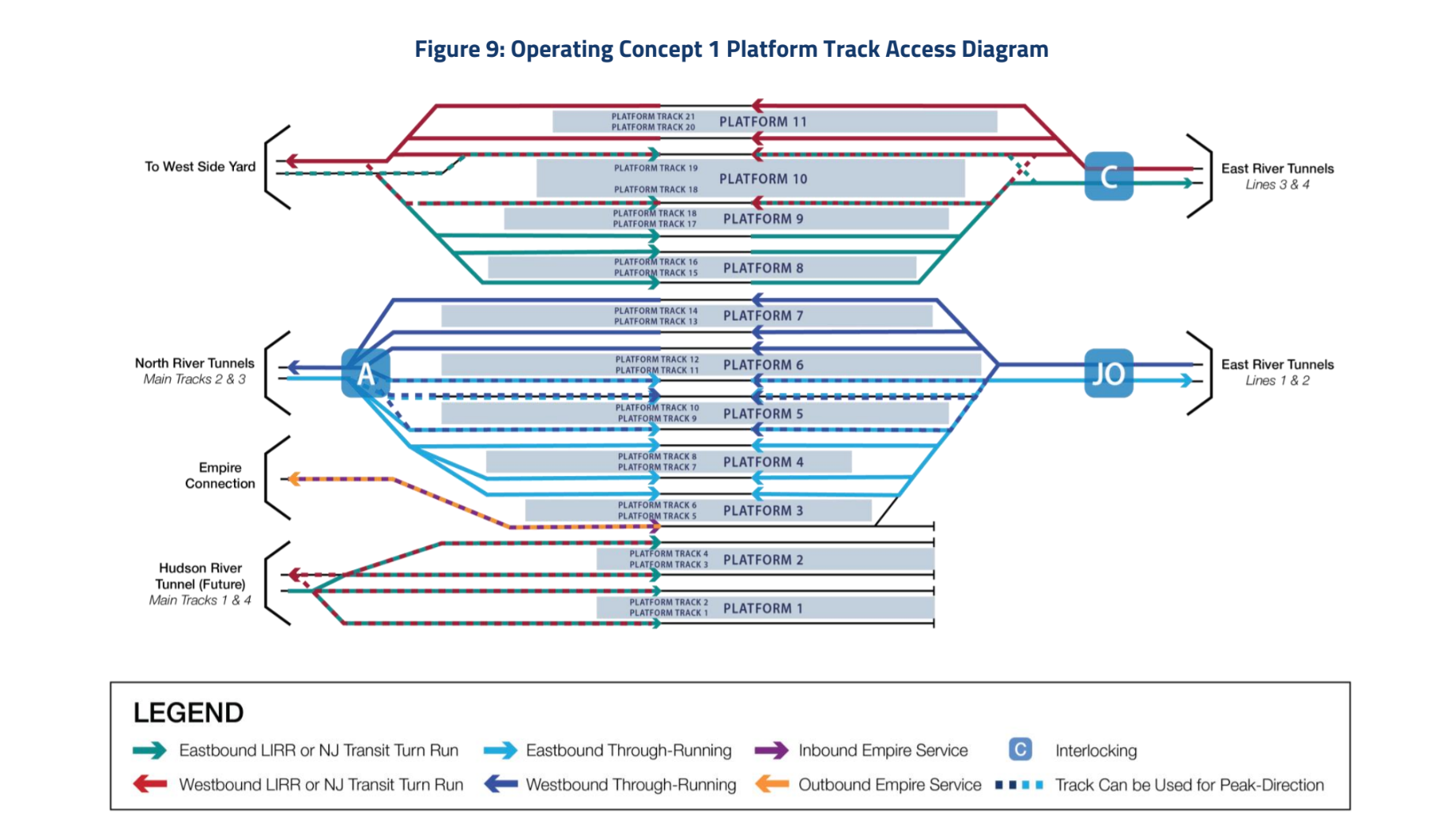
Under the FRA’s proposal, the northernmost tracks, 15 through 21, would be given to the Long Island Rail Road to move trains between the East River Tunnel and the West Side train yard. The southernmost portion of the station, tracks 1 through 4, would connect to the new cross-Hudson tunnel, and would be set aside for NJ Transit trains that end service at Penn Station and turn around. And track 5 would be used by Amtrak for its service between New York City and Albany and between New York City and Chicago.
The rest of the tracks, 6 through 14, would be for trains that through-run from the existing cross-Hudson tunnel (known as the North River Tunnel) to the East River Tunnel, which the federal agency suggests could be a setup that allows for revenue service through-running.
The FRA argues that separating the railroad operations into three zones could also cut down on cascading delays caused by trains that currently cross in front of each other.
“[T]his organization separates train flows by service type and movement intent— NJ Transit turning services on the south stub-ended tracks, through-running Amtrak and commuter service to New England and Sunnyside Yard through the middle, and LIRR service running through to/from the West Side Yard — sharply reducing the number of conflicting routes that must be set simultaneously,” the federal agency wrote in its report.
The report outlines a main obstacle to through-running: Penn Station’s limited platform capacity means riders need to wait on the concourse above the track level for their track to be called, and then wait for riders to get off the train before they can board. That arrangement contributes to the hub’s high “dwell time,” or the amount of time a train sits at the station taking up space, which limits the amount of trains that can use that space.
Advocates for through-running have said that operational changes by the railroads could get passengers on trains clear tracks more quickly.
Byford’s plan would cut down on dwell time by redesigning the track platforms to allow for more passenger movement. To do that, Byford would remove 100 support columns that hold up the buildings on top of Penn, primarily be removing the Infosys Theater, and adding additional escalators or elevators to every platform to give passengers more access on and off the platforms.
According to the FRA, even with aforementioned fixes, capacity would max out at 32 trains per hour during the morning peak and 30 trains per hour during the evening peak — above the current peak of 24, but well below the 48 trains per peak hour that the opening of the Gateway Tunnel could enable.
If the FRA concept for separating the railroads into specific zones is put into place, the report says four trains per hour could through-run between Long Island and New Jersey. In another concept with those service zones, platforms 5 and 6 could merge into a super-wide platform over tracks 10 and 11 to allow room for eight through-running trains per hour. The super-wide platform eliminates two tracks, but would allow passengers to wait on the platform for trains as opposed to on the concourse, which could cut down on dwell time, the FRA said.
Advocates who want the railroads to implement through-running welcomed the feds for at least taking the service operations piece of the puzzle seriously.
“After many years of thinly sourced studies all but dismissing the concept out of hand, this new work from the FRA recognizes that through-running can and should play a major role in Penn Station’s future,” said Blair Lorenzo, the executive director of Effective Transit Alliance, a group that’s argued Penn Station’s current footprint can already be configured for through-running.
Other expansion opportunities?
The FRA report didn’t delve into long-dormant proposals to expand the station’s footprint by knocking down the block to its south — a concept Byford recently said would be “immoral” to pursue before figuring out the maximum capacity possible within the station’s existing footprint.
“It would have been immoral to tear down a vibrant block of New York City before we had properly evaluated how to extract every ounce of additional capacity out of Penn’s existing footprint,” he said at a recent forum hosted by Manhattan Borough President Brad Hoylman-Sigal. “Maybe we will still need a bit of expansion to top off whatever we achieve, but rather than spend $16 billion on a stub terminal and impose mass relocation of New Yorkers from established homes and businesses — $16 billion that I note had no agreed funding source, yet our own proposal for just half that amount is somehow way more controversial.”
But with Penn Station capacity capping out at 32 trains per hour, proponents of expanding Penn Station see the report as vindication of their position that the existing station can only do so much.
“Andy made that statement that it would be ‘immoral’ to talk about expanding Penn Station until you’ve done everything you can to get capacity out of it, and I agree with him,” said Regional Plan Association CEO Tom Wright. “But there’s a second statement that goes along with that, which is once you confirm that you can’t get all the capacity out of Penn Station, it would be ‘immoral’ to just walk away without trying to figure out how to get as much capacity as efficiently as you can from other ways.”
That and other questions central to bringing passenger through-running to Penn Station will only be answered after the work has already started on the plan pitched by Trump, Duffy, Byford and Halmar.

Last week’s report was only part one of a two-part study, with a second piece set to come out in 2028 — months after Amtrak and Penn Transformation Partners begin the renovation. That study is supposed to look at hard questions about actually implementing the suggested service changes, new governance agreements between the three railroads, the impacts to current service patterns and what capital work outside of Penn Station would be need to get done to ensure the ideas from part one of the study, including through-running, could actually happen.
The FRA report assumed that reconstruction as a given at the expense of sorting out whether all of its proposed capacity improvements would actually be helpful or necessary, Lorenzo said.
“It’s good planning practice to prioritize improving operations as much as possible before embarking on expensive capital projects. … Analyzing it in the other direction may well find that it is possible to scale down some of Penn Transformation’s proposed vertical circulation elements, saving money without losing necessary capacity,” she told Streetsblog. “It’s hard to know if New York is getting value for its money with this plan.”
It’s also unclear so far what the tenant railroads will think of the proposed changes, though part one of the report suggested they could object to some of the ideas, such as requiring all LIRR trains to move to the West Side Yard instead of turning around inside Penn Station. The FRA suggested that requiring every LIRR train to go to the West Side Yard could slow down service on the railroad.
Pay to play
The FRA findings come as Byford makes the rounds on the local podcast-and-panel circuit to argue that, no, Trump’s Penn project is not merely cosmetic and no, it won’t be paid for in surcharges on rider tickets. In those appearances, Byford has side-stepped other possible ways train riders or transit agencies could get roped into paying for the project.
“He told me last week that riders won’t see ticket surcharges,” New York Times architecture critic Michael Kimmelman wrote after an interview with Byford in June. Yet during an appearance on the CBC podcast earlier in July, when Byford brought up ticket surcharges again, he only made a promise for one type of rider.
“I was asked directly, ‘Will Amtrak impose a surcharge on tickets?’, I said no. That’s not how we pay for things. I can’t speak for [New Jersey Transit] and the MTA,” said Byford.
Byford has pegged Halmar’s “Penn Transformation Partners” proposal at somewhere between $7 billion and $8 billion. But that’s a price tag without a final design — yet Byford claims that the federal government will give billions of dollars to a project in New York City, which is something Donald Trump and Sean Duffy have repeatedly tried to not do.
So where will the cash come from? Byford has said the federal government won’t cover the entire project cost, which means that New Jersey and New York are going to be expected to either pony up a chunk of cash up front or pay back Halmar for its costs on the project.
Streetsblog previously highlighted the Amtrak’s pursuit of a design-build-operate-maintain-finance (DBOM-F) arrangement with its Penn contractor. Under the terms of the planned public-private partnership, Penn Transformation Partners would be responsible for the operation and maintenance of Penn Station, with Amtrak, NJ Transit and the MTA paying it back for its construction efforts over several decades.
In 2023, when ASTM, which owns Halmar, proposed basically the same project Amtrak is advancing today, its operation and maintenance proposal would have put the conglomerate in charge of Penn Station for 50 years, and allowed it to collect $250 million per year from the tenant railroads.
Payments from the railroads are very much on the table, according to Halmar Vice President (and ex-Trump official) Peter Cipriano, who told reporters in June that he expects to levy the rent payments.
Halmar’s 2026 plan includes removing Dolan’s Infosys theater to make way for the grand, bright Eighth Avenue entrance and create that added space on the track platforms by removing support columns, but Byford and other officials have been coy about how much they plan to pay Dolan for his property. (Dolan hosted Trump and Duffy in his box during the one NBA Finals game the Knicks lost. Shortly after, the White House requested $1 billion for Penn Station from Congress.)
Gov. Hochul has been adamant that New York won’t pay for the project, but even if New York doesn’t cut a novelty-sized billion-dollar check for the project, New York could wind up paying for the project. Congress’s BUILD America 250 Act would give Amtrak expansive powers to leverage land around transit stations to fund its capital projects.
The provision would lets Amtrak team up with local mega-developer Vornado to build towers around Penn Station and use the property taxes on those new buildings that would otherwise go to the city to fund the station renovation. It’s a federal attempt at the same play Vornado tried to run at the state level until Gov. Hochul caved to opposition and kiboshed the effort. BUILD America 250 is stalled in the Senate, however, and needs to pass by Sept. 30 or else get kicked to next year, at which Democrats may have wrested control of Congress from the Republicans.
“[Amtrak] has to make the case to New York that it is worth them putting billions of dollars into this,” said Rachael Fauss, senior adviser at the good-government group Reinvent Albany. “I don’t think [Reinvent Albany] is ready to say that just because there’s capacity enhancement, suddenly, it makes sense for New York to pay any money into this. It’s not like anyone has seen a breakdown that says how much this costs and what the various features of it cost.”

Read More:
Streetsblog has migrated to a new comment system. New commenters can register directly in the comments section of any article. Returning commenters: your previous comments and display name have been preserved, but you'll need to reclaim your account by clicking "Forgot your password?" on the sign-in form, entering your email, and following the verification link to set a new password — this is required because passwords could not be carried over during the migration. For questions, contact tips@streetsblog.org.