Make Biking Great Again: Conservatives Should Embrace The Right Wing Values Of Cycling
Lefties are always championing bikes because they’re good for the environment, great for safety and are an effective tool for equity.
But years of advocacy have led to only incremental improvements to roadway design. Meanwhile, cycling remains aligned in the national mind with progressive causes like climate change, which makes it easy fodder in the Republican war on “woke.”
But that meat grinder need not chew up so many potential allies on the right, because the benefits of biking are profound from a conservative standpoint. It’s time for all of us who love bikes to make a better case to our red-state friends. In other words, yes, it’s time to “Make Biking Great Again.”
Why people bike: freedom and self-reliance
Consumer surveys consistently show that cyclists are not riding to work because they care about equity or even climate change. Rather, cyclists tell bike companies and researchers that their motivations align more with classic conservative political narratives:
- Cycling is a great way to stay healthy without needing government support.
- Cycling is all about self-reliance because a rider can get to where he or she is going efficiently.
- Cycling can save hard-working American families lots of money.
Biking saves taxpayers’ money
Roads are tremendously valuable, tax-subsidized real-estate. It’s estimated that up to nearly one-quarter of all urban land in the US is taken up by streets with an approximate land value of approximately $4.1 trillion. Roadway and bridge projects to maintain and expand these assets present huge capital and operating expenditures at all levels of government. This volume of money and land devoted to single occupancy vehicles alone does not represent the highest and best use of a public assets, especially when so many roadways are overbuilt.
Bike infrastructure, in contrast not only adds value to roadway assets (by expanding use cases and decreasing crashes), but can be installed at virtually no cost without materially impacting the driver experience.
Consider a routine roadway milling and resurfacing on a 35-foot roadway striped with two vehicular travel lanes. The cost of restriping the roadway is already built into the project budget, so reconfiguration is a simple matter of approving a different painting design. In this case, adding a five-foot bike lane on both sides of the roadway, and reducing travel lanes from 17.5 feet to 12.5 feet …
- Adds a new function to the roadway…
- Keeps cyclists out of drivers’ way…
- And potentially reduces congestion by providing an alternative means of transportation…
… all without reducing vehicular throughput:
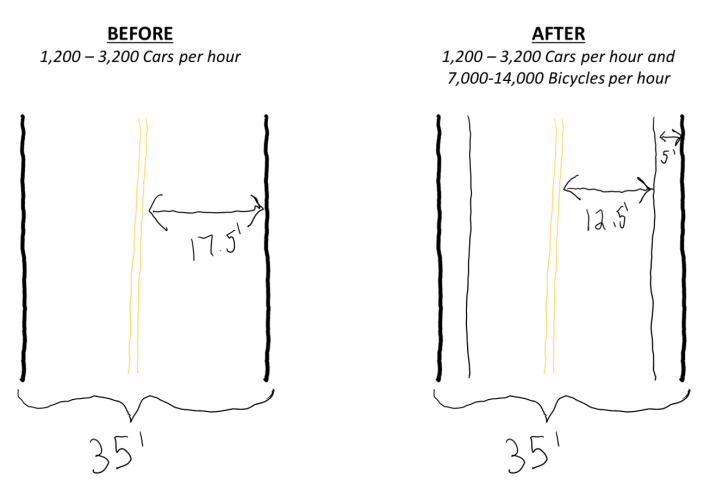
So for almost no extra money or labor, a roadway can support active transportation … which enhances everyone’s safety, extends the life of the roadway and gives voters more options for getting around. That sounds like a bargain (not to mention a return on investment that taxpayers can actually see)!
Bicycling is good for business
President Trump says he is “the president who stands up for Main Street, not Wall Street,” and indicated that “small businesses power our economy from the ground up.” If so, he should encourage cycling to take advantage of its proven economic development benefits. Research consistently shows that cyclists visit small businesses more frequently than drivers, and spend up to 40 percent more per month at local businesses. Other investigations highlight a correlation between bike lane projects and a reduction in commercial vacancies as well as an increase in property values near trails.
In addition to economic gains, bicycling also reduces economic loss. According to Texas A&M Transportation Institute’s 2025 Urban Mobility Report, traffic congestion in the U.S. accounts for roughly $269 billion in economic loss per year, a figure that has increased dramatically in the past 40 years. The average American driver loses roughly $894 annually in time and fuel, and in dense cities like Chicago and New York City, this number balloons to more than $2,000.
Studies from all over the world, including New York City have illustrated the effectiveness of bike infrastructure at reducing congestion. A 2014 study analyzing travel time on Columbus and Eighth avenues found that travel times fell 35 percent and 17 percent respectively after the installation of protected bike lanes. More bike infrastructure reduces congestion, and subsequently, economic costs on both the national level, and the wallets of individual Americans.
Liberating Americans from Big Government
If there’s one thing that Republicans, Democrats, and everyone in between can agree on it’s that no one likes going to the DMV. Yet 45 percent of Americans don’t have any alternative to driving, requiring them to enter “the system” in order to meet even the most basic daily transportation needs.
Bicycles, in contrast, require no registration, no government-issued identification, and no reoccurring fees/taxes. Supporting bicycle infrastructure and public policy provides an off ramp to this regulatory whirlpool, freeing Americans from this backdoor tax. Currently, more than 90 percent of Americans have a driver’s license, yet many commuter satisfaction surveys and polling indicate that they would use alternative modes if they were available. In tandem, providing viable low-cost alternatives to driving can also reduce demand for drivers licenses as well as associated administrative staffing costs.
Some may view this as an effort to placate the (insert your preferred adjective) executive in the White House. The primal instinct to fight like hell against the normalization of Trump’s (again, insert your preferred adjective) behavior is understandable, but is ultimately self-defeating in this case. Indeed, the facts about bicycling actually support conservative narratives about personal freedom, independence and the right to self-expression — and cleaner air, increased accessibility, diversified transportation options and social equity can ride quietly on those conservative coattails.
This reframing is not a panacea for every issue in this country. There are real issues and important dialogue that needs to happen on immigration, foreign affairs, and health care. In this case, however, we see what seems like increasingly rare common ground for all ends of the political spectrum. Taken in microcosm, perhaps today’s culture of “outrage” politics and ideological opposition prevents Americans on both sides of the aisle from taking time to listen, engaging in productive discourse, and ultimately realizing solutions that benefit us all.
Bikes bring people together, and that’s something we could all use right about now.

Streetsblog has migrated to a new comment system. New commenters can register directly in the comments section of any article. Returning commenters: your previous comments and display name have been preserved, but you'll need to reclaim your account by clicking "Forgot your password?" on the sign-in form, entering your email, and following the verification link to set a new password — this is required because passwords could not be carried over during the migration. For questions, contact tips@streetsblog.org.