Opinion: Mamdani Must Do More Than Just Undo the Mistakes of Eric Adams
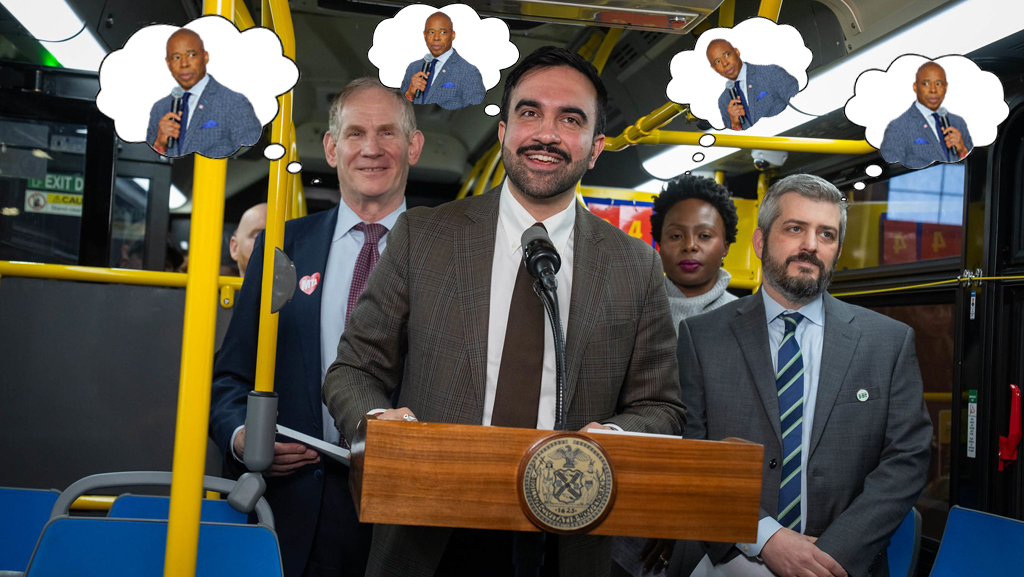
Mayor Mamdani’s commitment, announced on Friday, to improve bus speeds on Fordham Road by 20 percent may give some Streetsblog readers whiplash: In 2019, then-Mayor Bill de Blasio made a similar commitment to improve bus speeds citywide by 25 percent. De Blasio failed, and bus speeds didn’t budge.
Mamdani deserves credit for notching early wins by reversing his predecessor’s car-first mistakes — first on McGuinness Boulevard in January, and now on Fordham Road and Ashland Place and in Flatbush and Midwood. But simply restoring projects that were stalled, truncated or abandoned under Mayor Eric Adams won’t help the new mayor achieve his campaign plank of fast buses, let alone streets that are the “envy of the world.”
Let’s look at Fordham Road first. Amid the Covid-19 pandemic, de Blasio promised to create new bus priority projects to take advantage of the pandemic “space dividend.” He called it the “Better Buses Restart” and the “Red Carpet to Recovery.” One of those projects was Fordham Road.
Initially, the city Department of Transportation floated a one or two-way busway, with limited automobile access for local deliveries, trucks and pick-ups and drop-offs.
City surveys found 70 percent support from locals for the busway design. Then the backlash started: Bronx Council Member Oswald Feliz and leaders of well-connected businesses and institutions (run by people who lived outside of the borough) asked new Mayor Eric Adams to delay the project, citing concerns about spillover traffic.
DOT watered-down the plan to create “off-set” bus lanes — that is, bus lanes that are in the middle of the roadway instead of along the curb, where they are frequently blocked by double-parkers. Adams ended up kiboshing that, too.
That same “offset” bus lane design is what Mamdani announced on Friday. The announcement failed to live up to his promises on the campaign trail, where he explicitly cited for a “Fordham Road busway” while attacking Adams for neglecting bus riders, who are on average the lowest income of the city’s commuters.
Riders Alliance, which backed the mayor in the election, called him out for the reversal and refused to attend Friday’s press conference.
DOT now implies it was always reluctant to do a busway due to spillover effects on traffic (and other bus routes) on nearby streets. What role politics played in that reluctance is between agency officials and their maker. But even if the concerns about spillover traffic are legit, those concerns should be cause to do more, not less.
It’s hard not to feel that, on Fordham Road at least, Mamdani followed the same playbook as his predecessors: Open the door to something ambitious, then let the windshield perspective of powerful business interests — or the DOT “Deep State” — chip it away until you land on an alternative with fewer winners and losers.
But there are many losers here: Roughly 130,000 people take a bus on Fordham Road every day — and they are victims of the mayor’s deference to DOT. Buses run slower than 4 mph on some of the segments where DOT considered installing a busway. A 20-percent increase in speed only gets you to 4.8 mph. That’s an improvement, but it’s hardly “fast.”
Bus experts Annie Weinstock and Walter Hook estimate that offset bus lanes only improve bus speeds by around 7 percent. If that’s how things land, and Mamdani is true to his word, he’ll have to instruct his DOT to put some form of a busway back on the table. But that’s a whole lot of steps for a mayor who campaigned to speed up buses while promising a “new era” of governance.
There are many ways that Mamdani may disappoint his base because he can’t convince the governor or the legislature to fund some of his agenda. But he has no excuse when it comes to surface transportation: The mayor is essentially an elected dictator when it comes to street design. All he needs paint, signage and political will.
The good news is that Mamdani’s team hasn’t shied away from committing to meeting the Streets Master Plan’s unprecedented benchmarks — a commitment the new mayor reiterated on Friday.
But Mamdani must do so much more than reverse Mayor Adams’s failures. At this point in de Blasio’s first term, DOT had already put out a 42-page Vision Zero “action plan.”
Hopefully DOT Commissioner Mike Flynn is hard at work with his team cooking up a similarly broad vision for bus service.
Millions of riders depend on it.

Read More:
Streetsblog has migrated to a new comment system. New commenters can register directly in the comments section of any article. Returning commenters: your previous comments and display name have been preserved, but you'll need to reclaim your account by clicking "Forgot your password?" on the sign-in form, entering your email, and following the verification link to set a new password — this is required because passwords could not be carried over during the migration. For questions, contact tips@streetsblog.org.