Commish Tisch: Fix in Mix For 311
The future of 311 might involve getting some 411 from 911.
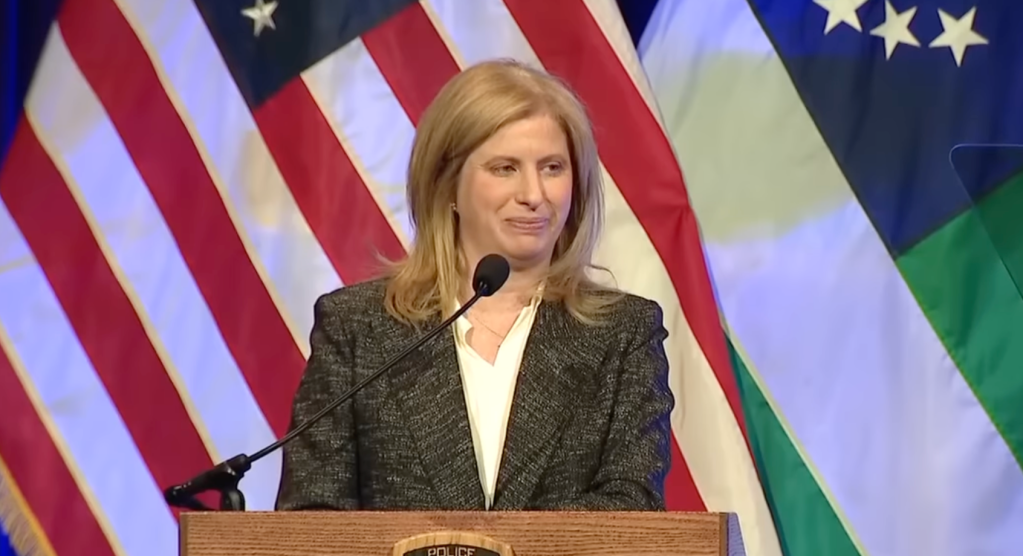
Police Commissioner Jessica Tisch says she will fix the NYPD’s notoriously subpar response to 311 service requests with a new “digital dispatch system” modeled on the 911 that will add accountability to a system long plagued by poor customer service.
“Requests coming in through 311 were often assigned through long text chains and phone calls,” Tisch said at the annual State of the NYPD address earlier this week. “Supervisors tracked jobs by hand, and officers didn’t always have a clear picture of what was assigned, what was still open, or who was responsible for follow-up. … That might work when volume is low. It doesn’t work in a city of eight million people.”
Tisch said that a new “digital dispatch system for 311 jobs” would ensure that quality-of-life calls are “handled with the same level of structure and accountability as 911.”
The NYPD was unable to supply specific information about the new system, such as its vendor and price tag. But the department said it anticipates that the system will be fully operational by this spring.
The problem with 311
It’s unclear why the NYPD’s internal 311 system isn’t already digitized. After all, the external system — the one that civilian New Yorkers deal with — features a well-designed smartphone app, assigns unique tracking numbers to all 311 requests, and encourages New Yorkers to attach photos to their complaints. It has a five-step workflow. Former Mayor Mike Bloomberg established the 311 system in 2003, so the city has had plenty of time to work out of the kinks.
But 311 has long concerned street safety advocates. In 2021, Streetsblog analyzed more than 26 million service requests about driver misconduct and discovered a systemic pattern of inaction and deception among NYPD officers who responded to them. We found thousands of complaints about disorderly motorists that officers closed out within five minutes of receiving them.
Some of those problems persist. “I have encountered cases where the responding officer has clearly not reviewed the photos or has implied it’s a laborious and or slow process to view the photos,” said the data scientist Jehiah Czebotar, who crunches 311 statistics. “It’s good to get those [photos] directly in the hands of city employees that respond to investigate and address a 311 report,” he added.
But a spokeswoman for the NYPD said the new system would solve that problem by adding in more accountability and traceability, just like with 911. The new digital system would allow cops to record their responses to 311 calls at all steps in the process, entering it into the digital system just as they do with 911 calls. Currently, 311 service requests that get routed to a particular precinct are assigned to individual cops either by radio or text with no real trackability.
It’s the same reason that Tisch wants to digitize command log books, which also remain frozen in time.
Can Tisch really fix it?
Tisch certainly has the appropriate résumé to oversee the installation of a fully digital 311 system. In December 2019, former mayor Bill de Blasio appointed her commissioner of the Department of Information Technology and Telecommunications, where she managed and upgraded the city’s digital infrastructure. She is responsible for the fact that New Yorkers can text 911.
And this is the not the first time Tisch has tried to fix the NYPD’s technological shortcomings. Before she served as police commissioner, she helped develop the department’s “domain awareness system” to better understand and anticipate crime, and later led efforts to equip all officers with body cameras and smartphones.
Nor is this Tisch’s first attempt to solve 311’s weaknesses in particular. Last year, Tisch established a brand-new Quality of Life Division and adopted a “QSTAT” system modeled after the department’s famed CompStat program.
Czebotar’s statistics show the latter campaign produced a measurable improvement. “311 satisfaction scores for NYPD overall have shown improvement in the past 12 months, but there is still room for more improvement,” he told Streetsblog. “In the last quarter of 2025, 64 percent were dissatisfied with NYPD responses to 311 reports and only 33 percent were satisfied. That’s improved from 2025 Q1 when it was 78 percent dissatisfied and only 19 percent satisfied.”
Other numbers support this narrative. For example, over the past year, NYPD officers issued summonses for nearly 27 percent of 311 service requests that concerned illegal parking. That amounts to a nearly 40-percent increase over January 2025.
To truly fix 311, however, Tisch will need to address the behavior of her own police force. According to Czebotar’s analysis, only 3 percent of New Yorkers who submitted complaints about cars parked on sidewalks — a longstanding and seemingly indelible practice within the NYPD — said they were satisfied with the police’s response.
Tisch will also need to confront the elements within her department that continue to treat certain quality-of-life complaints with a shameful amount of avoidance, trepidation and discretionary enforcement.
Streetsblog recently struck up a conversation with a traffic enforcement agent walking the streets in lower Manhattan. When we asked why they had not ticketed a nearby car that had a clearly defaced license plate, the agent said that he had received instructions to write tickets if — and only if — a civilian submitted a 311 complaint about it first.
In a statement to Streetsblog, a NYPD spokesperson who declined to provide a name, said, “That is not our policy.”

Read More:
Streetsblog has migrated to a new comment system. New commenters can register directly in the comments section of any article. Returning commenters: your previous comments and display name have been preserved, but you'll need to reclaim your account by clicking "Forgot your password?" on the sign-in form, entering your email, and following the verification link to set a new password — this is required because passwords could not be carried over during the migration. For questions, contact tips@streetsblog.org.