Opinion: The City, Not Just Lyft, Deserves Blame for Citi Bike’s Winter Mess
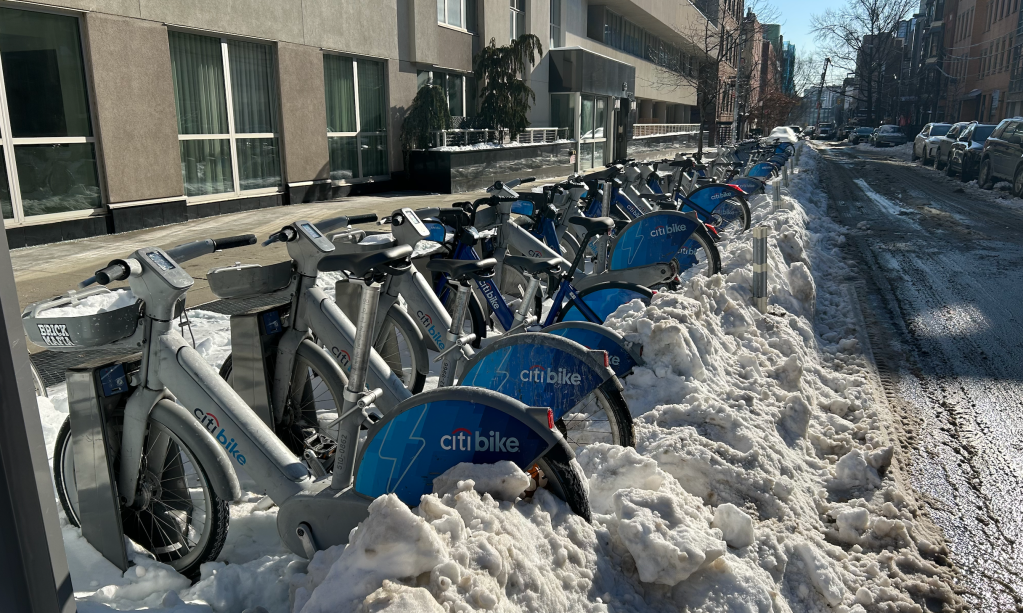
New Yorkers love to hate Lyft, which has operated and expanded Citi Bike since 2018. North America’s largest bikeshare system certainly has its share of issues, including sub-par bike balancing, broken docks and recurring price hikes. And after last month’s winter storm, riders, journalists and elected officials blamed the ride-hailing company for leaving entire Citi Bike stations encased in ice.
But Lyft’s many critics often overlook a critical factor: New York City almost never fines Lyft for neglecting its infrastructure, despite having the legal ability to do so. Furthermore, the city lacks a mechanism for rewarding Lyft when it meets or exceeds its contractual obligations.
The immediate problem is that the city does not adequately manage its Citi Bike contract. That critical document includes a long list of performance measures that the city must enforce. These include ensuring bikes are available for use, maintaining operational stations, providing quality customer service — and, yes, removing snow. Each measure carries specific penalties when the company doesn’t fulfill them. For example, each broken dock that has not been repaired within 48 hours of notification is subject to a penalty of $10 per dock.
In 2023, then-Comptroller Brad Lander’s office published a well-researched report about the Citi Bike contract. The report’s authors argued that the city’s contractual right to impose fines on Lyft is the best route to obtaining better service — but the city rarely exercises this right. The authors recommended that the city start fining Lyft when it misses performance targets.
But DOT is reluctant to sanction Lyft, “because doing it consistently would deprive the operator of funding to run the system,” said Jon Orcutt, the former DOT policy director who led Citi Bike’s initial development. Orcutt said he supports the report’s suggestion to offer Lyft financial incentives for good performance, because those payments would help offset fines. Financial incentives could also improve service for riders, Orcutt believes.
The city should prepare now for the 2029 Citi Bike contract
Lyft’s contract expires in 2029. If the company wants to compete for the next contract, it needs to demonstrate its worth. Must it hand out two weeks of free membership, as Streetfilms’ Clarence Eckerson suggests? No. It merely needs to do a better job. In a recent op-ed for Streetsblog, Orcutt implored Lyft to release granular data about where Citi Bike is being used. Doing so would “help the city overcome barriers to higher ridership, inform future expansion plans, and assist policymakers in containing costs to riders,” he wrote.
Separately, the city should start work now to prepare the bid. According to a 2025 report by the Independent Budget Office, this will be non-trivial as Lyft owns most of the equipment it operates, including the bikes, docking stations, and software. A new operator would either need to purchase all of the equipment or start from scratch. A lot of work will be needed to prepare for this, especially given that any new system must be fully ready to go if and when Lyft exits in 2029.
The next contract should also include more terms that benefit the system, such as incentives for good performance and concrete requirements for sharing data. The comptroller’s report recommends that the “city’s contract for Citi Bike should require operators to create a platform displaying real-time data and providing riders with a more accurate picture of the quality of service and operator performance.”
The success of a public-private partnership lies in the contracting
To ensure a true competitive bid that results in the best possible operator, the city should prepare to aggressively advertise the open bid process. It should not be a foregone conclusion that Lyft will win the next contract. The more Lyft understands this in 2026, the harder it is likely to work now to win the next contract.
Having worked on public-private partnerships in cities around the world, it is clear to me that the strength of the private operator — in this case Lyft — derives from the strength of the underlying contract. You can blame Lyft all day long, but it is still a for-profit company that will always act in its own interests.
Rather than piling onto Lyft, we advocates should focus our efforts where we can actually make a difference. We should persuade the city to fine Lyft for not digging their stations out of the snow, and lobby our elected officials to alter the current Citi Bike contract to include incentives for good performance. The next time it snows, we might actually have a working bikeshare system.

Read More:
Streetsblog has migrated to a new comment system. New commenters can register directly in the comments section of any article. Returning commenters: your previous comments and display name have been preserved, but you'll need to reclaim your account by clicking "Forgot your password?" on the sign-in form, entering your email, and following the verification link to set a new password — this is required because passwords could not be carried over during the migration. For questions, contact tips@streetsblog.org.