Universal School Streets Will Be a Heavy Lift for Mamdani: Advocates
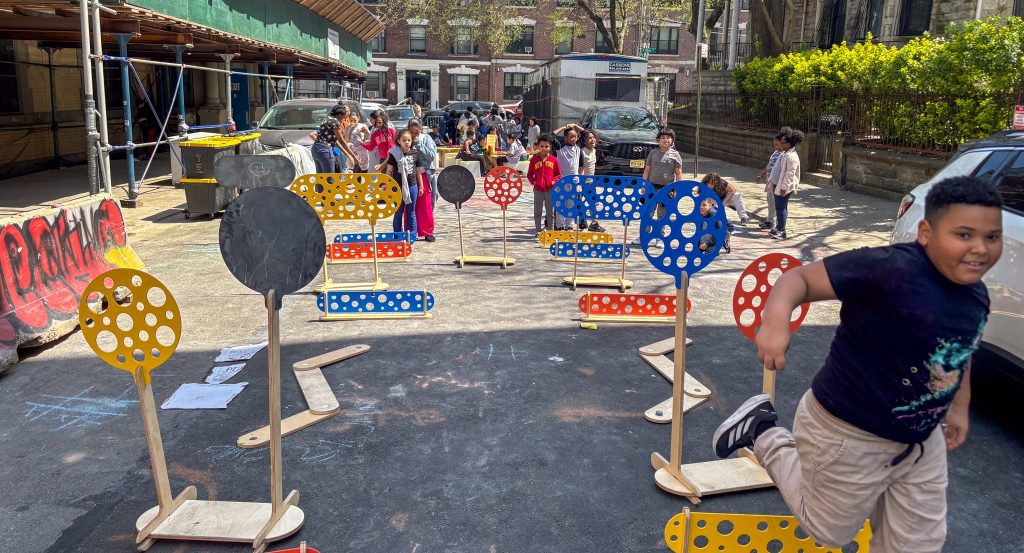
As a candidate, Mayor Mamdani promised “to implement universal school streets,” but advocates warn his campaign-trail proposal will require new resources and a heavy dose of political capital to overcome the opposition.
In a recent report, the urbanist non-profit Open Plans said Mamdani’s vision of a school street in front of every school building would require a slate of new policies — including a substantial reduction of paperwork and a dedicated annual budget — and strategies for persuading educators who are accustomed to parking their cars wherever they want.
Mamdani described his plan for school streets in a Reddit Q&A last year. “I want to implement universal school streets,” he wrote. “That means closing off the roadway to vehicle traffic in front of every single school building in the city [and] flipping the city’s current approach that requires schools to opt-in.”
This approach would radically increase the number of school streets in New York City, which lags behind its global peers in designating streets for children. Paris has 200 school streets, and London has at least 800, but New York has less than 70. Mamdani’s policy would likely create more than 1,000 brand-new school streets.
But Open Plans, which shares a parent company with Streetsblog, stopped short of formally endorsing the universal model in their report.
The leader of Street Lab, which operates school streets in the city, is skeptical as well. “It would be a mistake to say every school [should have a] school street,” co-founder and executive director Leslie Davol told Streetsblog. “I have people in my office right now on the phone with a school and they are just hearing about how much the teachers and staff want their parking spaces.”
City Hall did not return a request for comment, so it’s unclear whether Mamdani actually intends to pursue his opt-out plan for more school streets.
Whatever the new mayor decides, he is likely to rekindle a longstanding debate about where children belong in New York City.
Children in the street
It’s a rare sight these days, but children used to dominate the streets of Gotham. They ran around unsupervised, playing stickball, shooting craps, or just goofing off. That came to an end after the automobile arrived in the early 20th century and drivers began killing children.
In response, advocates pushed to close certain streets to car traffic so children could play in them, and in 1914, the NYPD authorized the first “play street” on Eldridge Street between Rivington and Delancey on the Lower East Side.
The street attracted “throngs not only of children, but of their parents,” the New York Times wrote at the time, and “drivers turn[ed] aside cheerfully so that youngsters [could] enjoy themselves in safety.” The Parks Department installed pianos and neighborhood girls performed traditional Romanian folk dances.
Decades later, Mayor John Lindsay opened more play streets throughout the city. Around 15 blocks still belong to the play street program, which is currently operated by the Police Athletic League. But it wasn’t until the Covid pandemic that the city began to open even more streets, including those near schools.
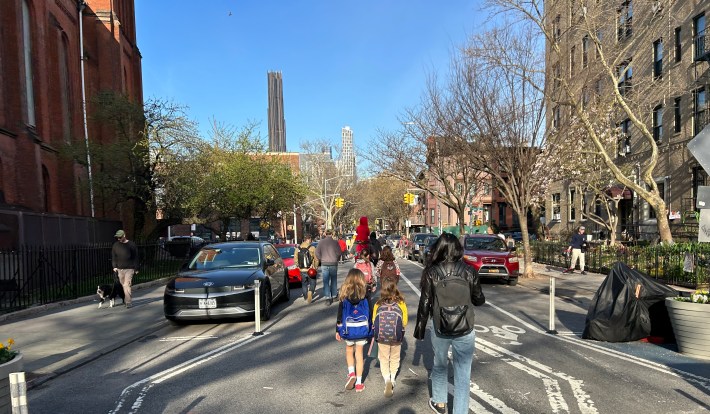
The City Council voted to make open streets permanent in 2021. In 2025, the Department of Transportation approved 71 total school streets, up from 64 in 2023 and 51 in 2022. But at the start of 2026, only 69 open school streets are in operation, according to DOT.
The benefits of school streets
Streets near schools are disproportionately dangerous. Three years ago, Streetsblog reported that school-adjacent streets experience 57 percent more crashes, and 25 percent more injuries per mile, than other streets in the 8 a.m. hour. Current and former city officials blamed DOT’s conservative approach to school safety, which leads to modest changes that don’t make a real difference.
The removal of car traffic near schools dramatically improves street safety. Consider the example of Paseo Park, a mile-long linear park in Jackson Heights that started as a pandemic-era open street and abuts nine schools. In two years of open street programming, crashes dropped by 77 percent and injuries by 89 percent, according to a Streetsblog analysis of crash statistics.
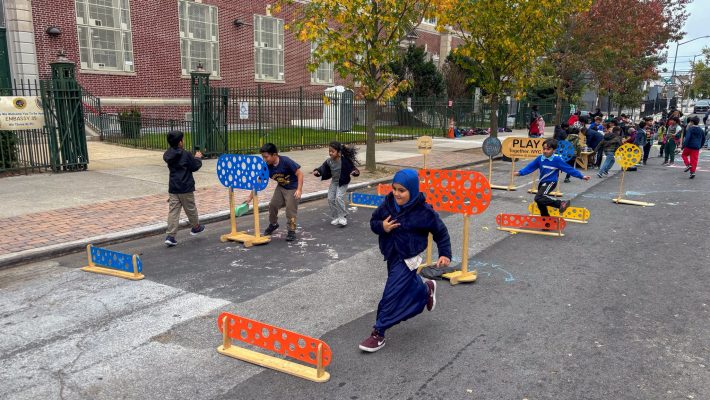
Beyond the more obvious benefits of safety and open space, school streets offer a bevy of intangible benefits, too. Jim Lammers, a community planner at Street Lab, said students “are able to make change in these spaces and feel like they have impact in their community.”
“School streets help bolster the relationships between caretakers and teachers and students because of the social infrastructure,” said Sabina Sethi Unni, a community planner at Open Plans. “You’ll see parents sitting and waiting at the median together on 34th Avenue” in Paseo Park. “It helps build social cohesion, resiliency and just friendship,” she added.
“The School Streets program is fantastic,” the City Council’s new transportation chair, Shaun Abreu (D-Morningside Heights), told Streetsblog. “Some schools use the program to make school pickup and drop-off easier for families, others to make sure our kids get the outdoor time they need. As someone who grew up playing stickball in the streets, I am all for setting aside a few blocks for our kids to be kids.”
The challenges of school streets
When the City Council voted in 2021 to make the city’s open-streets program permanent, it tried to divide the governance of individual streets between DOT and “community organizations,” which the legislative body defined as “any formal or informal group of people or businesses with ties to the community.”
In practice, the burden of governance — which includes administration, maintenance, programming, and other responsibilities — fell almost entirely on a mix of private community organizations and individual public and private schools. As of early 2026, DOT manages a single open street in Fort Greene.
The same legislation did not distinguish between open streets, which can be sited anywhere, and school streets, which are necessarily constrained by the locations of schools. The bill didn’t allocate any form of permanent funding, either. These oversights saddled the open streets program with a sense of uncertainty about who is in charge and how things are supposed to work.
To address this confusion, the aforementioned Open Plans report offered a number of potential fixes. These include the authorization of fully and permanently pedestrianized school streets, to reduce the number of staff required to set up and break down signage and barriers; the creation of a “clear structure” between DOT and the Department of Education to oversee a dedicated school streets program; and the allocation of dedicated funding in Mamdani’s 2026 budget, which would allow DOT to hire more full-time staff and “reduce over-reliance on non-profit partners.”
Open Plans also argued the city should try to address teachers’ parking concerns by moving dedicated teacher parking spaces to nearby blocks and offering teachers cash and other incentives to relinquish their city-issued parking placards.
Parking placards are one of the biggest and most electrified third rails in New York City politics. This is particularly true for placards issued to public school educators, who began receiving them in 2017 under a controversial labor arbitration agreement with the de Blasio administration. Soon thereafter, schools started turning outdoor spaces for children into permanent parking lots for adults.
This is why Street Lab is wary of Mamdani’s plan for a universal, opt-out program. “Even more so than other open streets, [School Streets are] harder because you have the whole school system and administration and bureaucracy that you’re pushing up against,” said Davol. “You have car culture, the DOE culture and the culture of each school.”
Davol added that policymakers should focus less on trying to implement school streets in every neighborhood and more on what actually happens in them.
“You could certainly wave a magic wand and say, ‘everybody gets a permit for a school street’, which would be great,” she said. “But I think then the question is, what do we do now? And how does this really work? And we don’t want backlash from the communities around the schools.”
But Sethi Unni still considers the opt-out option an exciting idea, because it would lessen the program’s dependence on savvy individuals and organizations who know how to navigate the city bureaucracy. “I think a big hurdle with the program is outreach,” she told Streetsblog. “The number one thing I hear is ‘I’ve never heard of this program.’ The benefit of opt-out is it would make sure every single school knows about it.”

Read More:
Streetsblog has migrated to a new comment system. New commenters can register directly in the comments section of any article. Returning commenters: your previous comments and display name have been preserved, but you'll need to reclaim your account by clicking "Forgot your password?" on the sign-in form, entering your email, and following the verification link to set a new password — this is required because passwords could not be carried over during the migration. For questions, contact tips@streetsblog.org.