Streetsblog provides high-quality journalism and analysis for free — which is something to be celebrated in an era of paywalls. Once a year, we ask for your tax-deductible donations to support our reporters and editors as they advance the movement to end car dependency in our communities.
If you already support our work, thank you! If not, can we ask for your help?This year's fundraiser includes a special gift for our biggest supporters. Don't miss out.
Together, we can create a more livable, walkable, bikeable, equitable and enjoyable city for all. Happy holidays from the Streetsblog team!
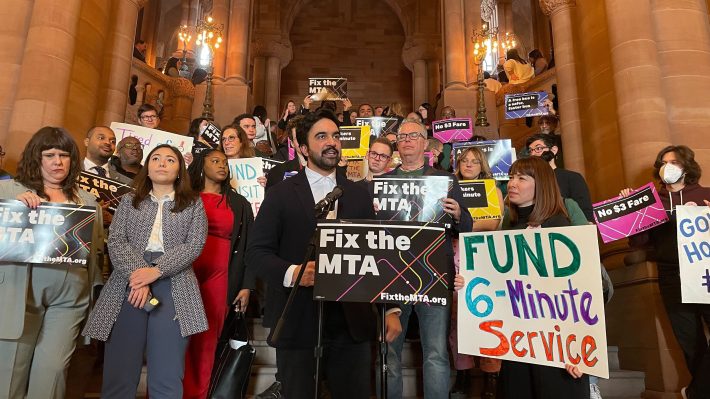
ALBANY — Mayor-elect Zohran Mamdani’s plan to make buses free is already drawing concerns from the state lawmakers whose support he'll need to make it happen — not about the concept, per se, but rather the politics and timing of such a drastic change to the MTA's operations.
In the grand scheme of things, the estimated $800-million cost of free buses isn't outlandish for a state whose annual budget clocked in at $254 billion this year. But Albany insiders worry fiscal prudence may be warranted amid President Trump's ongoing war on the finances of New York and other "blue" states. That context makes passing Mamdani's free bus proposal an "uphill battle," political consultant Jack O'Donnell told Streetsblog.
"There's definitely some energy around it. It certainly caught on during the election as something that motivated voters," O'Donnell said. "But I think there's a realization that it's really super expensive."
He added, "It's pretty hard to say folks in New York City deserve free buses, when there are much more limited options in terms of public transportation throughout the rest of the state."
Zohran Mamdani successfully got a free bus pilot passed in 2023, and many of his allies in that effort remain in Albany.Dave Colon
If a citywide free bus program feels like too big of a lift, lawmakers may instead opt to revive or expand the free bus pilot that then-Assembly Member Mamdani won for one route in each borough in the 2023 legislative session, said Assembly Member Rodneyse Bichotte Hermelyn (D-Brooklyn). Talks to do just that fell apart in 2024 — reportedly because of a dispute between Mamdani and Assembly Speaker Carl Heastie.
At the time, Albany bean-counters estimated an expansion to three or five routes per borough would run the state $90 million — far less than the growing estimated cost of citywide free buses. Something like a phased-in approach, where officials add more free routes each year, could also make sense, the top Brooklyn Democrat said.
"One bus per borough, and then the year after, maybe it'll be two buses and continue until we're at a place of financial stability," Bichotte Hermelyn told Streetsblog.
Mamdani’s plan already faces opposition from Gov. Hochul and skepticism from MTA officials. Deputy Senate Majority Leader Mike Gianaris (D-Queens) however, is just as supportive of the proposal as he was when he and Mamdani pushed successfully for the original free bus pilot back in 2023, he said.
Gianaris plans to push for free buses in the legislature in the event Hochul's executive budget proposal doesn't hit the mark, though he's found the governor's office open to discussing a solution for transit affordability thus far.
Ultimately, however, how hard lawmakers decide to push will depend on the incoming mayor's guidance, Gianaris said.
"It depends on what direction he wants to take it, and he's also proven very adept at mobilizing issue campaigns, so I would look forward to working with him on doing that," Gianaris said. "But this is a popular idea, and other than some bureaucrats at the MTA who just can't get their heads around a new idea like this. It's something that's proven very effective, both in other localities that have tried it and in our own pilot program here in New York."
And then there's the matter of upstate New York potentially wanting in on the fun. Free buses are nothing new up there — several counties have them — but the prospect of going to bat for nearly $1 billion in appropriations that only benefits the city may give pause to lawmakers who have their own regionally specific wishlists and pressing transportation concerns.
We made buses free in Newburgh, NY and ridership *doubled*
State Sen. James Skoufis (D-Orange County) is one of several state lawmakers to come out and say that Mamdani's plan for buses is sound public policy; his own district has had free buses for years. Skoufis's fear, though, is that taxpayers in upstate New York will help foot the bill for free buses in New York without seeing any of the benefit themselves, he told Streetsblog.
"If we start going down this road for New York City only, my expectation would be that the funding exclusively come from New York City taxpayers," Skoufis said. "If we brought in the conversation, and the conversation becomes one of funding free bus opportunities statewide, then I think the revenue conversation can become statewide."
The many paths to free buses
Mamdani has said he hopes to fund free buses with tax revenue from an increase on the marginal tax rate for the highest earners in New York City and a 2 percent increase on the state’s corporate tax rate.
But that's easier said than done. Mamdani's plan faces significant headwinds:
From Gov. Hochul, who opposes raising taxes and spent her time as governor actually prioritizing lowering income taxes in the last state budget.
From the state Legislature, where Mamdani has experience gathering support for transportation policy before, but not as mayor and not on this scale. Calls to “tax the rich” failed to pick up steam in the state Legislature in years prior, despite a growing left-wing presence in the Capitol.
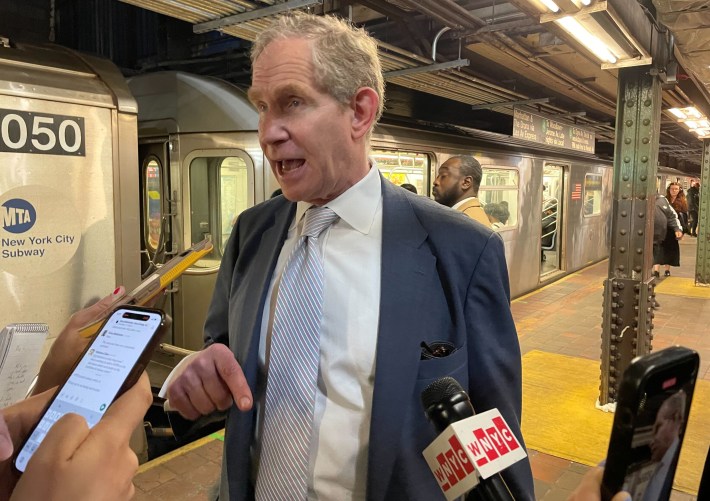
From MTA CEO Janno Lieber, who has expressed skepticism of free buses from an operational standpoint, worrying that it will peel riders (and fare revenues) from the subway.
And from MTA bondholders, who hold a significant portion of the MTA's debt under agreements structured around the promise of a steady stream of cash from riders, including bus riders. Eliminating the roughly $700 million generated annually by bus fares could rattle these investors who view that revenue as the guarantee they will be paid back.
MTA CEO Janno Lieber isn't so sure about free buses despite the plan's popularity.Photo: Dave Colon
The ultimate decision to eliminate fares will not rest with investors, however.
That authority lies solely with the MTA Board, the body of appointed leaders and elected officials who set the agency’s policies, budget and fare structure. If Mamdani wants to pay for the program out of the city's coffers, his team would need to present a guaranteed, long-term funding source to the board and convince its members that this new revenue is sufficient to replace the lost fares and satisfy the concerns of bondholders, said Rachael Fauss, senior policy advisor at Reinvent Albany.
That gives the MTA board final say over any city-funded plan to eliminate fares.
“There's the question of convincing the MTA board that the city revenue is enough to make it happen, right? Obviously, the city is a very important player and has some leverage politically speaking, but you also need to get the buy-in of the MTA leadership and the MTA board to then take that leap and make it free,” Fauss told Streetsblog. “The mayor can't direct the MTA to do anything here like the governor can.”
The city budget is a far more volatile funding source than the state budget. If an economic downturn hits, or if a future mayor prioritizes other agencies, a permanent line item of $700 million or more for bus fares could find itself a target for cuts.
For now, the New York City budget process, much like the state budget process, is executive-dominated — giving Mamdani significant leverage. But he would still need to sustain that funding year-over-year, get the MTA Board on board and hope his successors are willing to keep it going.
Room for compromise?
If free buses winds up a no-go and Mamdani needs an escape hatch to fulfill his calls for transit affordability, his administration could opt to expand the city's Fair Fares program.
Riders Alliance recently launched a campaign pushing the incoming mayor to expand the discounted fare program, which cuts the cost of subway rides as well as bus rides. Riders Alliance and the MTA have called on the city to raise the income threshold for Fair Fares — currently capped at 150 percent of the federal poverty level, far lower than the local cost of living.
The City Council included an expansion to New Yorkers earning less than 200 percent of the federal poverty line in its budget proposal this year, but faces resistance from Mayor Adams. The program costs the city approximately $115 million now but could increase to $157 million based on the council’s projections for expanded coverage.
On Sunday, riders took action to demand an affordability agenda that meets the moment. One that will offer free and reduced transit fare to more than 2 million New Yorkers by expanding the Fair Fares program and making our buses free for all riders. pic.twitter.com/BhN6OLq8Vl
Transit advocates view Fair Fares less as an alternative to free buses, which they also support, than another sensible addition to New York City’s arsenal of affordability tools. There are enough options available to public officials to satisfy concerns about the MTA's fiscal stability and maintain effective bus services, said Riders Alliance spokesman Danny Pearlstein.
“On the bus side, at least, there are people who will always invest to lower the fare, while hesitating to invest in the service,” Pearlstein said. “There are some people who are more concerned about subway fare enforcement, and there are other people who like the simplicity and the universality that comes with a free fare outright for everybody who uses the service. But I think that we have the ability in New York, and the resources are here, to satisfy both camps."
Before becoming Albany Bureau Chief in late 2025, Austin C. Jefferson was a state politics reporter for City & State NY, covering state government, elections and major legislative debates. His reporting has also appeared in the Daily Freeman, Chronogram Magazine and The Legislative Gazette. Having grown up in the Hudson Valley, he's always happy to argue about where Upstate New York truly begins.