Streetsblog provides high-quality journalism and analysis for free — which is something to be celebrated in an era of paywalls. Once a year, we ask for your tax-deductible donations to support our reporters and editors as they advance the movement to end car dependency in our communities.
If you already support our work, thank you! If not, can we ask for your help?This year’s fundraiser includes a special gift for our biggest supporters. Don’t miss out.
Together, we can create a more livable, walkable, bikeable, equitable and enjoyable city for all. Happy holidays from the Streetsblog team!
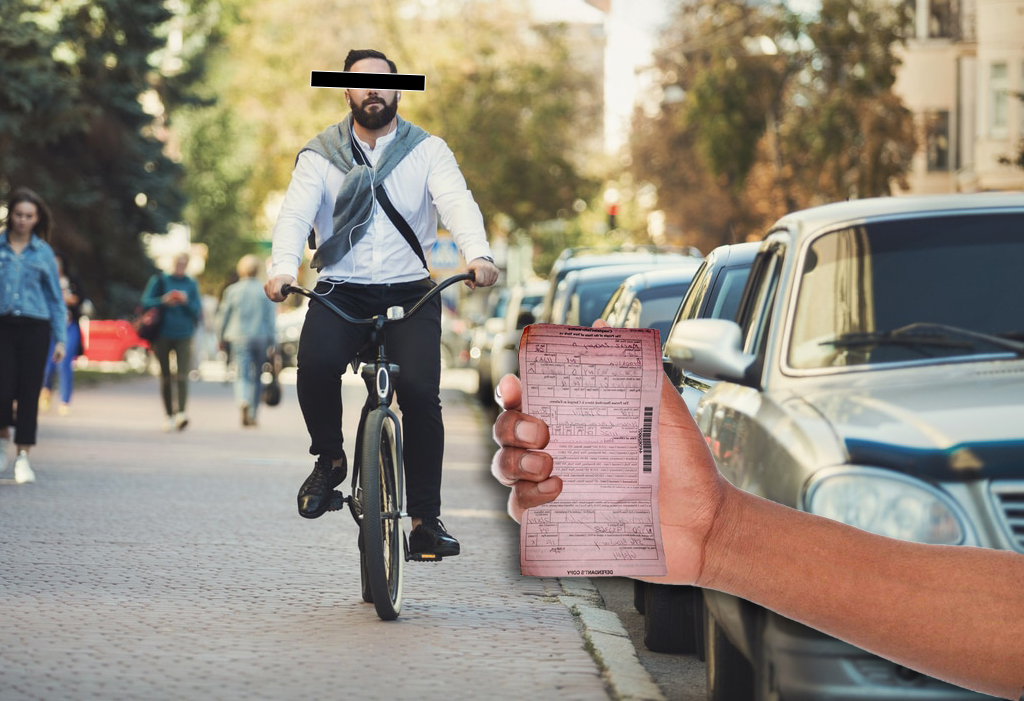
The NYPD has ramped up its enforcement against cyclists for riding on the sidewalk, but continues to do so in a haphazard and racially suspect manner, new data reveal.
In the 12 months from October 2024 to September 2025, cops wrote 5,068 summonses for “unlawful bicycle riding on sidewalk,” up nearly 69 percent from the previous 12 months.
But the racial breakdown of that crackdown suggests that the push for safer space for pedestrians is being carried out in a disproportionate way:
Black cyclists got 37.1 percent of the sidewalk-riding tickets, but Blacks comprise just 20 percent of the city population.
Hispanic cyclists got 34.4 percent of the tickets, but they comprise 28.3 percent of the population.
Meanwhile, white people, and to a lesser degree, Asian people, are getting tickets at a lower rate than their portion of the population:
White cyclists got 10.1 percent of the tickets in the most-recent period, even though white people comprise 31 percent of the population.
And Asian cyclists got 13.6 percent of the tickets even though they comprise 15.6 percent of the population.
Part of the reason for the disparity is that the NYPD seems to be enforcing the law against riding on the sidewalk almost by whim. As demonstrated by a map (below) of sidewalk tickets in the first three quarters of 2025, entire precincts, including those on the Upper East, Park Slope, Bensonhurst and Flushing, and all of Staten Island, are writing few sidewalk tickets, while enforcement seems to be an obsession of precinct commanders in the Chinatown portion of Sunset Park, a strip of Flatbush, most of Harlem, Roosevelt Avenue in Corona and East New York.
The blank zone on the Upper East Side and the crowded spot in Sunset Park are the most glaring examples (zoom in on the map to see what we are talking about):
Here’s what the tickets look like by precinct:
When asked about the data, an NYPD spokesperson, who did not provide a name, said that cops are deployed “in direct response to community complaints.”
“The NYPD has increased enforcement of illegal biking in some areas,” the spokesperson continued. “Officers are deployed to areas where those complaints are received most and where violations are observed. … NYPD officers carry out their work without consideration of race or ethnicity, and enforcement is conducted impartially.”
The claim of racial bias is difficult to prove. But the other claim — that NYPD officers respond to where there are the most complaints — is easily debunked. Here’s how:
Of the 250-odd 311 complaints that get sent to the NYPD, there is only one that relates to biking on the sidewalk: “Bike/Roller/Skate Chronic” with a location type, “Street/Sidewalk.”
In the first three-quarters of 2025, there were only 1,118 such complaints, according to New York’s open data portal for 311 service requests. As you can see from a map of the locations of those calls, they don’t match up with the places where NYPD is writing tickets for the infraction:
For instance, the NYPD received 120 complaints of sidewalk riding in the southernmost part of Staten Island, yet wrote no tickets there. And in Community Board 8 in Eastern Queens, the agency received 42 complaints of sidewalk riding and, again, wrote no tickets. And in the Community Board that covers Canarsie, the public made all of nine complaints — yet the NYPD precinct in that area wrote 369 tickets.
The context
The increase in ticket writing over the 12-month period overlaps with NYPD Commissioner Jessica Tisch’s decision, in March, to ramp up criminal summonses against bicyclists. Though it is unclear why the racial breakdown is so disproportionate in the riding-on-the-sidewalk tickets (which are not criminal summonses).
That said, criminal riding on the sidewalk summonses have an even more dramatic racial disparity — with white people getting just 5.8 percent of the those criminal summonses.
Some of that can be explained by the fact that many bike riders receiving criminal summonses in Tisch’s crackdown are delivery workers, and a large percentage of those riders are Blacks, Latinos and Asians.
The NYPD’s apparently disproportionate enforcement of traffic infractions is an ongoing concern. According to new statistics posted in one convenient place by data scientist Jehiah Czebotar, it is easy to draw the conclusion that NYPD officers are more likely to write tickets to Blacks and Latinos. For example:
Blacks and Latinos received 95.4 of the tickets for consumption of alcohol inside a vehicle, though they comprise less than half the population of the city.
Blacks and Latinos received 90 percent of the tickets for driving an unregistered vehicle, though, as just mentioned, they comprise less than half the population of the city.
Blacks and Latinos received almost 83 percent of the tickets for reckless driving, though, as we might have mentioned, they comprise less than half the population of the city.
Blacks and Latinos received 80 percent of tickets for idling, though they comprise, as we might have just said, less than half the population of the city.
Tabloid legend Gersh Kuntzman has been with New York newspapers since 1989, including stints at the New York Daily News, the Post, the Brooklyn Paper and even a cup of coffee with the Times. He's also the writer and producer of "Murder at the Food Coop," which was a hit at the NYC Fringe Festival in 2016, and “SUV: The Musical” in 2007. He also writes the Cycle of Rage column, which is archived here.
Streetsblog has migrated to a new comment system. New commenters can register directly in the comments section of any article. Returning commenters: your previous comments and display name have been preserved, but you'll need to reclaim your account by clicking "Forgot your password?" on the sign-in form, entering your email, and following the verification link to set a new password — this is required because passwords could not be carried over during the migration. For questions, contact tips@streetsblog.org.
Cars returned to Freedom Drive on Oct. 7 without any warning — several weeks before the city’s official schedule, which bans car from the corridor through October.