Gridlock Sam: Trucks Aren’t Rerouting into the Bronx or Staten Island to Avoid Congestion Pricing
Second verse, same as the first.
Truck drivers aren’t flooding the South Bronx or Staten Island to avoid paying for congestion pricing — just like general traffic hasn’t been rerouted around Manhattan — according to a new report from a prominent traffic analyst.
“Gridlock” Sam Schwartz, who was the city’s Traffic Commissioner in the 1980s, examined the first two months of truck traffic in 2025 to see what truck drivers did in response to the toll, and found that truck traffic did not increase on the Verrazzano Bridge or any of the MTA’s bridges leading to the Bronx.
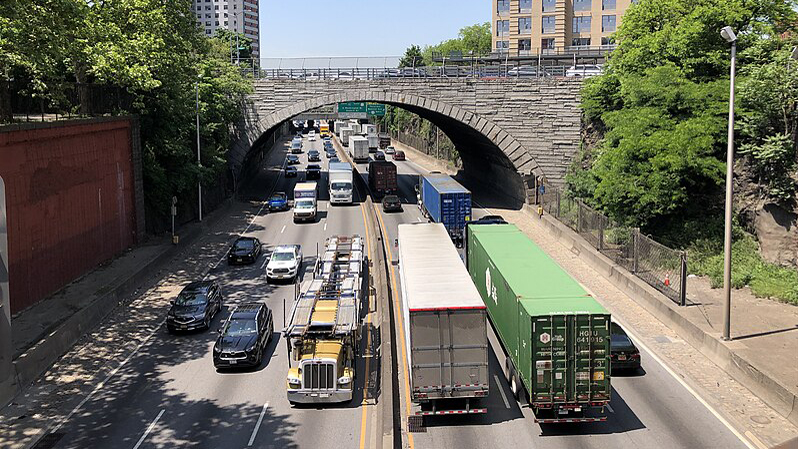
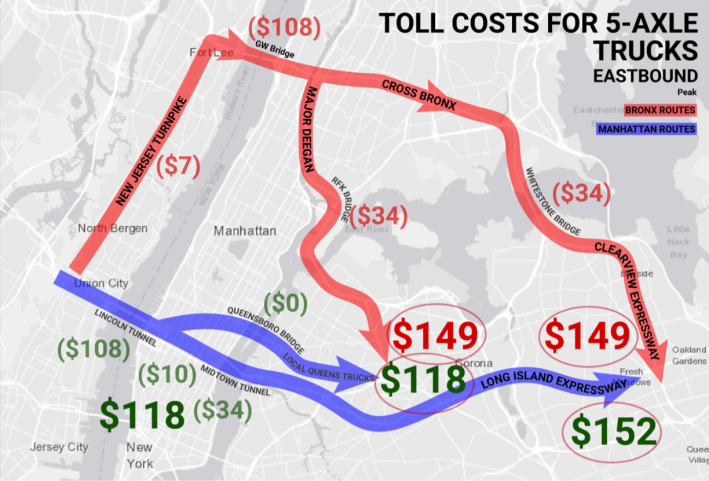
The MTA’s environmental assessment for congestion pricing predicted that truckers trying to avoid the toll would do so via either the George Washington Bridge to the Cross Bronx Expressway or the Verrazzano Bridge through Staten Island. To that end, the MTA planned $330 million worth of pollution mitigations to get the program approved by the Biden administration.
So far though, the predicted spillover simply hasn’t happened.
“So far, there’s no evidence that the forecasts that the MTA had for hundreds or even thousands of trucks diverting through the Bronx [have] happened,” said Schwartz. “Those would have been picked up at the MTA’s Bronx-Queens crossings, and there’s no evidence that there are more trucks at those crossings.”
Per the numbers crunched by Schwartz and his Hunter College student-researchers, daily truck traffic was basically flat on the Bronx-Whitestone and Throgs Neck bridges year-over-year from the beginning of January to the end of February. There were 4,057 trucks per day on the bridges last year, compared to 4,013 this year. There was also no traffic increase during the same period on the Triborough Bridge, with traffic daily truck traffic actually dropping from 2,045 per day in 2024 to 1,973 per day in 2025.
On the Verrazzano Bridge, there was an increase from 2,596 trucks in 2024 to 2,644 trucks per day on weekdays, which Schwartz said was a negligible increase and in line with the nationwide trends of increased vehicle miles traveled since the end of pandemic shutdowns. The Verrazzano even saw a 5 percent drop in weekend truck traffic, Schwartz said.
At the same time, the Queens-Midtown and Brooklyn Battery tunnels saw significant drops in truck traffic, with daily weekday truck counts falling 14 percent from 904 to 781. Weekend truck traffic dropped 11 percent from 324 trucks per day to 281.
Some truck drivers may have rerouted to the Manhattan, Williamsburg or Queensboro bridges since those bridges don’t have an additional toll the way the MTA tunnels do, and are therefore cheaper to drive across, Schwartz theorized. But some trucking companies may have figured out that it’s more economical to consolidate freight loads and make fewer trips, he said.
“It’s too early to tell, but I think some truckers may have figured out, ‘Why send a half-load if we’re going to be charged to cross the Manhattan or the Queensboro bridge? So let’s consolidate,'” said Schwartz, a longtime congestion pricing proponent.
The fact that extra truck traffic hasn’t materialized so far in the Bronx or Staten Island the way that the MTA predicted it did may simply come down to inherent flaws in the models the authority used to make those predictions.
In the same way that a bridge is tested to withstand weights that are far above a realistic trip across it, the MTA’s traffic models looked at worst-case scenarios for how people might respond to a toll in lower Manhattan, Schwartz said.
“Why they would go around if the most convenient route to go through midtown Manhattan and midtown Manhattan got faster?” Schwartz said.
“What would be the incentive for them to go further north, incur miles traveled, and in the case of the larger trucks, a $7 fee on the New Jersey Turnpike, go to the George Washington Bridge, which is the same price as the Lincoln Tunnel, fight their way through the Cross-Bronx, which is torturous, and then go over another bridge with a toll when they also had a free way of going out via the Queensboro Bridge?”

Read More:
Streetsblog has migrated to a new comment system. New commenters can register directly in the comments section of any article. Returning commenters: your previous comments and display name have been preserved, but you'll need to reclaim your account by clicking "Forgot your password?" on the sign-in form, entering your email, and following the verification link to set a new password — this is required because passwords could not be carried over during the migration. For questions, contact tips@streetsblog.org.