OPINION: State Must Subsidize E-Bike Purchases
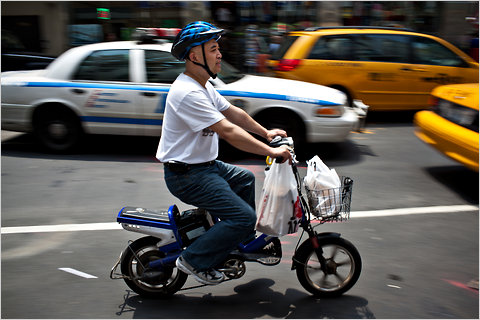

Since the pandemic broke out in March, we’ve witnessed a nationwide surge in bike sales as old patterns of transportation have been upended. New York City has experienced its own “bike boom”: at a City Council hearing in New York City earlier this month, DOT Commissioner Polly Trottenberg testified that weekend bike ridership is up 57 percent over last year and weekday ridership up 26% (remarkable given that only 10 percent of workers were commuting to the office as of last month). Alongside traditional bicycles, e-bikes — bicycles with integrated electric motors — have also increased in popularity, with reported year-over-year sales doubling.
Transportation in New York State accounts for 36 percent of our greenhouse gas emissions. If we are going to meet the goals enshrined in the landmark climate bill passed by our state legislature last year (which commits the state to an 85 percent reduction in greenhouse gas emissions by 2050), we need to expand the scope of our efforts to shift New Yorkers away from fossil-fuel powered vehicles.
To build on the momentum of the bike boom and work toward our climate goals, Assembly Member Robert Carroll, co-author of this op-ed, introduced, A10974, which would expand New York State’s existing electric car rebate program, Drive Clean, to cover e-bikes. The current Drive Clean program offers a direct, point-of-sale rebate of up to $2,000 to buyers of electric cars. A10974 would allow the state to offer a similar rebate for the purchase of e-bikes, covering 50 percent of the purchase price with a maximum rebate amount of $1,100.
By offering a rebate, we can remake the existing electric subsidy program into a more progressive version of itself, bringing into the fold an even more affordable and sustainable form of transportation with additional benefits.
A sustainable and more inclusive transportation alternative
Around the world, cities are looking to bicycles, e-bikes, and investments in biking infrastructure to get residents and workers back on the move – and to ensure that when we emerge from this pandemic, it won’t be to traffic-clogged streets.
Research has shown that e-bikes can be extremely effective in replacing trips traditionally made by car. Studies from Europe, where e-bike subsidies are more common and adoption rates higher, have shown that 35-50 percent of e-bike trips replace car trips.
Closer to home, according to the most recent National Household Travel Survey, 76.8 percent of car trips in the U.S. are 10 miles or shorter, putting these trips squarely within the range of an e-bike. In fact, in a survey of e-bike owners in North America, the average distance of respondents’ last three trips was 9.3 miles, and nearly 65 percent of respondents stated that replacing car trips was a main reason for buying an e-bike.
Owners of e-bikes report being able to ride further, more often, and with greater ease, and to carry more cargo than owners of traditional bikes. As a result, they quickly become the primary mode of transit for utilitarian trips, like commutes and errands. With their comparative ease of use, e-bikes represent an opportunity for segments of the population affected by barriers to traditional bike riding, notably those with physical limitations. E-bikes also provide extended mobility for those who do not or cannot drive cars, or who live in areas that are not yet well served by public transportation.
Bring rebates within the reach of more New Yorkers
The majority of New York City residents don’t own a car, and therefore cannot benefit from the current rebate program. New Yorkers who are in the market for a new vehicle will discover that the average base price of one of the 40 electric car models eligible under the Drive Clean program is $51,984. Even after taking advantage of federal and state rebates, this leaves electric cars, many marketed by manufacturers as luxury models, outside the reach of most New Yorkers.
In contrast, some of the most popular e-bikes range from $1,100 to $8,000 in price — a fraction of the cost of an electric car. Still, according to a policy brief published by the UC Davis Institute of Transportation, “e-bike costs are one of the strongest barriers to adoption.” Our rebate will make e-bikes much more affordable for those who need them. And, because the New York State Energy Research and Development Authority program is already funded, it won’t require any new budget to provide an immediate impact.
An e-bike rebate is a logical expansion of the Drive Clean program. We find ourselves at an inflection point, coming on the heels of the legalization of e-bikes this past year and the decarbonization mandate of the state climate bill passed in 2019. As our underfunded public transportation systems strain under the stress of operating during a pandemic, some New Yorkers line up in front of their local bike shop, while others file into neighboring car dealerships. With this bill, New York can choose to incentivize the adoption of a broader set of low-carbon mobility options over the fossil-fuel powered status quo.
There is much more to be done to address the non-financial barriers to biking, from over-policing to lack of infrastructure. This is just one of many steps towards a cleaner, more accessible transportation system — and we should take it.
Robert Carroll (on Twitter: @bobby4brooklyn) represents the 44th Assembly District in the state Assembly. Michael Francoeur (@mjfrancoeur) is a member of the Ecosocialist Working Group of NYC-Democratic Socialists of America and resident of Lower Manhattan.

Read More:
Streetsblog has migrated to a new comment system. New commenters can register directly in the comments section of any article. Returning commenters: your previous comments and display name have been preserved, but you'll need to reclaim your account by clicking "Forgot your password?" on the sign-in form, entering your email, and following the verification link to set a new password — this is required because passwords could not be carried over during the migration. For questions, contact tips@streetsblog.org.