Op-Ed: Jewel Avenue is the New Boulevard of Death

Jewel Avenue — a critical link between Eastern and Western Queens — is such a deadly corridor that the city should redesign it immediately.
Running three miles from Queens Boulevard and Yellowstone Boulevard in Forest Hills to the Utopia section of Fresh Meadows, this tarnished Jewel carries thousands of users each day, including motorists, bus riders, cyclists and pedestrians — and it’s dangerous for all of them.
In the last two years, three pedestrians have been mowed down on a one-mile stretch in Kew Gardens Hills; a motorist was also killed in a three-car crash nearby.
These four deaths are the result of poor roadway design, including:
- a too-wide road that encourages speeding;
- unmarked crosswalks at T-intersections used by pedestrians;
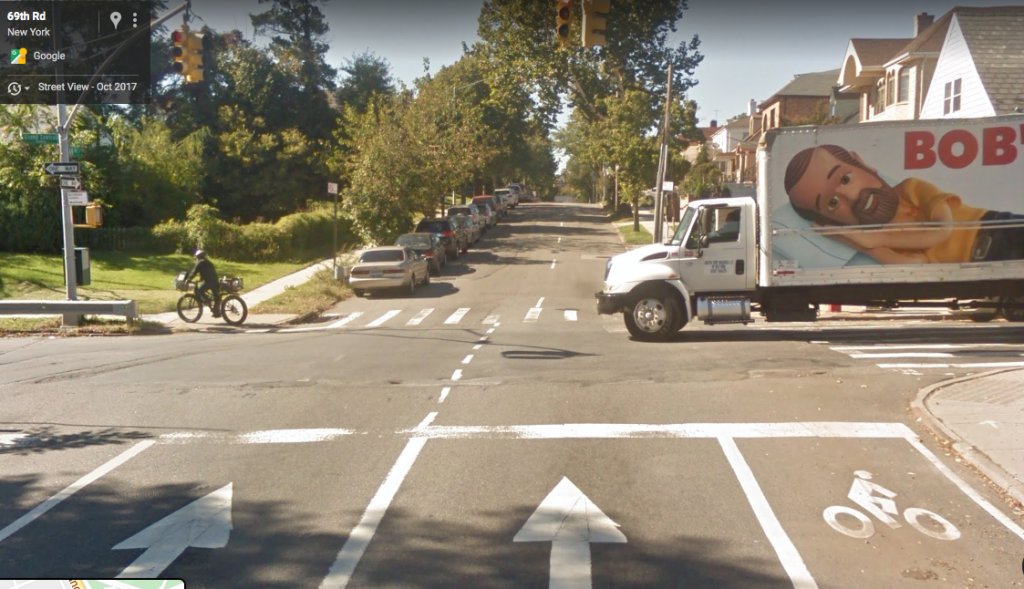
- standing or double-parked cars that frequently impinge on the bike lane (for example, see this picture), and
- significant gaps in the bike-lane network.
For most of its length, Jewel Avenue runs through low-density, single-family tracts and two-story garden apartment complexes, so you wouldn’t think it would generate many crashes. Yet, according to city data, since October 2014, this one road has seen 743 crashes killing the four people cited above and injuring 247 (158 motorists, 77 pedestrians and 12 cyclists).
After grandfather Elou Rakhminov was killed on Jewel Avenue in Kew Garden Hills in September — mere months after another motorist severely injured his wife just blocks away — Assembly Member Daniel Rosenthal and Council Member Rory Lancman asked the Department of Transportation for fixes along a two-block stretch.

But the entire avenue needs attention. Recently, I wrote to Queens Community Boards 6 and 8, which represent the neighborhoods bordering Jewel, urging them to request a corridor-wide traffic study. [Local pols, including Council Member Rory Lancman and Assembly Member Daniel Rosenthal are also concerned. See their letter linked here and embedded below.’
Pedestrian safety is already on DOT’s radar. West of the Grand Central Parkway, nearby 69th Avenue has received some attention as part of DOT’s Forest Hills Senior Focus Area. But transportation planners also should focus on cyclist safety for this key bike corridor.
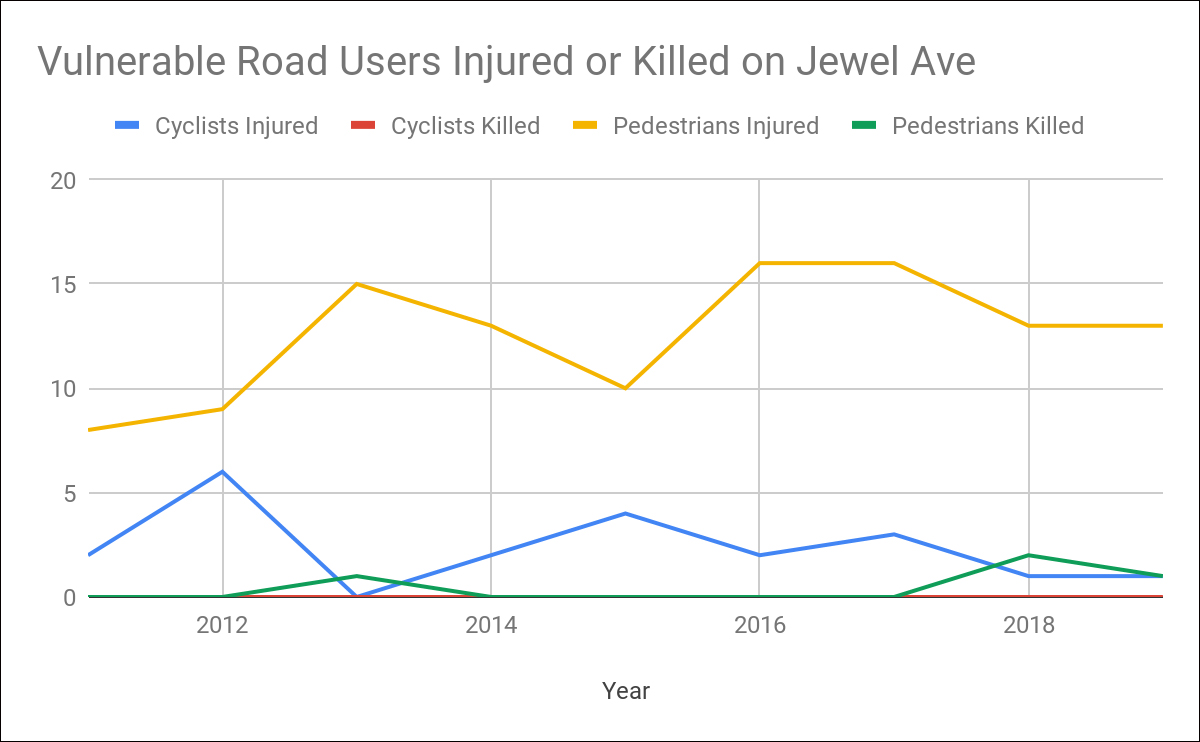
Every year, a few cyclists are injured on Jewel Avenue — mostly in areas with no bike lanes. (The Ghost Bike Project records one death, which is not represented in city data, of an unnamed cyclist killed in 2014.) The area sees heavy cycling traffic because of its proximity to Flushing Meadows Corona Park — but the bike network in the neighborhood is disconnected and spotty.
The bike lane on 69th Road (which pairs with Jewel — both act as a parallel conduits to the Grand Central Parkway) disappears as you cross the Grand Central Parkway Service Road westbound going uphill, leaving a five-block gap that endangers riders. But cyclists will keep riding there: So few streets cross Flushing Meadows Corona Park that to avoid cycling down Jewel, they would have to go almost two miles out of their way to cross the park elsewhere.
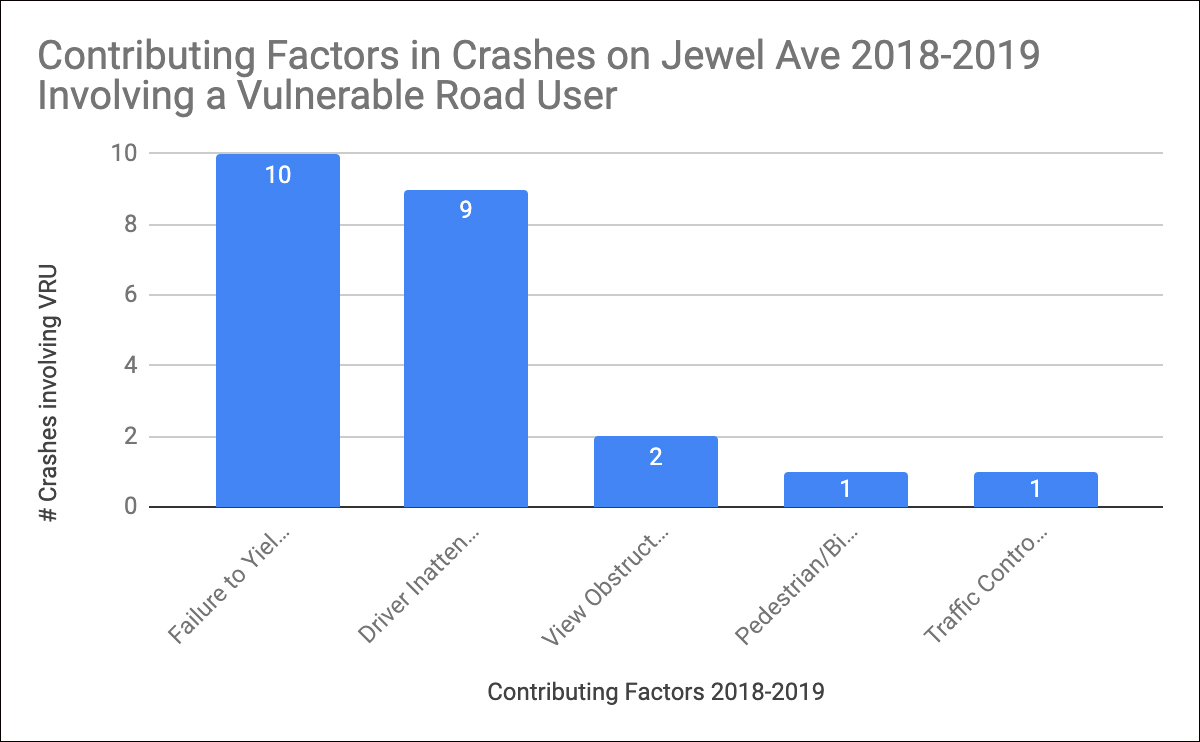
The data for crashes that resulted in pedestrian or cyclist injury or death for the past 21 months (see chart above) clearly show that the leading causes were failure-to-yield, driver inattention, and obstructed views. Thus, the leading cause of crashes involving pedestrians or cyclists is driver behavior — which street calming can help reduce.
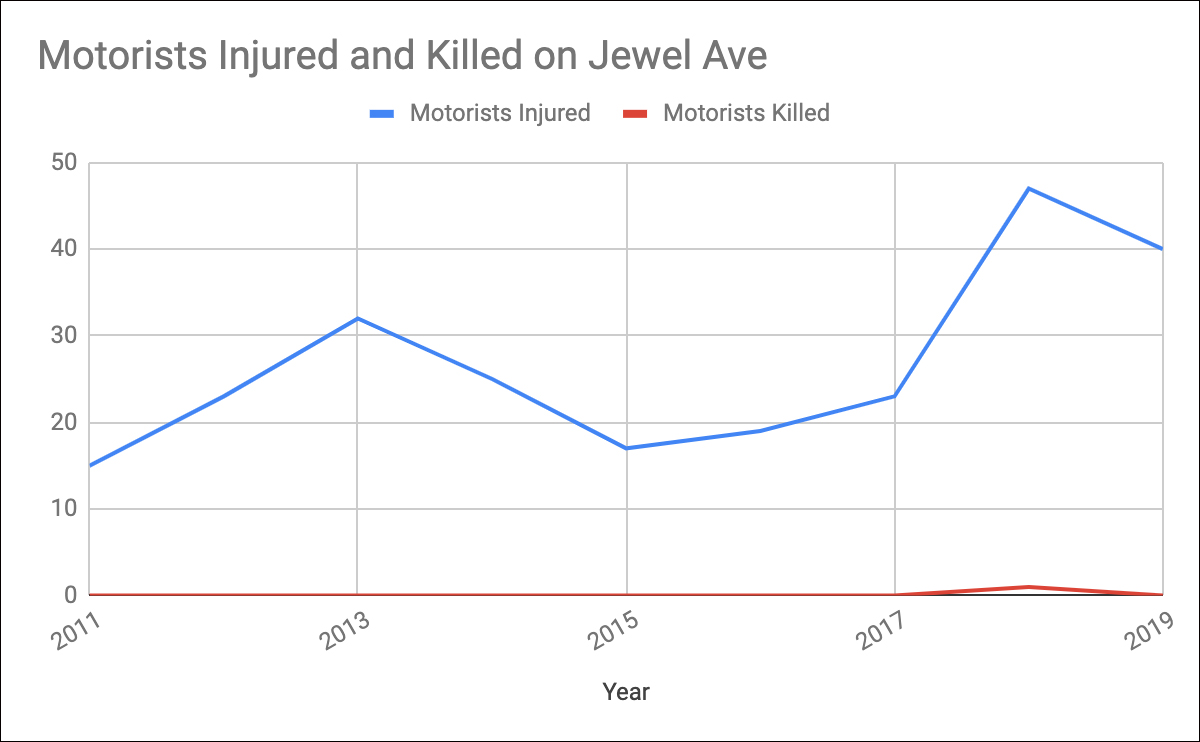
Meanwhile, Jewel Avenue isn’t safe for motorists, either. As the chart above shows, motorist injuries on Jewel Avenue declined from 2013 to 2015 but have trended upward since.
Jewel Avenue long has had a deadly reputation.
In 2006, a driver turning right from Jewel Avenue onto 164th Street struck and killed 63-year-old teacher Roni Futoran in front of PS 200, prompting DOT to do a road diet from Main Street to 164th Street.
The revamp extended the (narrow) Jewel Avenue bike lane and created a buffered lane from Kissena Boulevard to 164th Street. A painted bike lane also was installed for 164th Street from Oak Avenue in Flushing to 84th Road in Jamaica Hills. Those Bloomberg-era changes — enacted over community opposition — improved the street, but more is needed.
The carnage on Jewel Avenue may stem from diffuse authority — the road traverses two Council districts as well as Community Boards 6 and 8. The boards, Council Member Karen Koslowitz, Lancman, and other electeds, should unite to make Jewel Avenue safe now.
How many more pedestrians and cyclists must be killed or injured before the city installs life-saving safety measures?
Joby Jacob (@Joby_Jacob) volunteers for Transportation Alternatives Eastern Queens Committee and founded Motor Parkway East.
Fixing Jewel Ave. Crosswalks by Gersh Kuntzman on Scribd

Read More:

Streetsblog has migrated to a new comment system. New commenters can register directly in the comments section of any article. Returning commenters: your previous comments and display name have been preserved, but you'll need to reclaim your account by clicking "Forgot your password?" on the sign-in form, entering your email, and following the verification link to set a new password — this is required because passwords could not be carried over during the migration. For questions, contact tips@streetsblog.org.