San Antonio Gets a Badly Needed Kick in the Pants on Pedestrian Safety

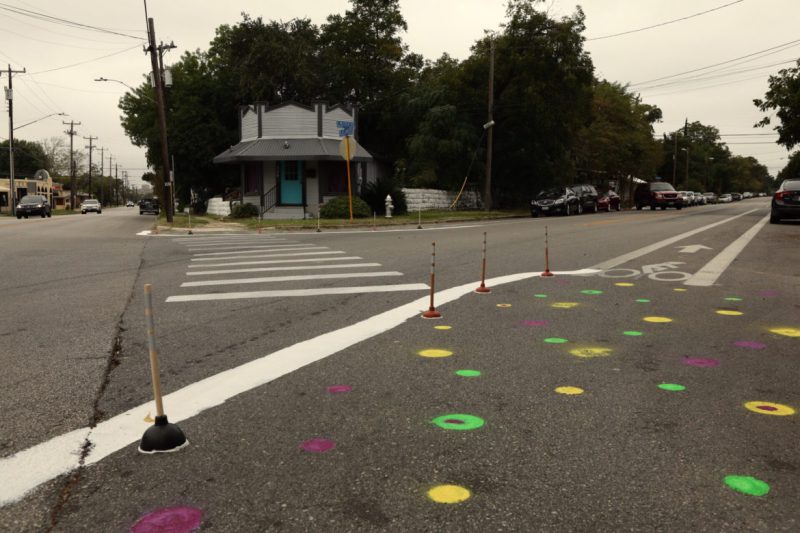
It would be easy enough to make the intersection at St. Mary’s and Mistletoe in San Antonio safer for pedestrians. That much an anonymous group calling themselves the San Antonio Department of Transformation has proven.
Without official permission, the group painted a zebra crosswalk and extended the curb, using toilet plungers and polka dot paint. It was similar to an official city project in nearby Austin, Texas, implemented last year.
In removing the demonstration, San Antonio officials acted with the kind of swiftness that they’ve never displayed in response to the city’s staggering pedestrian death rate.
Local news site the Rivard Report has been doing a bang-up job covering this story. While the city has gotten the ball rolling by passing a Vision Zero policy and devoting a big chunk of an infrastructure bond issue to street repairs, writes Robert Rivard, frustration is warranted:
City crews were quickly dispatched Friday to undo the anonymous SADOT’s public works project carried out sometime in the pre-dawn hours Friday. Deputy City Manager Peter Zanoni was quoted in the Rivard Report article as saying those responsible, if caught, could face criminal charges and fines.
What he didn’t say is that such urban rear guard actions should be no surprise in San Antonio. Elected leaders aspire to become a Vision Zero city, yet 65 pedestrians were killed on San Antonio streets in 2016, an increase over the 54 people on foot killed in 2015. It’s been more than two years since the City Council under former Mayor Ivy Taylor adopted the initiative, first championed by Councilwoman Shirley Gonzales (D5) and her husband Kevin Barton, both avid cyclists.
Pedestrians and cyclists are frustrated by the slow pace of change. It’s been nearly two years since urban activists struck with a similar stunt on Broadway at the entrance to the Pearl, yet nothing has been done to make the pedestrian-dense stretch of roadway north of Jones Avenue and south of Grayson Street more safe for people on foot. Broadway will become a Complete Street in the 2017 Bond, but that $56 million ($42 million in City funds) project will take years to carry out. An inexpensive, interim solution seemed logical, yet never happened.
What was lost in Friday’s response by City officials, who stressed the cost and inconvenience of undoing the unauthorized overnight street improvement project, is that San Antonio remains an unacceptably dangerous city for pedestrians, City Council action notwithstanding.
More recommended reading today: Plan Charlotte writes about the nearly-car-free suburb of Vauban, Germany, where children roam freely. And ATL Urbanist talks about the struggles of the Atlanta Streetcar in the context of the sea of parking that surrounds it.

Read More:
Streetsblog has migrated to a new comment system. New commenters can register directly in the comments section of any article. Returning commenters: your previous comments and display name have been preserved, but you'll need to reclaim your account by clicking "Forgot your password?" on the sign-in form, entering your email, and following the verification link to set a new password — this is required because passwords could not be carried over during the migration. For questions, contact tips@streetsblog.org.