Seattle Just Canned Its Bike-Share System. What Went Wrong?

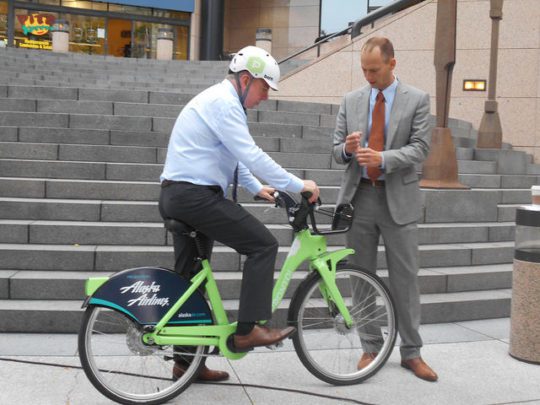
With Seattle’s three-year-old bike-share system, Pronto, struggling to attract riders and make ends meet, Mayor Ed Murray announced last Friday that he’s going to scrap it.
The city had been contemplating an expansion that would have roughly doubled the size of the system and added e-bikes supplied by Bewegen, a supplier with major question marks (it’s the descendant of Montreal-based Bixi, which went bankrupt in 2014). But Murray shifted course and will wind down the system, redirecting the $5 million in expansion funds to Safe Routes to School projects and other investments in safe walking and biking, reports Zach Shaner at Seattle Transit Blog.
Local bike advocates applauded the funding for safes streets, but scrapping Pronto has Tom Fucoloro at Seattle Bike Blog wondering if “the well may be poisoned for bike share” in the city.
If Seattle is going to give bike-share another try, it will have to learn from this experience. The Pronto system started off small and never scaled up. The network had about 50 stations, and they were spaced too far apart and in non-contiguous areas, limiting the trips people could make.
And as Shaner noted last year at Seattle Transit Blog, the city’s mandatory helmet law was clearly a hindrance:
Though controversial within the cycling community and a guarantee of a comment flame war, there is simply no doubting the empirical reality that our rare all-ages helmet law adds a barrier to ridership and drags down performance. Seattle may have its dangers, but if Manhattan can be safe for millions without a helmet law, so can Seattle.
Again, if we value mandatory helmets over spontaneous ridership, that is a value choice we are free to make, but then we similarly must reduce our ridership expectations.
The good news is that Murray will be accelerating the city’s investment in bike infrastructure. If he uses that $5 million to fill gaps in Seattle’s bike network, people on bikes will be safer and the city will be in a better position when it takes another stab at bike-share.
More recommended reading today: City Observatory and Bike Pittsburgh remember Martin Luther King’s unfinished legacy fighting for justice in transportation. And the Frontier Group points out that even as the gas tax has produced smaller and smaller returns for transportation, federal officials have been spending ever more money on highways — crowding out funding for other national priorities.

Read More:
Streetsblog has migrated to a new comment system. New commenters can register directly in the comments section of any article. Returning commenters: your previous comments and display name have been preserved, but you'll need to reclaim your account by clicking "Forgot your password?" on the sign-in form, entering your email, and following the verification link to set a new password — this is required because passwords could not be carried over during the migration. For questions, contact tips@streetsblog.org.