Signs That the Car-Share Industry Is Losing Steam

Back in 2013, when Avis purchased Zipcar, car-share seemed like the wave of the future.
But is the industry already peaking? David Levinson, a transportation engineering professor who has been bullish about car-sharing in the past, notes at Transportist that Car2Go is pulling out of Minneapolis. Is this a sign of wider problems with the car-share business model or an isolated event due to unique circumstances? He says the situation is still murky:
The company complains about taxing, and I am sure that is also an element. Clearly carsharing should not be taxed a the same rate as rental cars, which are aimed to extract money from out-of-towners (taxing foreigners living abroad) who don’t vote locally, this is a case of public policy not catching up with changing technology.
There is also the rise of ridehailing apps like Uber and Lyft, which are only slightly more expensive and loads more convenient than carsharing for many trips. That they are only slightly more expensive is due to tremendous Venture Capital subsidies, which are great to exploit as customers, while they last. This also did not help carsharing.
Now this might be a particular case of a particular city, Car2Go is expanding in some places globally, but Car2Go has also withdrawn from several other US cities (e.g.
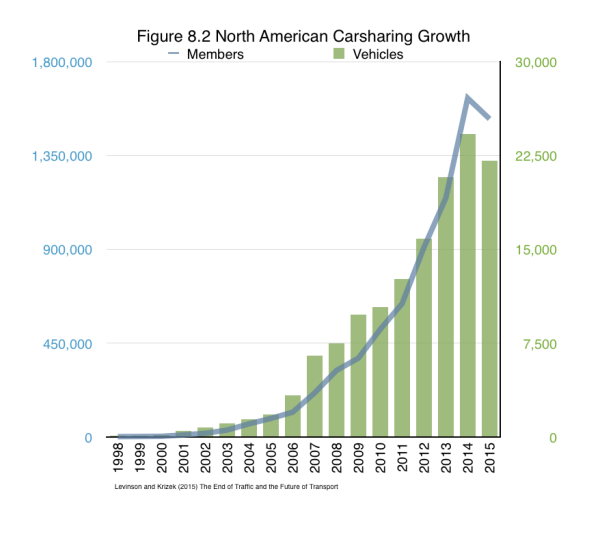
Arlington,San Diego, Miami) and elsewhere (London, Birmingham, e.g.), so that is a fact. Susan Shaheen and Adam Cohen reported that North American carsharing membership appeared to have peaked 2 years ago. What the future holds awaits.The future of urban transport is complex. That we are moving towards automation and electrification is a pretty solid bet, with some hedging on the timeline perhaps. Whether, when, and where fleet ownership/sharing/renting replaces individual ownership is less so. Certainly Manhattan is the kind of place this will be common, as taxis are already very important. Existing customers can easily shift, as doing old things better is the first step in a new technology. But most of the US is not taxi-reliant now, so is not a mere conversion but a major behavior shift. Doing new things is the second step. While many people certainly believe this will occur, just look at Uber’s optimistic valuation, this is a company that has yet to realize a profit, so it is built on many “ifs”.
Elsewhere on the Network today: Greater Greater Washington puts concerns that D.C. may become “too dense” to rest. BikeWalkKC says the first thing the region needs to do before going forward with an $800 million transportation bond is develop a citywide transportation policy. And Bike Portland reports that the city is adding another 5.6 miles of buffered bike lanes to its network.

Read More:
Streetsblog has migrated to a new comment system. New commenters can register directly in the comments section of any article. Returning commenters: your previous comments and display name have been preserved, but you'll need to reclaim your account by clicking "Forgot your password?" on the sign-in form, entering your email, and following the verification link to set a new password — this is required because passwords could not be carried over during the migration. For questions, contact tips@streetsblog.org.