“Pocket” Bike Lanes: A Small Step to Make Intersections Work Better?


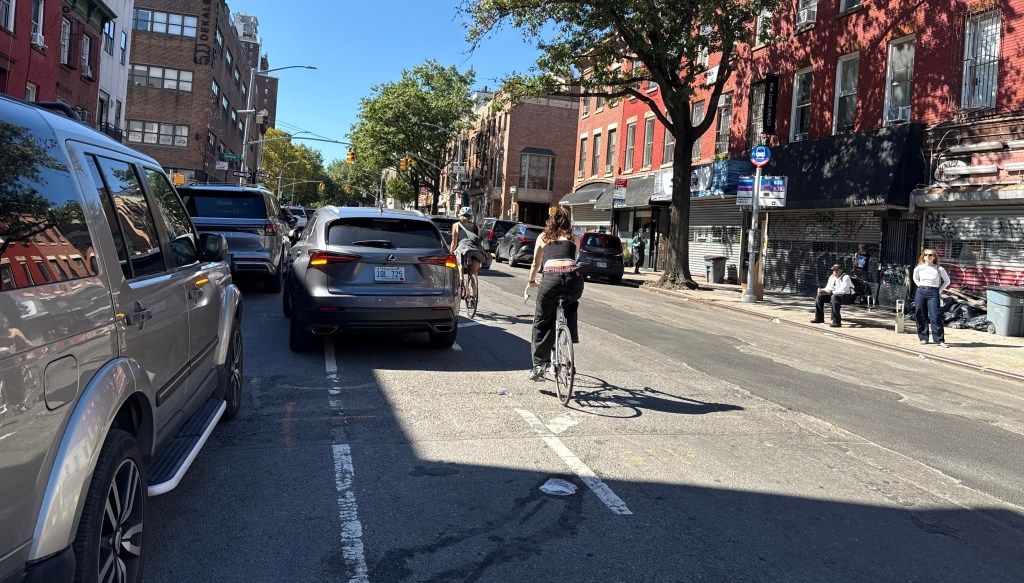
A bike lane that appears at an intersection to help guide bicyclists out of the way of turning drivers — in Washington, D.C., they call this a “pocket lane.” David Cranor writes at Greater Greater Washington that the District is looking to add them along streets that don’t otherwise have bike lanes, targeting intersections where they might help avoid conflicts. He says:
The District Department of Transportation recently installed “pocket lanes” on southbound 2nd Street NE at Massachusetts Avenue and at Hawaii Avenue and Taylor Street NE. A type of through bike lane that’s less than a block long and doesn’t continue on the other side of the intersection, they sit between the lane for going straight or turning left and the right turn lane.
Pocket lanes have several uses, and they make intersections more efficient for everyone. For starters, they keep people on bikes who are heading straight through an intersection from having to wait behind a queue of left-turning vehicles, whose drivers are in turn waiting for a break in oncoming traffic. They also keep drivers from having to wait in line behind a cyclist who’s traveling straight.
Another benefit is that they give people on bikes their own space that’s to the left of right-turning traffic, which prevents a situation known as the “right hook.” The “right hook” occurs when a driver who’s turning right hits a cyclist riding on the right hand side of traffic and going straight.
Have you seen “pocket lanes” in your city? On streets without bike lanes, would a “pocket lane” be a low-cost way to help guide drivers and cyclists through intersections? Would you appreciate more of them in your city or not?
Elsewhere on the Network today: Mobility Lab explains how Portland’s TriMet transit agency helped pioneer the open data system that has spurred a wave of private innovation in transit apps, with major benefits for riders. The Urbanist explains the many ways roundabouts are superior to ordinary intersections. And Market Urbanism says that intercity buses, long undermined by government policies aimed at protecting public investments in rail, are making a comeback in Europe, with some potential benefits for consumers.

Read More:
Streetsblog has migrated to a new comment system. New commenters can register directly in the comments section of any article. Returning commenters: your previous comments and display name have been preserved, but you'll need to reclaim your account by clicking "Forgot your password?" on the sign-in form, entering your email, and following the verification link to set a new password — this is required because passwords could not be carried over during the migration. For questions, contact tips@streetsblog.org.