In the Midst of Seattle’s Transit Crisis, a Money Grab for Roads

Despite some horrendous transit cuts looming in Seattle, the Washington legislature can’t seem to get a transportation budget passed, reports Josh Feit at PubliCola.
The state’s Democrats and Republicans are struggling to reach an agreement, he says, and a recent budget proposal from two lawmakers helps explain the impasse.
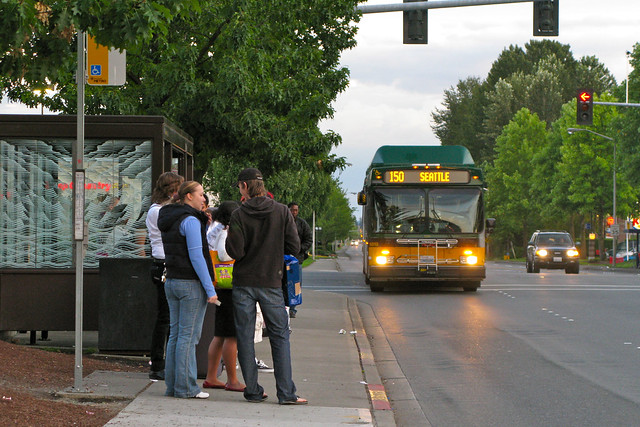
As Seattle Metro riders brace for service cuts caused by a budget shortfall, the state legislators have shifted the balance of the proposed funding fix from transit to roads:
Sens. Curtis King (R-14, Yakima) and Rodney Tom (D-48, Medina), the co-sponsors of the bill, have transposed the transit/roads split in the language that authorizes King County to raise the Motor Vehicle Excise Tax (MVET). The split used to be 60 percent for transit and 40 percent for roads, which would have put about $75 million toward bus service and $50 million toward county roads.
Reversing the split, and earmarking $50 million for transit instead, would fail to offset King County Metro’s funding shortfall; Metro needs about $63 million to maintain its current level service.
Isn’t it weird that Sen. Tom, who lives in King County, would scale back Metro bus money?
Feit reports that local King County electeds have come up with a contingency plan to counter the statehouse dysfunction:
Of course, since the Metro cuts will kick in in September—and since the legislature has been unable to pass a transportation package—King County has already decided to go it alone.
King County Executive Dow Constantine and the County Council (unanimously) placed a $60 Vehicle License Fee plus a 0.1 percent sales tax increase (to raise the same amount of money as the MVET would have) on a special April 22 ballot. Constantine and the Council went with a 60/40 transit/roads split to prevent a potential 17 percent cut to bus service. The sales tax and the VLF (as opposed to the MVET, which is based on the value of your car) are both regressive, but without state legislative action over the last year and half, they were the only options the county had.
Elsewhere on the Network today: Streets.mn shares a chart that illustrates the difficulty of predicting traffic trends. The Dirt reviews a new book by the NRDC’s resident urbanist Kaid Benfield, the upshot of which is “sustainable places are really just places people love.” And Transport Providence reports that the Boston Marathon is planning to kick out cyclists, who have held an informal midnight ride on the route the evening before the event — but not for the reason you think.

Read More:
Streetsblog has migrated to a new comment system. New commenters can register directly in the comments section of any article. Returning commenters: your previous comments and display name have been preserved, but you'll need to reclaim your account by clicking "Forgot your password?" on the sign-in form, entering your email, and following the verification link to set a new password — this is required because passwords could not be carried over during the migration. For questions, contact tips@streetsblog.org.