NYPD Has Spent $1.32M to Suppress a Monthly Bike Ride

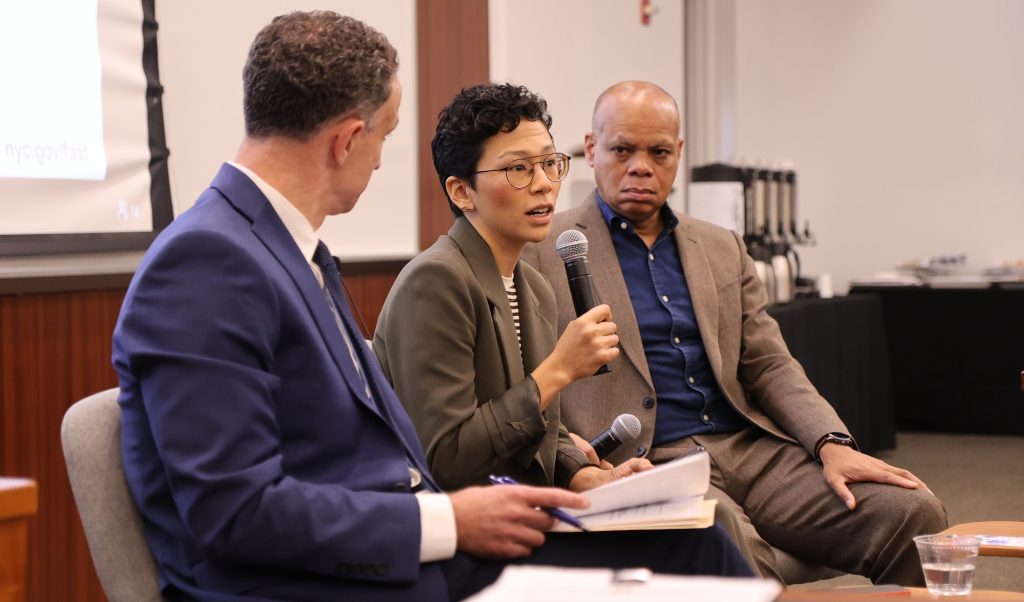
Charles Komanoff, flanked by Marquez Claxton and Norman Siegel, at City Hall this morning.
Time’s Up took its campaign for safe bicycling into the economic arena this morning with release of a report documenting the Bloomberg administration’s squandering of New Yorkers’ tax dollars in suppressing the Critical Mass bike rides.
With the City Hall steps as backdrop, the grassroots environmental group released a report I helped prepare, estimating that police and other agencies spent $1,320,000 harassing and arresting Critical Mass riders from September 2004 through August 2006.
This figure comprises:
- $1,000,000 spent by the NYPD policing the rides and processing arrestees (calculated by prorating officer’s salaries and costs of scooters, police transport vehicles, helicopters and other equipment for the hours deployed)
- $150,000 spent by the Manhattan District Attorney’s office charging arrestees and trying cases
- $170,000 spent by the NYC Law Dept. bringing and settling lawsuits against Critical Mass (the “Bray” and “Time’s Up” cases)
During the same two-year period the city spent less than $700,000 planning, engineering, and installing bike lanes in the five boroughs. Thus, over the past two years New York City spent twice as much suppressing two dozen bicycle rides as it spent creating a safe bicycling infrastructure that hundreds of thousands of New Yorkers could be using every day.
At the City Hall event, Marquez Claxton, who does public relations and political affairs for 100 Blacks in Law Enforcement Who Care, called the NYPD’s suppression of Critical Mass a “personal campaign” by Police Commissioner Ray Kelly. “When you see such illogical allocation of police resources,” Claxton said, “you have to conclude that the impetus is personal vindictiveness rather than dispassionate analysis.”
Noted civil rights attorney Norman Siegel called on NYC Comptroller William Thompson to verify the dollar estimates in the Time’s Up report. “Auditing use of tax dollars is your job as comptroller,” Siegel said. If you’re serious about running for mayor in 2009, the people of New York City will see to it that this is an issue you can’t duck.”
Another speaker, Mark Taylor of Assemble for Rights, urged New Yorkers to speak out against the NYPD’s proposed parade-permit rules at a November 27 public hearing. Letting the police write the law in addition to enforcing the law is something that happens in a police state, Taylor warned.
For more information on this issue, here is my 2004 report (PDF file) documenting the trivial traffic impacts of Critical Mass rides on New York City traffic congestion and mobility.
Photo: Fred Askew
Read More:
Streetsblog has migrated to a new comment system. New commenters can register directly in the comments section of any article. Returning commenters: your previous comments and display name have been preserved, but you'll need to reclaim your account by clicking "Forgot your password?" on the sign-in form, entering your email, and following the verification link to set a new password — this is required because passwords could not be carried over during the migration. For questions, contact tips@streetsblog.org.