‘No Better Place’: Mamdani Must Pedestrianize Financial District
Residents of Lower Manhattan have been demanding pedestrianized streets for decades, but the city and Big Business keep thwarting them. Sounds like a job for Mayor Mamdani.
Streetsblog provides high-quality journalism and analysis for free — which is something to be celebrated in an era of paywalls. Once a year, we ask for your tax-deductible donations to support our reporters and editors as they advance the movement to end car dependency in our communities.
If you already support our work, thank you! If not, can we ask for your help?This year’s fundraiser includes a special gift for our biggest supporters. Don’t miss out.
Together, we can create a more livable, walkable, bikeable, equitable and enjoyable city for all. Happy holidays from the Streetsblog team!
It’s time to put the Amsterdam back in New Amsterdam.
The incoming Mamdani administration should finally cut cars from Lower Manhattan, which is a prime candidate for the city’s first low traffic neighborhood, local advocates and transportation experts said.
Planners have floated projects to curb motor vehicles from the Financial District’s narrow roads for at least half a century, but a lack of city leadership and pushback from big businesses have stymied the dream for an area that continues to favor a minority of drivers.
“This is an opportunity for our city to show the rest of the world that we are the city of the future,” said Catherine Hughes, a board member of the civic group Financial District Neighborhood Association. “People want to experience the city with their feet, not in their car.”
The neighborhood association and other residents downtown have been pushing to at the very least turn the majority of roads into pedestrian priority streets with 5-mile-per-hour speed limits east of Broadway and south of the Brooklyn Bridge, via a proposal known as Make Way for Lower Manhattan.
The Financial District group envisions many streets being transformed into shared spaces for pedestrians, cyclists and cars — with 5-mph speed limits.
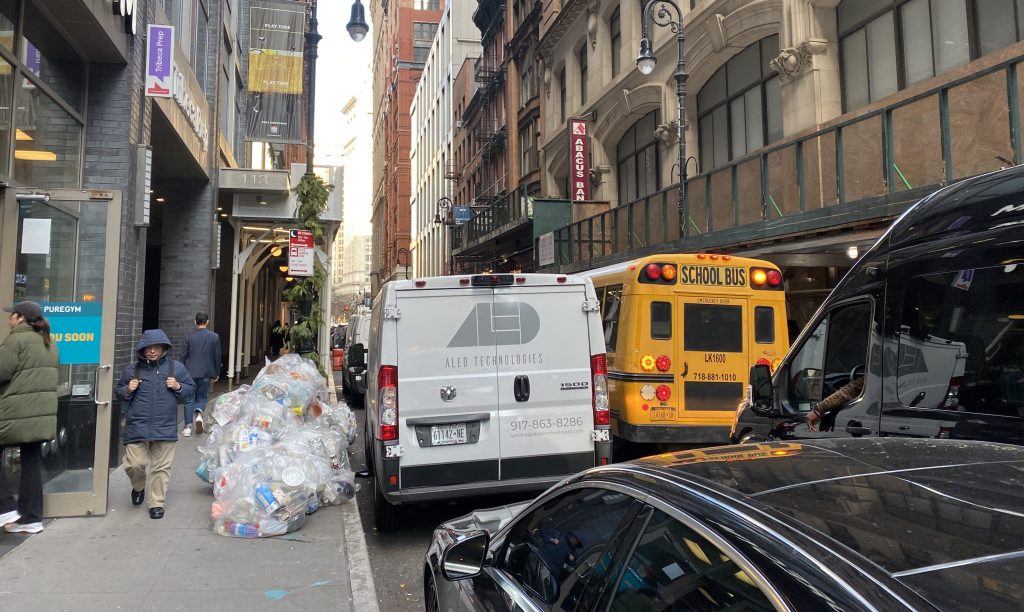
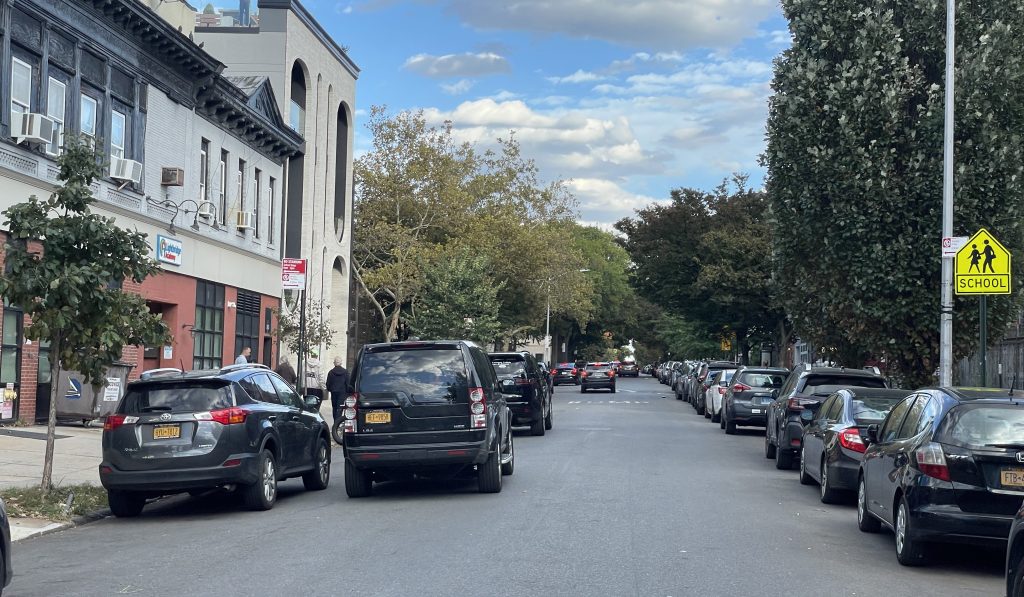
The status quo is a mess of cars funneling through and parking along the streets dating back to the 1600s.
There’s also a large share of drivers using government placard class parking all over the curb with impunity.
Almost all subway lines and the PATH trains from New Jersey converge on the neighborhood, and 78 percent of households in the City Council district don’t own a car, while 85 percent get to work on foot or on transit, according to data crunched by MIT’s Norman B. Leventhal Center for Advanced Urbanism. (And that zone includes higher-car ownership areas to the west of the pedestrianized target zone.)
Removing the barrage of private vehicles could also clear the way for waste containerization. The Department of Sanitation previously singled out the Financial District as too tight and dense for its nascent Empire Bins curbside trash pickup program.
There have been plans and small-scale pilots repurposing the streets of the crowded downtown district going back to the Lindsay administration, but few have stuck.
“There’s no better place in America to do it than FiDi,” said John Massengale, a local architect who has sketched out what a more pedestrian-friendly downtown could look like. “People famously say, ‘We’re not Amsterdam.’ It was laid out by Dutch people in the 17th century and they called it Nieuw Amsterdam.”
Transportation veterans agree that any plan will need a champion in City Hall to overcome resistance among entrenched car-first bureaucrats and businesses. They hope that will be incoming Mayor Zohran Mamdani, who previously told Streetsblog that he wanted to capitalize on traffic reductions due to congestion pricing by reclaiming that space for pedestrianization “in and around Times Square and the entire Financial District.”
“It’s clearly time to bring it back,” said Michael Replogle, who was Department of Transportation policy director for six years under Mayor Bill de Blasio and who founded the Institute for Transportation and Development Policy. “A new mayor has a real chance to break this gridlock that has seized this district of the city for the last decades.”
Foot-dragging
Recent attempts to study pedestrianizing the Financial District surfaced around 2019, when then-Council Member Margaret Chin secured $500,000 for the DOT to study a pedestrianization plan for the area.
But Chin’s goal of creating a pilot pedestrian priority area petered out due to opposition from within the DOT and from the Downtown Alliance, which represents the area’s major businesses, according to several former senior transportation officials involved in the plans who spoke to Streetsblog on the condition of anonymity. (The agency did convene a committee with stakeholders at least once, but Covid-19 derailed the plans; DOT officials have been largely mum on the half-million-dollar study since.)
The Alliance has been hesitant to embrace larger-scale restrictions on private car access, and DOT sided with the business group.
The Alliance previously put forward its own proposal in 2018 to better manage freight deliveries and “declutter” all the security gates in the area around the New York Stock Exchange at Wall and Broad streets, which have already been closed to personal vehicles since 9/11 as a security measure.
Its president Jessica Lappin has not shown particular interest in larger pedestrianization, saying in a 2022 podcast interview that the area’s windy layout was “complicated” and that residents “want to be able to access their buildings and they want to be able to get their deliveries as well.”
Recently, Chin’s successor, Council Member Chris Marte, took to social media to call on DOT to explain the four years of delays.
The lawmaker told Streetsblog that he spoke with Mamdani about the proposal and hopes to get all the parties to the table agein.
“History has shown that pedestrianization actually helps commercial activity tremendously,” Marte said in an interview.
The pol pointed to DOT’s recent redesign of Broadway north of Union Square as part of the Broadway Vision project, which has repurposed parts of the road for pedestrians and cyclists over cars.
“It’s one of the most walkable and tourist rich areas now because of that transformation, and it’s something that we could see here,” Marte said.
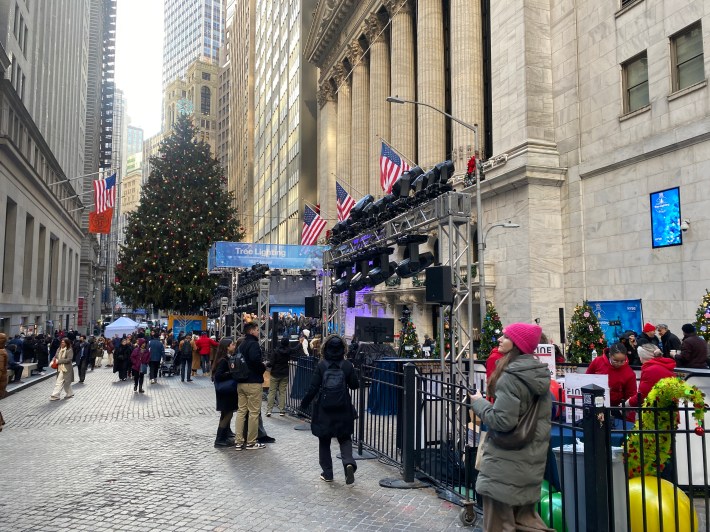
There’s also a great example already in the area already, right outside the New York Stock Exchange.
The New York Stock Exchange is already car free. Photo: Kevin Duggan
Delivery vehicles can still access gated area, which brims with foot traffic from tourists and finance types. The car-free setup has been nothing but a blessing, said an employee at the Italian restaurant Serafina, which is within the security zone.
“This is New York, we all walk,” said Cristian, who declined to give his last name or his position at the eatery. “In general for any restaurant to have foot traffic, it’s the best thing that can ever happen.”
The owner of another restaurant just outside the barricades on Ann Street wished she could have similar restrictions, rather than the onslaught of cars and construction covering most of the two-block street.
“I would love for the block to be pedestrian only,” said Linda Marini, the owner of Da Claudio. “That would be ideal, that would help our business tremendously, I would love that.”
Decades of plans
The city’s years of stalling mark just the latest case following decades of unsuccessful attempts to rein in the car chaos downtown.
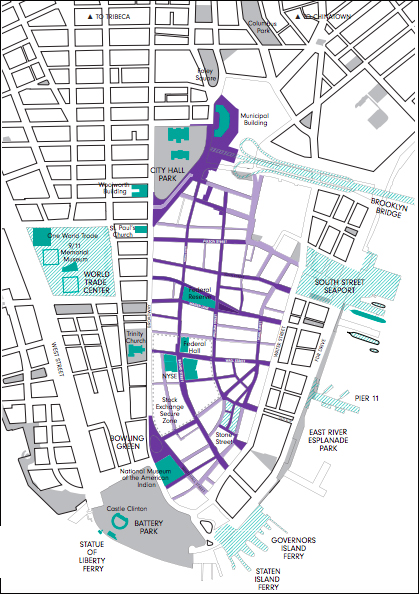
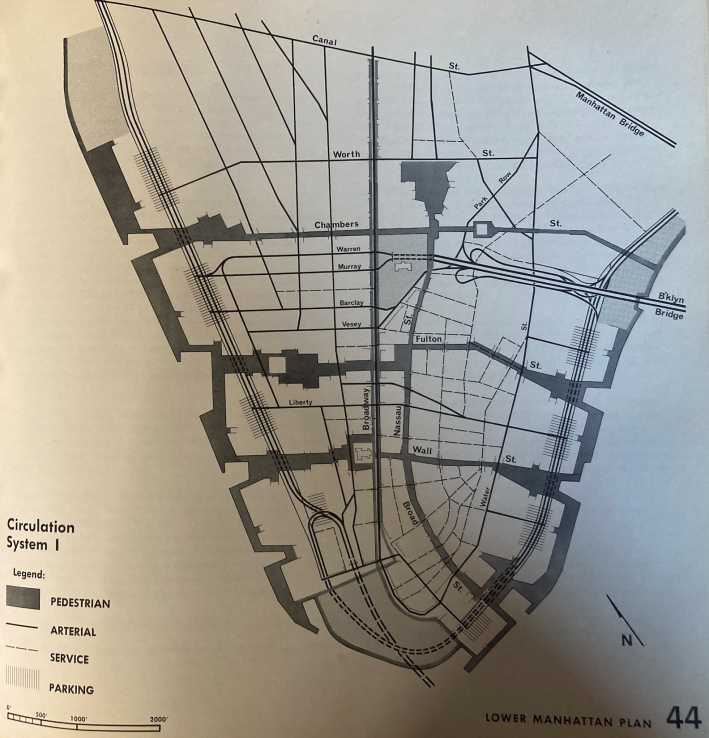
The 1966 Lower Manhattan Plan identified “pedestrian-first” streets (in dark gray) for the neighborhood. Photo of map: John West
Back in 1966, then-Mayor John Lindsay published a The Lower Manhattan Plan as part his dedicated office to spur development in the area. The proposal identified corridors for “pedestrian emphasis,” including Nassau and Broad Streets going north to south, along with the crosstown Chambers, Fulton and Wall Streets, and the entire waterfront.
Car traffic could still go on “arterials” like Broadway, Water Street, and Liberty Street.
The city did kick cars off Nassau during weekday lunch hours as a result of those plans, according to an official who worked on implementing the development plan. The program was “self enforcing,” with passers-by telling drivers to stay out, according to John West, an urban designer for the mayor’s office in the 1970s.
“People would bang on the car and say, ‘You’re not supposed to be here,'” West told Streetsblog.
The Giuliani administration studied pedestrianization in 1997. As did former Mayor Michael Bloomberg again in 2008, noting that cities saw big gains in business activities when they banished cars, such as Copenhagen, where retail sales jumped 30 percent.
Kevin Duggan joined Streetsblog in October, 2022, after covering transportation for amNY. Duggan has been reporting on New York since 2018, starting at Vince DiMiceli’s Brooklyn Paper, where he covered southern Brooklyn neighborhoods and, later, Brownstone Brooklyn. He is on Bluesky at @kevinduggan.bsky.social and his email address is kevin@streetsblog.org.
Streetsblog has migrated to a new comment system. New commenters can register directly in the comments section of any article. Returning commenters: your previous comments and display name have been preserved, but you'll need to reclaim your account by clicking "Forgot your password?" on the sign-in form, entering your email, and following the verification link to set a new password — this is required because passwords could not be carried over during the migration. For questions, contact tips@streetsblog.org.
In their latest video, the current and former NYC public school students of the Joint Transit Association have some concerns about Mayor Mamdani's plan to rebuild the BQE.