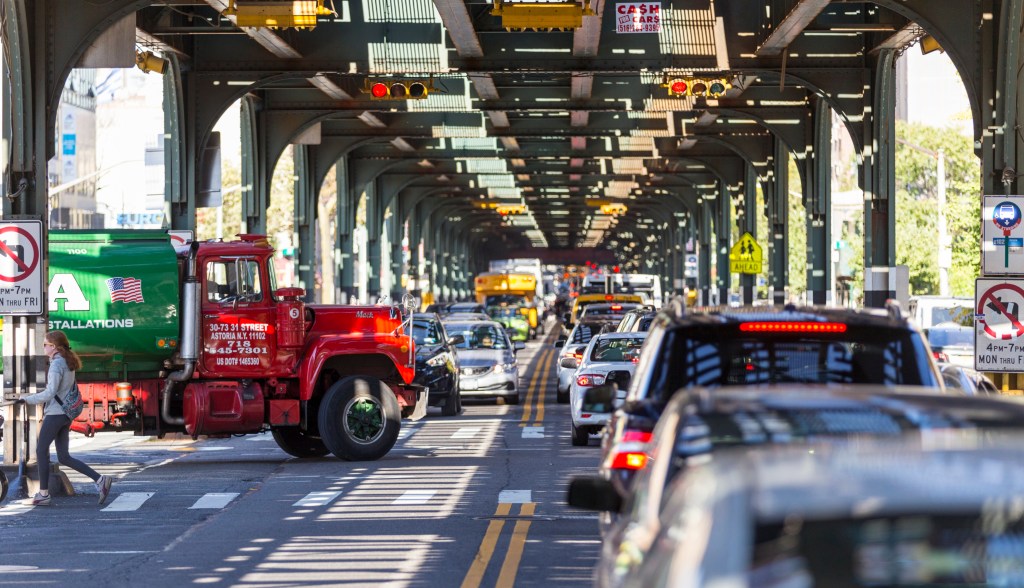
The Futility of de Blasio’s Meager Traffic Congestion Plan
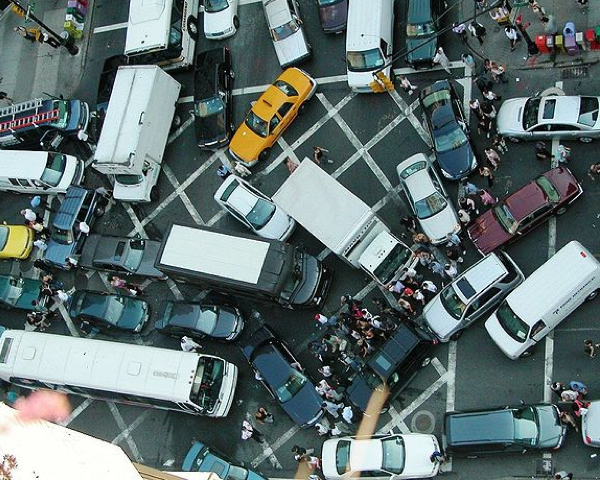
It’s faster to summarize Mayor de Blasio’s new “clear streets” plan for what’s not there: placard reform, smarter curbside metering, or congestion pricing.
What is there is this “toolbox,” as City Hall puts it:
The new effort will include both new and proven approaches to traffic congestion, including the creation of new moving lanes in Midtown, clearing curbs during rush hours, expanding NYPD enforcement of block-the-box violations, limiting curbside access in crowded corridors, and bringing coordinated attention to recurring traffic spots on local highways.
Almost all of this hodge-podge has been tried by past mayors. The common denominator is a dependence on education or enforcement, along with the lack of any attempt to lessen traffic volumes.
The plan’s headline feature, so-called “clear lanes,” seeks to raise vehicle speeds on 11 Midtown streets by 10 percent. Even if it succeeded — which it almost certainly will not, in the absence of measures to regulate the demand for driving — the time-saving benefits would be slight, worth around $75 million a year. That’s just 3 percent of the $2.6 billion a year in time savings and other societal benefits that I project for the Move NY plan built on “Gridlock” Sam Schwartz’s proposed toll swap.
In other words, comprehensive congestion pricing like Move NY could improve the lives of New Yorkers more than 30 times as much as Mayor de Blasio’s proposed suite of measures. (See details on calculations at the end of this post.)
Can the mayor’s plan really be so puny compared to Move NY? Yes, it can. Here are the key reasons:
- Mayor de Blasio’s plan addresses just 5.7 percent of the street space in the Manhattan Central Business District that carries around 9.3 percent of CBD traffic. Move NY addresses all of it.
- Because it doesn’t reduce CBD traffic volumes, de Blasio’s plan won’t improve traffic speeds outside the CBD; congestion pricing actually saves more driver time on roads approaching and leaving the CBD than on streets within it.
- Congestion pricing, by lessening traffic volumes, yields substantial non-travel-time benefits such as cleaner air, fewer crashes, and more people using active transportation; de Blasio’s plan offers no such benefits.
Congestion pricing like Move NY generates substantial and reliable revenue that can be used to upgrade transit and thus attract trips from cars at the same time that congestion pricing prices some car trips off the roads. In contrast, de Blasio’s plan will drain municipal budgets by requiring as many as 200 new full-time traffic and police officers to enforce traffic rules, at an annual cost on the order of $15 million (which, conservatively, I’ve excluded from my comparison of net benefits).
It’s true that the 11 streets in the Midtown core that de Blasio is targeting are unusually congested, with average vehicle volumes 64 percent greater than the CBD average. I’ve allowed for that by assuming that traffic speeds on those streets are 43 percent less than the already dismal CBD average of 8.21 mph between 8 a.m. and 6 p.m. on weekdays.
It’s also true that “clear streets” for Midtown is just one of five baskets of measures in the mayor’s announcement yesterday. But it’s the only one with a target lending itself to quantitative analysis. And even if each of the other four were generously accorded the same ambition as the first, the total benefits from all five would only be on the order of $375 million a year. While that’s not chicken feed, it’s still just one-seventh of the $2.6 billion in net societal benefits I project for the Move NY plan.
And even that requires the enormous leap of faith that this mayor can pull off what no one has ever been able to manage: to make lasting dents in New York’s traffic congestion without addressing its root causes — the failure to treat street space as the precious municipal resource it is, by pricing it.
Calculations supporting this post appear in my Balanced Transportation Analyzer, a 5 MB Excel file, under a new tab: BdB’s Plan.

Read More:
Streetsblog has migrated to a new comment system. New commenters can register directly in the comments section of any article. Returning commenters: your previous comments and display name have been preserved, but you'll need to reclaim your account by clicking "Forgot your password?" on the sign-in form, entering your email, and following the verification link to set a new password — this is required because passwords could not be carried over during the migration. For questions, contact tips@streetsblog.org.