Deep Dive: Amazon’s Latest Anti-Union Push Not Only Endangers Workers But Also NYC Streets
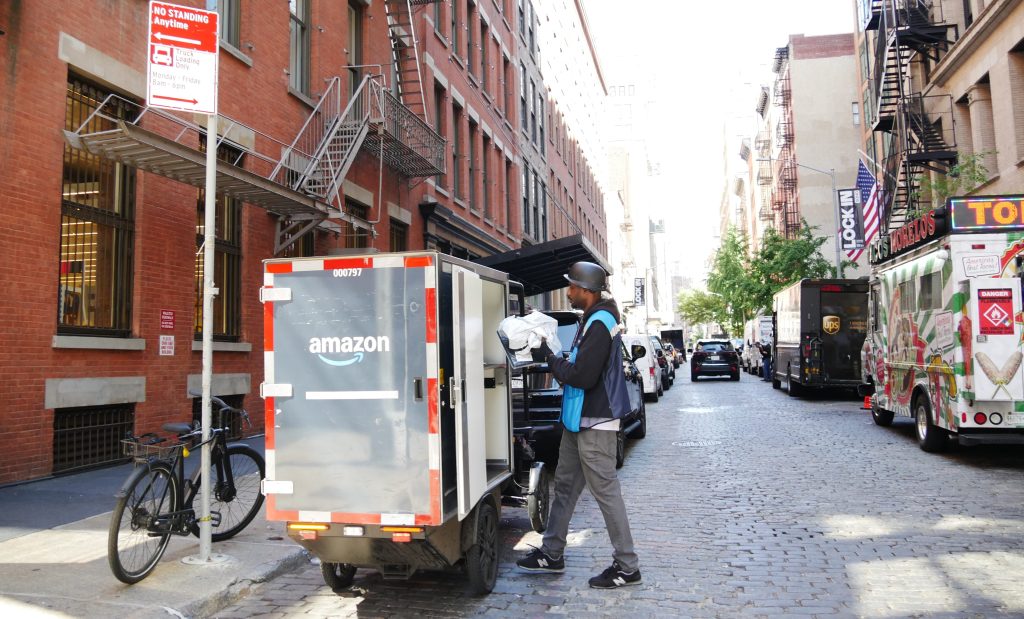
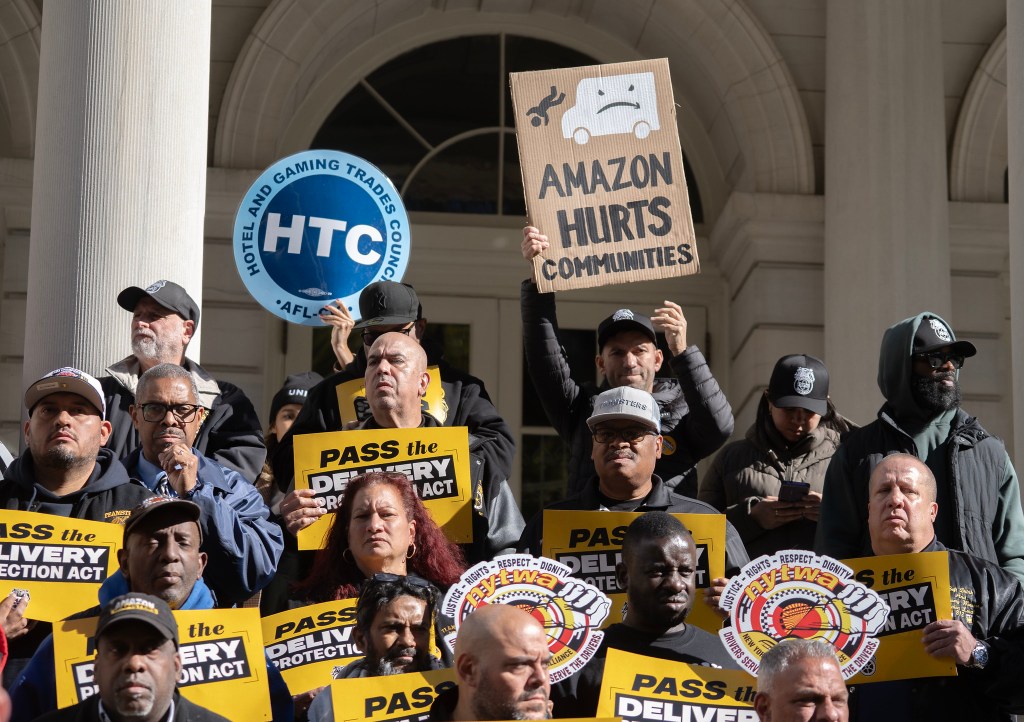
Amazon is using its status as a leader in sustainable delivery to threaten supporters of a landmark City Council bill that would pave the way for unionizing the drivers and e-bike riders that deliver its many packages, Streetsblog has learned.
Amazon has already spent millions fighting the Council’s “Delivery Protection Act,” but is now quietly telling supporters of the measure that it will shut down its cargo-bike-delivery operation entirely if the Council passes the bill, which has the support of a majority of Council members, as well as that of the mayor.
“Amazon is going around telling Council members that they should kill this bill because it will shut down their bike delivery operation,” said a person close to Council discussions, who was granted anonymity because they are not authorized to speak to the press. “It’s a threat dressed up as an ask. Really what they’re saying is, ‘If you pass this, we are going to shut down the micromobility stuff that we’re doing.’ They’re trying to use that as a wedge, but the reality is there is no reason that this would force them to abandon that as a mode of delivery.”
At issue, of course, is not Amazon’s popular quad-bike delivery operation; Intro 518, sponsored by Council Member Tiffany Cában (D-Astoria) and 34 co-sponsors, would force Amazon and other companies operating same-day last-mile warehouses to directly hire the workers rather than using a third party, known as Delivery Service Partners, as an intermediary. In short, it would cut into the heart of today’s increasingly exploitative and precarious job market.
Cabán frequently highlights the bill as a street safety measure with a labor policy solution. The bill would give the city more control over what types of vehicles Amazon sends onto the street through a required license. And eliminating the “Delivery Service Partner” model would give these bike workers a chance to organize and fight for higher wages, labor experts say. That would turn bike work into a good job, rather than something with low pay and high turnover.
Last year, a comptroller’s report found that traffic injuries are increasing near last-mile warehouses.
Another report by Oxford Economics, commissioned by the Amazon-backed Five Borough Jobs Campaign to assess the claims in the comptroller’s report came to the conclusion that the findings did not demonstrate that mandating a direct-employment model would reduce crashes.
And separate report from the Teamsters argued that the DSP model leads to rampant illegal parking with little consequences, and that the algorithm-driven companies pressure workers with quotas leading to high driver turnover.
“It’s inherently a street safety issue. Their workplace is the street. So if we are talking about making that workplace safer we are talking about street safety,” said Alex Morano, a safe-streets advocate. “What I am confused by is why there isn’t more discussion and support for this bill on the basis that it makes the streets safer.”
For Transportation Alternatives, the city’s leading safe-streets advocacy group, Amazon’s micromobility program is important to protect.
“Amazon’s e-cargo bike and safe delivery van programs take dangerous, polluting trucks off our roads — ensuring safer streets, fewer crashes, and cleaner air for all New Yorkers,” said Executive Director Ben Furnas.
TA has long supported cargo-bike delivery, but amid talk of Amazon’s threats to pull its bikes off the street, Furnas declined to offer a full-throated support for Cabán’s bill. Instead, he told Streetsblog the organization is “hopeful” that “these common sense programs will persevere under any future regulatory framework” because “oversized and deadly trucks have no place on our streets.”
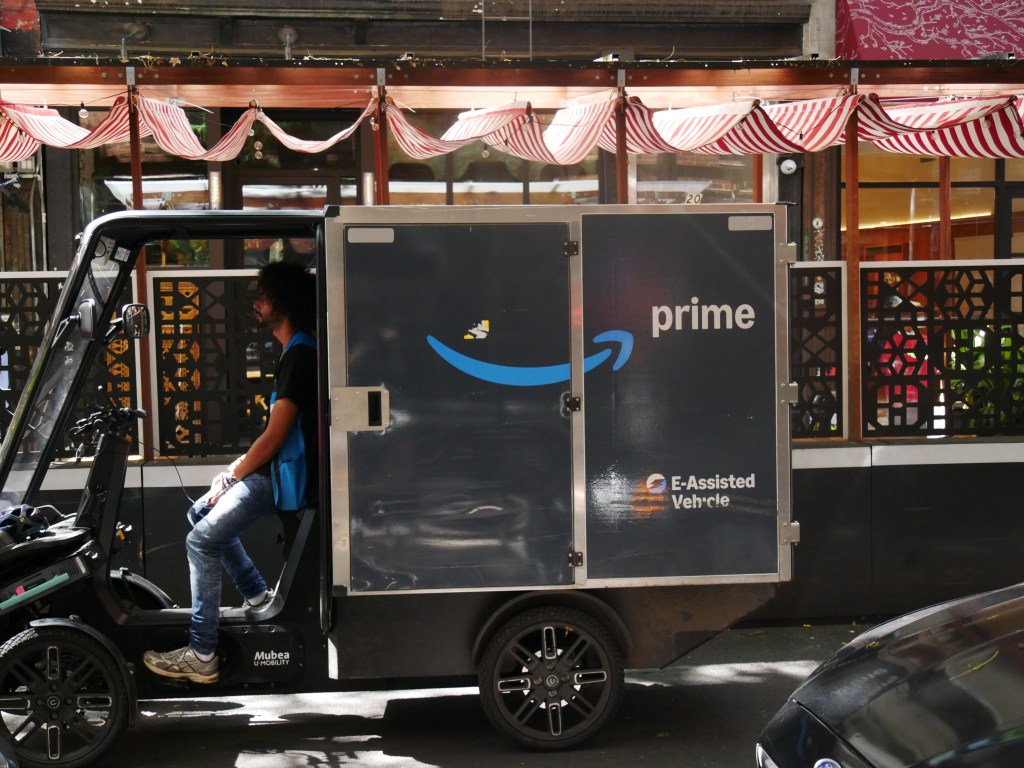
The danger presented by vans and trucks coming in and out of last-mile facilities is clear. But Amazon’s e-quad bike riders say they are also put in a vulnerable position as they struggle to make sure customers can get their items in one day.
Streetsblog spoke with two workers currently riding e-bikes for Amazon DSPs in Manhattan under the condition of anonymity. The workers described damaged equipment, inconsistent schedules, low wages and a confusing system where they are disincentivized to report a bike in disrepair for fear of losing access to their shift if there is nothing else to ride.
“My first time on the road is on one of these Amazon bikes,” said one of the anonymous workers Streetsblog interviewed. “New York drivers, being what they are … I’ve been ‘brake-checked’ before because the bikes, they go like 12 miles an hour, so you’re almost always the slowest thing on the road even compared to other cyclists.”
And the other worker directly called for more bike lanes.
“The job itself is very excellent, and I would hope that the workers are properly compensated for it,” he said of being on the e-quad bike around the city. “I do hope that this technology proliferates, and then UPS starts using e-bikes, and maybe FedEx starts using e-bikes because it’s just better to use it in Manhattan. I would like it if the bike lanes are expanded more to invite micromobility.”
The workforce, together with the bike-riding delivery workers of Uber, DoorDash, GrubHub, and Instacart, are subject to all the dangers that come with biking in New York City. Last month, three cyclists were struck and killed by hit and run drivers on roads with no bike lanes in a single week. One of them was working for DoorDash when he was killed.
“It’s always a game of whack-a-mole in this industry when a new company, through a mix of venture capital and some creative legal loopholes, finds a new way to get someone to deliver their package for the cheapest amount possible, which is essentially the nature of delivery work across the industry,” said Josh Woods, a bike messenger and long time delivery worker, who supports the bill. “We’re all part of the same industry, and a rising tide lifts all boats.”
Amazon’s anti-union scheme
Amazon’s model is to use Delivery Service Partners to make all deliveries — and this is the main target of the Council legislation. These Delivery Service Partners hire the people who drive the Amazon-branded vans and cargo bikes to the package’s final destination, but Amazon exerts significant control over the workforce and is usually the DSPs only customer. The companies also usually lease Amazon-branded vehicles, including the cargo e-bikes which the company calls “e-quads,” from Amazon directly.
The DSPs operate as stand-alone businesses. The small companies hire their own team and Amazon says they are able to work with other companies if they choose to.
This is part of what labor experts call the “fissured workplace,” a term coined by Brandeis Professor David Weil, which describes the “fundamental restructuring of employment” pioneered by companies like Amazon. The gig-economy is also a part of this growing fissure. Companies like Uber, Grubhub, DoorDash, and Instacart only hire tech workers. The ones out in the street doing the work that the company is known for — bringing things to you on a bike — are private contractors.
“Over the past several decades, businesses are increasingly trying to not employ people, and they’re doing this through a variety of different kinds of business models. Some through a franchising model, some through subcontracting, some through using staffing agencies, and this results in far worse working conditions for people,” said Terri Gerstein, the director of the NYU Wagner Labor Initiative.
The workers Streetsblog spoke with hope the Delivery Protection Act will give them power to change that by forcing Amazon to hire them directly rather than through third-party contractors.
“We haven’t been replaced by drones just yet, you know. The people doing this stuff, they have real physical bodies … and they’re working for one of the biggest companies on the planet, for what is essentially pennies, capable of being fired at any time with no real protections,” said one worker who delivers packages for Amazon on an e-cargo bike in Manhattan.
Amazon said the bill would “directly undermine” its commitment to its customers and threaten the businesses it partners with, including the DSPs who deploy e-quad bikes.
“Our commitment to providing safe, fast, and affordable delivery to New Yorkers is central to everything we do in this city,” said Amazon spokesperson Steve Kelly. “If enacted as written, this bill would directly undermine that commitment by threatening the more than 40 local small businesses we partner with to deliver to Amazon customers and the jobs of the more than 5,000 people they employ.”
The 40 DSPs operate out of a number of Amazon-owned last-mile warehouses. The DSPs make all deliveries for Amazon, not just the Prime ones. To Gerstein, the subcontracting model is clearly a stop-gap to full unionization. Amazon can stay out of the union negotiations by saying, “We’re not going to negotiate with you because we’re not your employer,” Gerstein said. This makes organizing harder.
At the end of last year, delivery van drivers working out of Amazon’s DBK1 facility in Woodside, Queens, attempted to unionize with the Teamsters, following drivers who did the same a year prior at DBK4 in nearby Maspeth. But Amazon won’t come to the bargaining table, partially because the workers are technically employed by the DSPs, not the larger company. And the company can simply stop doing business with DSPs that vote to unionize.
The micromobility program is used exclusively for same-day deliveries, which Amazon Prime customers have enjoyed for free since 2015. Trucks drop the parcels already packed and sorted at various last-mile facilities in the city, and the e-bike riders take it from there. Shifts are often in the middle of the night, from 2 a.m. to 12:30 p.m., workers said. This can cause issues since often the person getting a package doesn’t come to the door at say, 4 a.m., but the workers are still graded on whether or not the delivery was successful.
“If people are asleep and they don’t open their doors, and you can’t deliver your package because of that, it still affects your score. It’s very stupid when it comes to that. That’s usually when my score goes down,” one worker said.
The third-party response
Streetsblog spoke to two DSP owners, one who sends out e-bikers and Honda Fastport quads in Brooklyn (Fastports are bigger than the e-quads in Manhattan). He said the Delivery Protection Act would destroy the business he has built in the last year and a half, and argued he is offering his workforce a good opportunity.
“This is not a regular job, or a minimum wage job. I can offer people great benefits, I have tuition reimbursement. I have a 401k with a match component. I have health insurance. I have PPO. I have overtime. Every standard, I meet it and I exceed it,” said Juan Martinez, the owner of COPR Industries, the DSP.
But not all DSPs are the same. The two workers who spoke to Streetsblog said it’s hard to find full-time work at most DSPs, which is the way to unlocking benefits. And even Martinez acknowledged, “There bad apples in there.”
The e-quad workforce makes just around $20 per hour, according to job postings, and interviews with workers. Van drivers often make around $23 per hour. Amazon said the DSPs set their own wages, but the amounts are pretty much standard across mobility types, according to job postings.
The bill’s intent is to change the structure that Amazon has built in order to shift responsibility to the company that is really in control. When Streetsblog mentioned this to the DSP owners, they said they saw it differently.
“I never even considered that. I always looked at it as an opportunity to run my own business,” said Joe Artus, who runs WGA Transit in the Bronx which sends out workers who make deliveries on foot. Artus said he works hard to hire people from within the community who don’t have other work options. “I wouldn’t change a thing. It’s been the greatest privilege to be able to do what I do and help people throughout. And when it comes to things like unionization and all that, that’s up to the employee base.”
And Martinez got emotional defending his business.
“I’m here speaking with you because I feel like everything that I do is for my team, not for me, and that’s how I work. That’s how I show up to work every day. And this bill is going to take that away,” he said, fighting back tears.
Artus and Martinez both stressed that they provide good working conditions and that the DSP model gives them the ability to offer an above-minimum wage job to those with few opportunities, but the wages are still low by most standards. According to job postings, Artus hires workers at $18.50 per hour, which adds up to $38,480 per year before taxes. Martinez’s “walkers” at COPR Industries, who deliver on foot, make the same as Artus’s. The e-bike associates at Martinez’s company make $20.50 per hour or $42,640 per year before taxes. New York City’s poverty threshold is $47,190 for a renting family of four, according to a report from Robin Hood.
If any of these employees were supporting a family of four, they would qualify for SNAP benefits in New York State, a benefit program that’s essential … but has also become part of the business model of companies like Amazon.
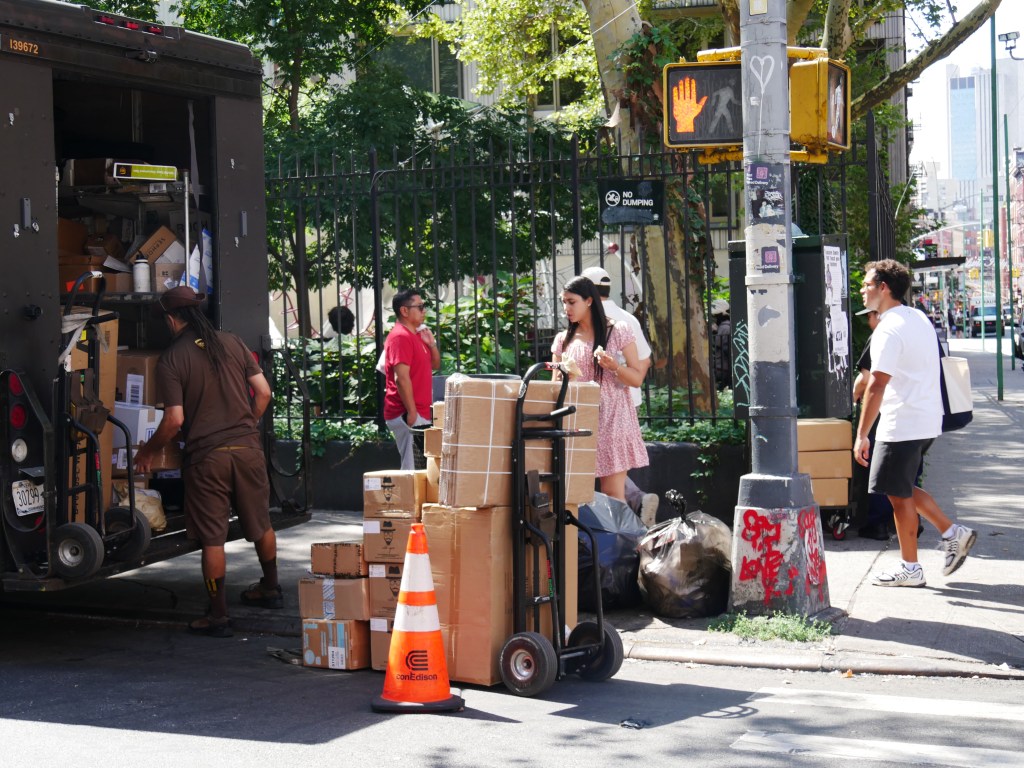
One way to get higher wages and better benefits across the workforce is unionization. The Teamsters Union, which represents freight drivers and warehouse workers for companies like UPS, have become the face of the bill and are the reason it has such a wide breadth of support from members on both sides of the aisle.
Martinez and Artus are part of New York Delivers, a group that fights the Council legislation yet is funded almost entirely by Amazon.
Amazon’s involvement in the coalition’s lobbying efforts, and the company’s involvement in the day-to-day work of the DSPs should mean that it is the one responsible for its workforce, Gerstein said.
Amazon has “no responsibility for the people who are powering their businesses and doing some of the most-crucial functions of their business that their business could not operate without. … That is just a really bad set of incentives that sets the stage for degraded working conditions,” she added.

Read More:
Streetsblog has migrated to a new comment system. New commenters can register directly in the comments section of any article. Returning commenters: your previous comments and display name have been preserved, but you'll need to reclaim your account by clicking "Forgot your password?" on the sign-in form, entering your email, and following the verification link to set a new password — this is required because passwords could not be carried over during the migration. For questions, contact tips@streetsblog.org.