Deep Dive: Cheaper Citi Bike Will Need More Than Public Subsidy

Advocates are demanding that the Mamdani administration do more to rein in Citi Bike’s soaring costs by subsidizing the wildly popular bike share system, but city cash alone won’t go far enough, according to experts and a Streetsblog analysis of the bike share’s finances.
The safe streets advocacy group Transportation Alternatives plans to launch a campaign on Wednesday to call for a $3 cap on e-bike rides under 45 minutes for annual members — a trip that currently costs $12 for New Yorkers who already shell out $229 for the annual subscription. (To compare, non-electric bikes cost members zero for a 45-minute ride.)
But before the city starts throwing money at the problem, the Department of Transportation and its contractor Lyft must both do more to reduce costs of running the largest bike share program outside of China, high costs that are a function of imperfect management by both the city agency and the taxi cab giant.
“What you don’t want to do is put a bunch of money into it that causes Lyft to do less,” said Jon Orcutt, who was a project leader at DOT when then-Mayor Michael Bloomberg launched Citi Bike back in 2013.
The program’s e-bikes have become hugely popular and account for the vast majority of Lyft’s revenue from Citi Bike, but the silver two-wheelers are also around 10 times more expensive even for annual members, compared to other bike shares in peer cities like Tokyo and London.
Mayor Mamdani – himself an avid Citi Bike rider – should lower the upfront cost by providing taxpayer funding to Lyft’s operations like many cities around the world, according to Transportation Alternatives. The Big Apple already subsidizes public transportation systems heavily, including $56.5 million a year for its other public-private partnership, the NYC Ferry, which logs only about one-quarter of Citi Bike’s daily ridership.
There has also been legislation in the Council to tie Citi Bike trip costs to the $3 subway and bus fare, but that 2024 bill by Council Member Lincoln Restler (D-Brooklyn) has yet to advance.
The entire Citi Bike contract comes up for bid in 2029 – still within Mamdani’s first term – and Lyft will have an advantage, given that it owns the fleet, according to transportation experts.
For starters
The city should get a better handle on the costs of running bike share and use that information to extract the best value from Lyft or whichever firm takes over the contract in three years, advocates said.
“There are definitely operational cost savings they could find from that that would allow them to not need as much of a subsidy,” said Annie Weinstock, the director of programs at People-Oriented Cities. “If you offer a subsidy they’ll happily take it.”
The city does not currently have the authority to implement such a cap, according to DOT spokesperson Will Livingston, who added that mayor wants to ensure that any cost savings it works out with the bike share operator would have to go back to riders.
“This administration is committed to creating a more-affordable city, including through transit options like Citi Bike,” Livingston said in a statement. “In any near-term negotiations around bike share cost, and looking ahead to 2029, the Mamdani administration will work to secure the strongest benefits for riders and their wallets.
But DOT has amended its bike share agreement nine times over the past 16 years, and there were already negotiations about subsidies and cost caps, according to a Streetsblog review of the contracts.
Bike share back-end
Citi Bike has become the North America’s most-popular bike share program, at around 200,000 daily trips, rivaling ridership on the Port Authority’s PATH trains.
But a look at the finances of Citi Bike shows that Lyft has reported only a thin profit from Citi Bike after years of running at a deficit, with many of the costs going to maintaining the system, including moving bikes around, also known as re-balancing, and swapping out e-bike batteries.
The program generated $133.3 million revenue a year and turned a $1.8-million profit, according to Lyft’s latest annual report from 2023, after running at a deficit for two prior years, at $10.7 million in the red in 2022 and $1.1 million in 2021.
Most of Lyft’s revenue came from ridership in 2023, including membership fees and e-bike surcharges, at $122.2 million, while largest expense is field operations, at $75.5 million, which includes maintenance, charging, redistribution, and facilities.
Since its inception, the system has been designed supposed to operate at no cost — “whatsoever” — to the city, which is codified in its original 2014 contract [PDF], obtained by Streetsblog via Freedom of Information request.
Over the years, DOT and successive bike share operators have agreed to nine amendments to the original agreement, which have added higher per-minute charges for e-bikes that began hitting the streets in 2018, while also expanding Citi Bike’s fleet and coverage area.
Lyft took over as bike share operator that year, and agreed to invest $100 million for a large expansion of the system that would eventually reach all boroughs except Staten Island.
DOT has been legally required to release annual financial updates since 2016, under Council legislation from the year before, but the fiscal statements were not available before 2021 or after 2023, and the agency declined to provide them.
Surging surcharges
Lyft has increasingly relied on e-bike charges for much its income in recent years, as the company has been able to continuously increase per-minute fees on the battery-powered rides, while growing the e-bike share of the fleet.
In June alone, e-bike surcharges accounted for nearly $14 million out of $32 million in revenues, according to Citi Bike’s latest monthly operating report.
The city in a 2018 contract amendment agreed to allow the bike share operator to charge higher rates for “premium modalities,” which includes e-bike rides, in order to pay for the extra costs of keeping the bikes charged and in good shape.
DOT initially capped e-bikes at 20 percent of all vehicles in the system when Lyft launched the pedal-assist cycles in 2018, but in 2024 officials allowed Lyft to scale up the share to as high as half of the fleet. E-bikes accounted for two-thirds of Citi Bike rides in New York and New Jersey in that year, and 81 percent of trips over the city’s bridges were with the electric bikes.
The changes gave the private operator too much leeway to raise prices and replace much of the classic bikes with pedal-assist versions, Orcutt argued.
“Once the city gave Lyft total control over e-bike pricing it was almost guaranteed that Lyft would push for an all-electric system because they can make more money off of it,” Orcutt said.
Now, an e-bike costs $4.99 to unlock and $0.41 every minute for non-members, so even before pedaling an inch, the ride costs more the $3 subway and bus fare. And within two-and-a-half minutes, the cost is already double that of public transit. Members get a free unlock and the per-minute charge is $0.27, so it takes about 22 minutes to cross that $6 threshold.
Charge-less
A key way to lower costs for Lyft would be to roll out more charging docks that get rid of the need for the company to hire drivers to manually swap out batteries.
But the company and the city have installed only 32 stations with power so far, about one percent of the the 2,400 active docking locations as of June.
The city launched the first two electrified stations in 2024, and Lyft plans to expand the network to “at least” 160 stations together with DOT and Con Edison, according to a rep.
The company estimated that it could reduce battery swaps by 90 percent and slash 300,000 in driving miles a year by electrifying top ridership stations, according to its annual “Multimodal” report.
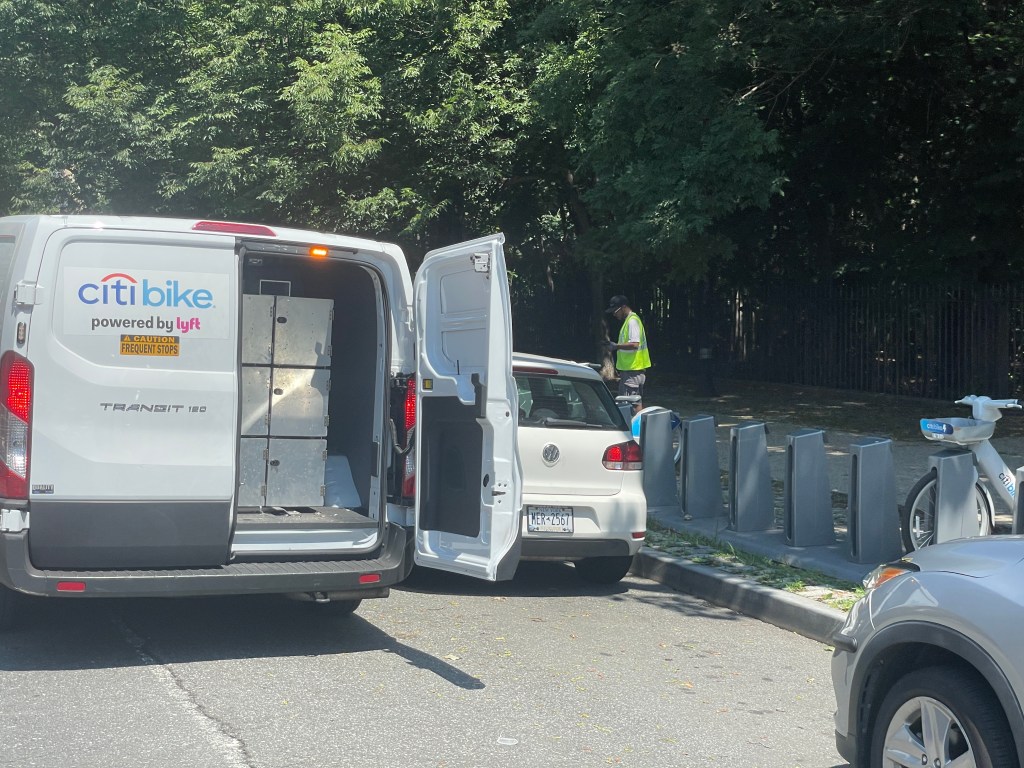
Workers manually replace more than 5,000 batteries on busy summer ridership days, hitting multiple locations in vans, according to Lyft spokesperson CJ Macklin. Electrifying even 10-20 percent of stations would “materially reduce this volume and the associated costs,” the rep added.
DOT officials and Lyft had aimed for 20 percent electrification, according to the most recent contract amendment from 2023 [PDF], which would be about 480 stations in today’s network.
Both parties committed to “good faith discussions” around passing those savings onto riders, coupled with a “public subsidy to support policy goals,” and had planned to reconvene in a year, but so far, they have not signed any further agreements.
Lyft does not have to divert any cost savings from electrification back to riders, according to DOT, which could be holding up further roll outs.
The rep for the company said that the reduced expenses from charging docks is currently paying off the costs of installing the electric docks.
“Right now, any savings goes back into reducing overall expenses tied to that buildout so we can maintain the affordability of the program as best as possible,” said Macklin. “We look forward to continuing to work with DOT to accelerate electrification and figuring out how to pass on savings to riders as that network is completed.”
Another issue Lyft called out in its Multimodal report is the “high costs of trenching” in American cities, which are still “catching up on electrification trend.”
Other municipalities have been able to eliminate arduous battery swaps by plugging in their stations, including Barcelona’s Bicing, which is fully electrified, or Quebec City’s àVélo, where just having half of all stations with charging capability has allowed the French-Canadians to eliminate battery swapping from field operations.
In Chicago, where Lyft runs the bike share Divvy, 26 stations are hooked up to the grid.
Lost money, bikes and data
Beyond electrification, the city has let its operator pocket more revenues in recent years and has kept lax oversight over its operations, according to the contracts, financial reports, and outside watchdogs.
Citi Bike’s operator can generate money from fares and memberships, but also from other sources, like advertising and sponsorships on the bikes, stations and websites or apps, along with “user data as well as all other program revenue sources,” according to the contract document.
The private contractor gets to keep most of the revenue, but has to share a portion of it with the city above a certain threshold. The contractor is also supposed to pay an annual fee to the city for lost meter revenue from car parking replaced by bike docks.
DOT agreed to reduce its cut of revenues during the Mayor Bill de Blasio administration in December 2020, which has reduced the city’s potential share of revenues by millions over the years. The share for the city went from from the original 5 percent of all income above $30 million to a decreasing percentage, according to a contract amendment obtained by Streetsblog via FOIL [PDF].
Under the changes, the city still got 5 percent of revenues between $30-$40 million, but only 4 percent of the next $10 million and 2 percent of any income above $50 million.
DOT lost out on about $5.5 million due to that change in revenue sharing between 2021-2023, according to a Streetsblog calculation of the three available annual financial reports.
Lyft also simply loses hundreds of bikes a month, reporting a “net loss” of 315 of its two-wheelers in June alone, and New Yorkers dump them anywhere from the Brooklyn Bridge bike lane to the Bronx River.
“They’ve been in there so long, you have to point out that it’s not a reef or rock formation,” said the Bronx River Alliance’s Deputy Director Daniel Ranells.

A scathing 2025 audit by state Comptroller Tom DiNapoli also found numerous possibly missing revenues and a glaring gaps in oversight by DOT, calling its management of the bike share program “passive.”
“DOT maintains a passive approach to monitoring the Citi Bike program, resulting in deficiencies in its oversight of the program,” DiNapoli’s report read. “With the increasing popularity of the Citi Bike program, it is critical that DOT actively perform its roles and responsibilities to fulfill the objectives of the program and ensure the vendor meets both its service requirements and financial responsibilities to the city.”
Even though Lyft was supposed to pay the city $1 million a year for the lost parking meter revenue, DOT couldn’t actually prove that Lyft deposited that cash for four years in a row – equivalent to $4 million.
Sponsorship revenue from bike share’s main advertiser, Citibank, came up $21.3 million short of what it was supposed to be, and its $1 million parking replacement fee has remained flat for 16 years despite city meter rates and inflation increasing during that time – effectively selling the city’s curb for cheaper each year.
The report accused the agency of failing to properly monitor Lyft’s activities or conduct reviews or audits to evaluate what works well with the program and what doesn’t.
For example, DOT failed to count more than 900,000 rides, excluding revenue the agency would be due from Lyft, the state’s financial watchdog said. DOT maintained that there was “no dollar impact.”
Other systems have closely examined their operations with public reports for expansion plans, like Washington D.C.’s Capital Bike Share, which Lyft also operates. The nation’s capital took a close look at how the region will grow and where officials should target bike share expansions in a 2020 report.
Weinstock said that it was crucial for DOT to better understand the data independently of Lyft, so it can properly assess how much of a subsidy would deliver meaningful savings. (And, let’s face it, even our Socialist mayor is unlikely to municipalize Citi Bike to create a fully public bike share system similar to Boston’s Bluebikes, London’s Santander Cycles or Mexico City’s ECOBICI, as other advocates, not Weinstock, have championed.)
“They should be doing something to model the operating cost so they can determine what’s reasonable in terms of subsidies,” she said. “They can’t just take Lyft’s word for it.”

Read More:
Streetsblog has migrated to a new comment system. New commenters can register directly in the comments section of any article. Returning commenters: your previous comments and display name have been preserved, but you'll need to reclaim your account by clicking "Forgot your password?" on the sign-in form, entering your email, and following the verification link to set a new password — this is required because passwords could not be carried over during the migration. For questions, contact tips@streetsblog.org.