Citing Vague ‘Legal Requirements,’ Mamdani Puts A Fig Leaf On His Predecessor’s Bedford Ave. Bike Lane Junk

Mayor Mamdani on Monday cited vague “legal requirements” to explain his continued inaction to reverse his predecessor Eric Adams’s backroom decision to erase three blocks of the protected bike lane on Brooklyn’s Bedford Avenue.
Asked at an unrelated press conference why he has yet to follow-through on his campaign pledge to bring back the removed protections for cyclists, Mamdani said “legal requirements” could derail the effort if city officials aren’t careful — even as his administration has moved quickly to implement street redesigns blocked by his predecessor, often as part of quid-pro-quo deals or, as federal authorities charged, outright corruption.
“We are following up on a lot of the different projects that were either paused or canceled by the prior administration,” Hizzoner told Streetsblog on Monday. “And we are also looking to ensure that the way that we are going about doing so is one that is both in line with the legal requirements and also in line with ensuring that those projects will be durable for not just the short term, but the medium term and the long term.”
It was not immediately clear what “legal requirements” are at play on Bedford Avenue, where the Department of Transportation under Adams installed protected bike infrastructure in 2025 in accordance with all legal requirements, but then ripped up three blocks of the protection after Adams changed his mind in consultation with political allies in the Satmar Hasidic community of Williamsburg.
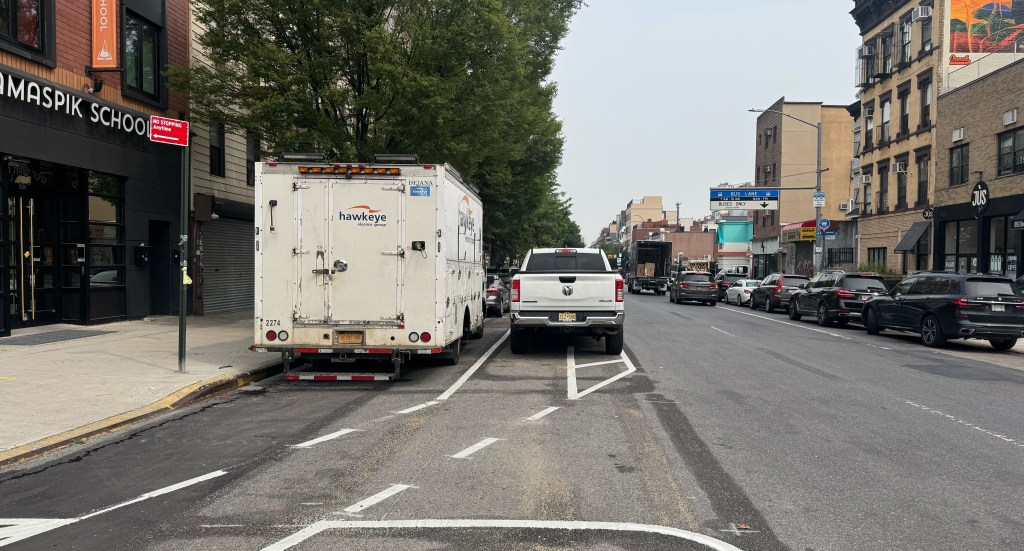
Mamdani’s DOT could re-do the bike lane at any time. And Satmar Hasidic leader Moshe Indig, an ally of the mayor’s, recently told Streetsblog he was ready to sit down with the city and come up with a way forward.
On Monday, the mayor said his administration “believes there should not be a hierarchy of safety. Whether you are driving, whether you are walking, whether you were biking, whether you are using public transit, you should come to expect the same level of safety in our city.”
Hizzoner stopped short of explicitly extending that commitment to Bedford Avenue, however. That obfuscation may have to do with the political value offered by Indig, one of the few Orthodox Jewish voices willing to defend the Muslim mayor in the press from unsubstantiated allegations of anti-semitism, said one political analyst who studies Muslim identity in American politics.
“Anyone who’s aware of these issues and aware of the [anti-Mamdani] campaign and what happened would immediately realize that identity is at the forefront of what is happening,” said Mobashra Tazamal, the associate director of Georgetown University’s Bridge Initiative, and the author of, “Islamophobia And The Political Rise of Zohran Mamdani.”
Tazamal’s report traced the Islamophobic rhetoric used against Mamdani by other politicians during his campaign. The young mayor continues to face intense scrutiny over his views on the Middle East, specifically Israel and the war in Gaza. He has been clear to call Israel’s actions a genocide and has advocated for Palestinian rights.
Politicians, especially Muslims, who are critical of Israel often face accusations of anti-semitism from opponents who claim that criticizing the government of Israel is a form of hatred of Jews, Tazamal said in her report. Even though the contested area spans just three blocks in Brooklyn, any action from Mamdani could invite scrutiny because of the Hasidic groups involved.
“If he didn’t have the pressure of constant media and political, not just national, but international attention, I think we could have a different story,” said Tazamal. “You are focused on a very local issue. Unfortunately, that local issue domino effects into an international issue. … It is so much larger than bike lanes.”
For years, activists pushed the city to install a protected bike lane on Bedford Avenue from Crown Heights to Williamsburg. Council Members Chi Ossé (D-Bedford-Stuyvesant) and Lincoln Restler (D-Williamsburg) led the most recent charge.
But after DOT finally installed the redesign in late 2024, leaders of the Satmar Hasidic community pushed for its removal on the three blocks between Willoughby and Flushing avenues. Indig and others corralled then-Mayor Adams to a town hall meeting in May 2025. Adams announced plans to rip up the bike lane days later, restoring the segment to an earlier, more-dangerous unprotected bike lane design that forces cyclists to navigate in and out of car traffic to avoid illegally parked cars.
Despite Mamdani’s inaction on Bedford, the mayor has otherwise made undoing Adams’s missteps a key theme of his nearly seven-month tenure. Since taking office, Mamdani ended the Adams’s push to increase criminal summonses for cyclists who break minor traffic laws, announced plans to finish the protected bike lanes on Ashland Place and McGuinness Boulevard, and he is placing a bus lane on Fordham Road in the Bronx.
But Bedford stands out as an outlier. DOT’s original proposal for a fully protected bike lane followed decades of research and planning — and officials even admitted the bike lane’s removal made the street less safe. DOT recorded a 47-percent reduction in injuries on Bedford Avenue between DeKalb and Flushing Avenues after its installation.
Unsurprisingly, safety has declined since undoing part of the protected bike lane. During the seven months when the original project was intact, the city counted 31 crashes that injured nine cyclists. But in the seven months after Adams deprotected those three blocks, the city counted 34 crashes that injured 13 cyclists — a 44-percent increase in cyclist injuries, albeit based on a small sample size.
Despite the opposition of some members of the Satmar community, many others bike around Williamsburg and deserve safe streets, said Baruch Herzfeld, whose teenaged son Rafe served as the lead plaintiff in an unsuccessful lawsuit to stop Adams from removing the lane.
“Zohran Mamdani represents New York City’s future, and he should not manage neighborhood politics according to the old rules of Brooklyn,” Herzfeld said. “The Bedford Avenue bike lane is about recognizing where the community is going — not preserving assumptions about where it used to be.”
Correction: An earlier version of this story citied an 85 percent increase in cyclist injuries, that number is 44 percent.

Read More:
Streetsblog has migrated to a new comment system. New commenters can register directly in the comments section of any article. Returning commenters: your previous comments and display name have been preserved, but you'll need to reclaim your account by clicking "Forgot your password?" on the sign-in form, entering your email, and following the verification link to set a new password — this is required because passwords could not be carried over during the migration. For questions, contact tips@streetsblog.org.