‘Death Trap’ Scooter Maker Adds Warning To Website After Deadly Bridge Crash
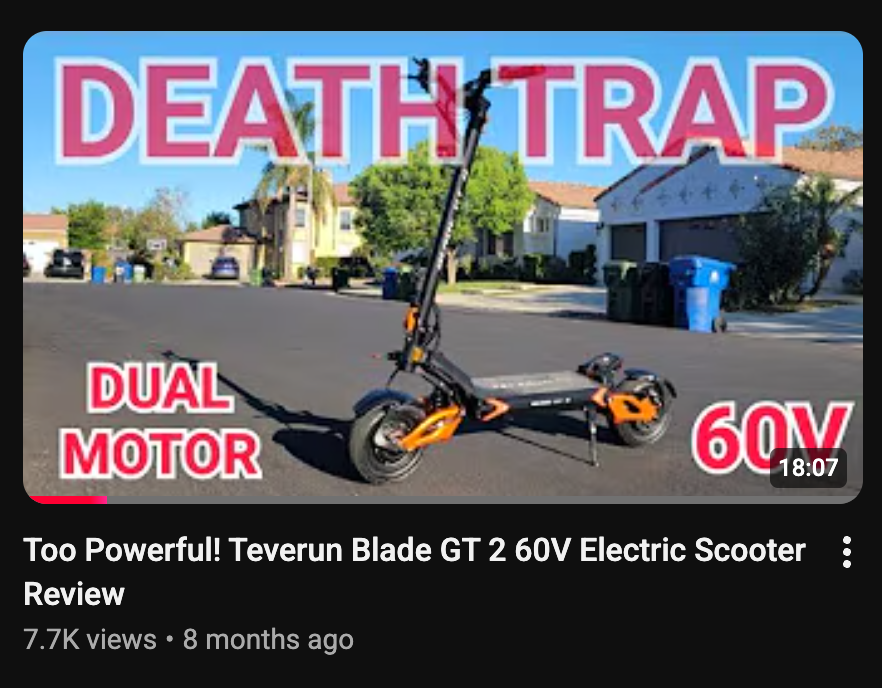
The company that makes the illegal stand-up electric scooter used by one of the victims of last week’s deadly head-on collision on the Queensboro Bridge bike path has added a warning label on its website after reviewers alerted the manufacturer to Streetsblog’s coverage.
Teverun — which makes the Blade GT II on which Francis Delvalle was riding on May 28 when he smashed into Dmytro Stechenko, killing them both — has since added some fine print to its website:
“All TEVERUN scooters are shipped with a speed limit of 25 km/h [15 miles per hour] for public roads. Unrestricted mode is for private or off-road use only. Always comply with local laws and wear protective gear,” it reads (you can see the small warning at the top of the webpage … if you squint).
The disclaimer could be a move to shift liability from the company to the consumer in the aftermath of the high-profile crash, one lawyer suspected.
“It’s a bit of an acknowledgement that these scooters are dangerous on the roads at higher speeds,” said Peter Beadle, a bike lawyer and a safe-streets advocate.
After Streetsblog reported the make and model of the scooter and pointed out that the device is illegal to operate on all New York City streets and bike paths, people began flooding the comment section with links to our coverage.
“You will die and kill someone else too,” one commenter, Eric, wrote before giving the scooter one-star and linking to Streetsblog.
“Perfect killing machine,” posted “Tom Smith.” “Great for killing myself and others! Just wish it could go even faster so I could end more lives.”
Scooter companies commonly falsely advertise their devices as legal by offering buyers the option of shifting to a different “mode” to violate speed limits or city rules. Many online retailers sell scooters and e-motos with “off-road” modes, as Streetsblog reported last year.
The details of the state’s vehicle and traffic code don’t clearly draw a line on mode shifting. But another factor that affects the legality of an electric two-wheeler is the wattage of the motor. The VTL clearly states that bicycles with electric assist must have a motor with 750 watts of power or less. Vehicles that can be shifted into “off-road” modes with high speeds will inevitably have motors with greater wattage.
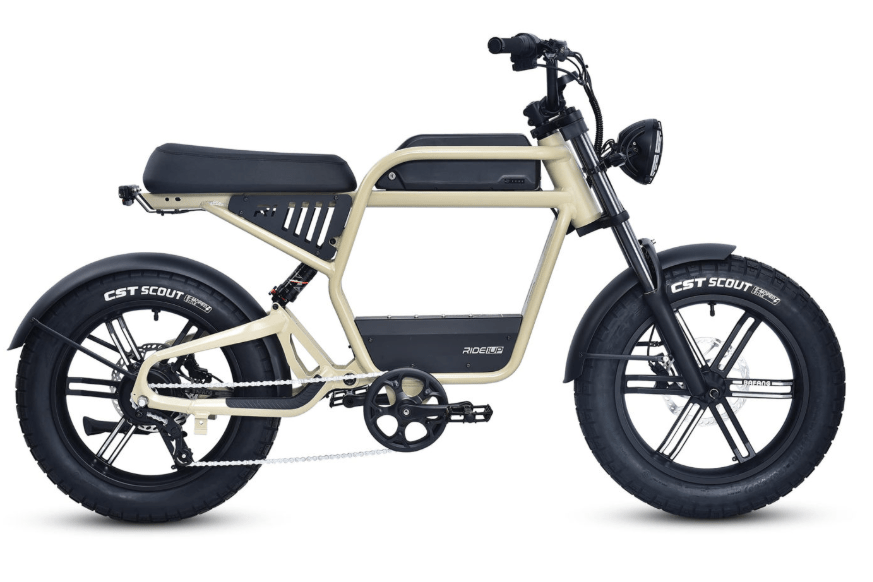
For example, the brand Ride1Up specifically calls its vehicles “moped-style e-bikes.” On its website, the company clarifies that a “moped-style e-bike” has “programming and motor capabilities that allow for a higher top speed than class 3 e-bike regulations allow. The company then adds a disclaimer that it’s only for a private course. Ride1Up markets it as a Class 2 e-bike, which legally can reach 20 miles per hour with the throttle. But the motor is 1,820 watts, which exceeds the 750-watt limit, making it illegal to ride regardless of mode.
Our Revv1 … is pre-programmed as a Class 2 e-bike, so you can ride most anywhere at 20 miles-per-hour with throttle and pedal assist. However, you can unlock the programming to reach speeds north of 28 mph. This is intended for private property only.
This agile and robust bike is tough enough to cope with the most demanding of rides. However, with its practical and sturdy design, it remains suited to any rider with a comfortable saddle, upright riding position and throttle forward use-case that provides a boost up to twenty-eight MPH or more when unlocked for “Off-Road Mode.”
The state’s traffic code does not specify a wattage cutoff for e-scooters. But companies selling them must display maximum speed and wattage on a sticker for both scooters and e-bikes. Still, the city’s own educational materials state that the max speed capability for a stand up electric scooter is 20 miles per hour.
It’s very difficult for police officers to, at a glance, know which motorized two-wheeled vehicle is a legal electric bike or an illegal e-moto. But police agencies in Europe, where e-bikers are common and provided ample space where their riders do not have to compete with cars, don’t seem to have this problem.
Beadle pointed out that although the company added a small disclaimer to the site about its modes, the page still reads as an advertisement for the fastest settings.
“The problem is that, some of these bikes and scooters can have their modes changed so easily that of course users are going to change the mode, it’s part of the marketing,” he said.
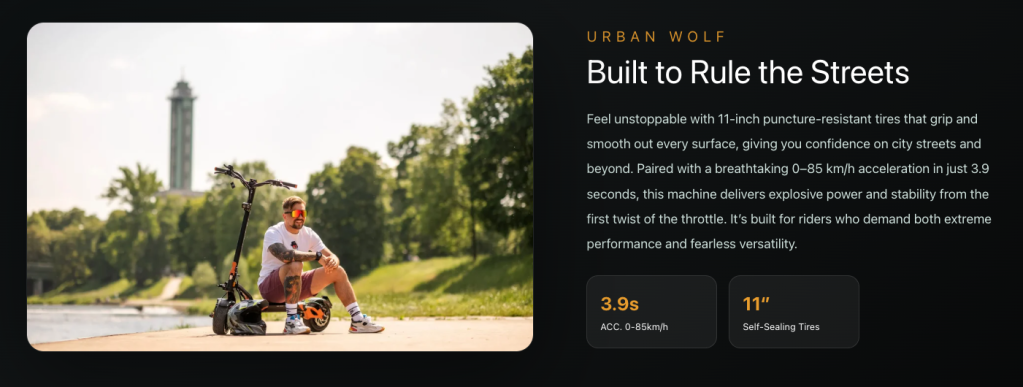
The site still advertises the scooter as “built for street dominance” and focuses on the scooter’s max speed. The site also specifically addresses safety, saying “speed is thrilling but safety comes first,” before encouraging riders to wear a helmet (as both victims of last week’s crash were). The website also clearly markets the scooter for city use:
Its 11-inch puncture-resistant tires, high-torque motor, and stable suspension allow it to tackle uneven roads, steep inclines, and urban obstacles with ease. Whether it’s potholes, gravel, or curbs, this scooter maintains smooth, controlled performance.
“That’s not marketing to a 15-mph scooter. That’s marketing to the 53-mph,” said Beadle.

Read More:
Streetsblog has migrated to a new comment system. New commenters can register directly in the comments section of any article. Returning commenters: your previous comments and display name have been preserved, but you'll need to reclaim your account by clicking "Forgot your password?" on the sign-in form, entering your email, and following the verification link to set a new password — this is required because passwords could not be carried over during the migration. For questions, contact tips@streetsblog.org.