State Police Went AWOL During City Patrols — And Supervisor Had No Idea
Discourtesy, unprofessionalism, disrespect.
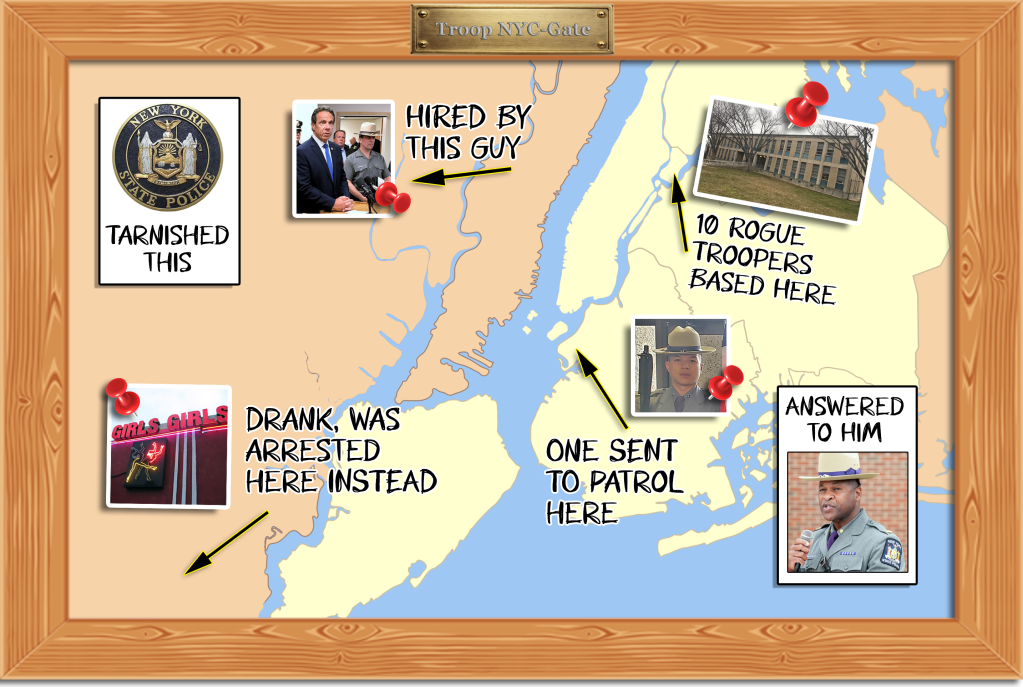
Troopers in a rogue New York State Police unit based in the city routinely blew off their supposed duties of patrolling MTA bridges and tunnels to listen to music, sleep with their girlfriends and, in one notorious case, drive to a strip club in New Jersey, get drunk and get arrested for assault, Streetsblog has learned.
All of the officers were paid for that time — and some, including the trooper who had the rendezvous at his girlfriend’s place, even made overtime.
In other police agencies, officers going full overnight shifts without making any traffic stops — or reporting any interactions with the public — might have aroused suspicion among the top brass. But this unit was staffed by inept supervisors, according to an internal affairs file obtained by Streetsblog: One sergeant was never trained to supervise some patrols; another sergeant was locked out of his computer for months and was unaware even where his officers were supposed to patrol.
The State Police has never publicly acknowledged the many problems its internal affairs unit found in the small city-based bridges and tunnels unit.
It kept eight of the nine troopers who repeatedly neglected their duties on the force despite investigators later identifying almost three dozen shifts — including 16 overtime shifts — in which these state police officers failed to do their jobs.
The eight troopers remain among the highest paid cops in New York State, averaging around $180,000 annually.
“It’s stunning that we have this level of graft and misconduct,” said Cory Morris, an attorney who has sued the State Police over requests for its disciplinary files. “Although, the more it goes on, the less I’m stunned.”
What is Troop NYC?
The State Police, whose 5,000 officers are known for their purple ties, gray Stetsons and blue and yellow vehicles, answers directly to the governor.
Troop NYC was the smallest unit and was typically overshadowed by the massive hulk of the NYPD, the state’s largest police force. But former Gov. Andrew Cuomo changed that in 2016, more than doubling the number of troopers in the city, reportedly to rebuke Mayor Bill De Blasio after reports that some NYPD traffic enforcement was slipping. The New York Times called Cuomo’s deployment “unprecedented” and likely more about “expanding his political footprint than with addressing the needs of law enforcement.”
The bridges and tunnels unit was supposed to do ramped-up toll enforcement as part of the transition to cashless tolling. And for a while, it did: The purple ties wrote more than 15,000 tickets the following six months, up from only around 1,600 the entire previous year. The troopers’ presence was very much felt in neighborhoods such as Red Hook and Long Island City, and city politicians quickly pushed back.
In 2020, after the city banned some forms of restraint, the troopers’ union demanded that the governor remove all state police from New York City on the grounds that the bill “puts an undue burden upon our troopers,” as then-union president Thomas Mungeer put it at the time.
The agency’s current New York City troop contains a federal drug task force, a number of high-level counterterrorism missions — and a small bridges and tunnels unit languishing in relative obscurity, said sources familiar with the state police.
It’s unclear what that troop is even doing on taxpayer time: On a weekly blotter page where state police troop reports their traffic stops, arrests and other interdiction efforts every day, Troop NYC has not disclosed any actions since November 2022 — and neither of the 2022 incidents on the page are related to traffic.
Arrested on duty in NJ
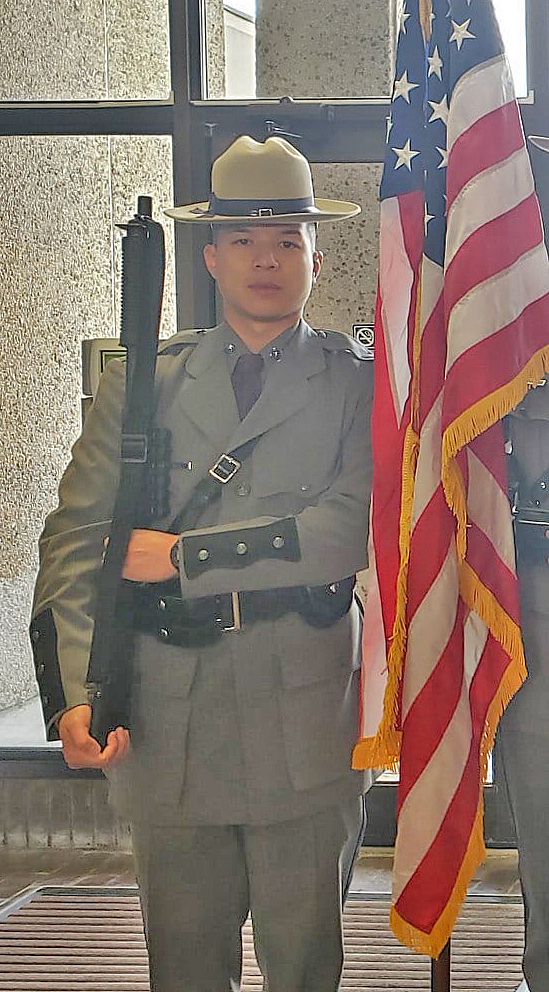
Top brass might never have had to confront the small unit’s lawless slacker culture but for Trooper Michael Lin’s night of drinking in New Jersey in August 2024. Instead of serving on a taxpayer-funded overnight DWI patrol in Brooklyn, Lin headed to the Garden State in his personal car. He went to a strip club and was arrested for assault.
Lin and his partner, Trooper Marc Vixama, started work that evening about an hour early. They seemingly wanted to drive up their citation numbers before Lin abandoned his post, and they had no trouble doing so — at least four illegal vehicles passed them in just 50 minutes.
Lin pulled over a driver with a suspended New York license. The driver’s white Buick had a New Jersey license plate for a 2007 Mercedes.
Lin issued six citations and let the driver leave.
Vixama stopped one vehicle with switched plates and two with suspended registrations. He also stopped a car with a fake license plate — an obvious felony.
Vixama issued a number of citations to each driver and let them leave.
In no case did the troopers call for a tow truck, as was required by policy.
Lin then drove back to the station on Wards Island. He parked his department vehicle and picked up his girlfriend in his Mazda with no front plate and a camera-thwarting plastic cover on the back plate. He drove over the Verrazzano Narrows Bridge to New Jersey, evading the toll along the way.
He and his girlfriend drank at a Thai restaurant and then a strip club. They drove to a gas station, where Lin crawled under a bathroom stall to confront his girlfriend.
They continued to argue in Lin’s car. Lin grabbed the woman’s wrists, leaving marks.
She called 911 from a nearby parking lot.
Lin was arrested by local New Jersey cops after showing them his badge. He was booked at the police station, where he urinated in his holding cell to “get the police in trouble.”
Then the local cops in New Jersey called a sergeant with the State Police. That sergeant called another sergeant and word went up the chain: Something had gone wrong on the bridges and tunnels unit’s overnight shift.
That was actually Lin’s second consecutive night abandoning his duties, he would later admit. He had left his post to have sex with someone in a parking lot the previous night.
Lin was not prosecuted in New Jersey after his girlfriend declined to press charges. He texted her while he was under investigation to ask her to lie to the State Police.
“Don’t let them know we talk. They will try to trick you,” he texted her after she was contacted by internal affairs. “Just ignore them until tomorrow. Fuck them.”
Hundreds of unaccountable hours
Lin’s arrest spurred an internal affairs investigation that first drilled into his and Vixama’s conduct.
Lin did not always abandon his overnight and overtime shifts. Sometimes, he simply parked his squad car for a bizarre form of recon.
For instance, Lin told investigators that he spent one shift in a parking lot near the Throgs Neck Bridge.
“How do you fill your time during that five-hour period?” an internal affairs officer asked.
“I don’t, I simply watch the bridge. That’s it,” Lin responded.
“So you stare at the bridge for five hours?” the officer asked.
“Pretty much,” Lin replied.
Vixama told investigators that Lin repeatedly left his post to meet women, but he wouldn’t provide specific dates or times. And then investigators scrutinized Vixama’s work records, where they found two overtime shifts where he was off post the previous week.
The night of Lin’s arrest, Vixama spent about three hours of on-duty time at his girlfriend’s apartment in East Harlem. He left when Lin called from New Jersey. But rather than radioing his supervisor, Vixama met up with a colleague who was also off his post.
That colleague, Trooper German Tyuryayev, admitted to investigators that he also repeatedly failed to meet his patrol partner. Investigators identified four shifts — including one overtime shift — where he did little police work.
In one instance, Tyuryayev described waiting by the Prospect Expressway in Brooklyn.
“From 12 to 5, I just, I just sat there,” he said.
Investigators later found that eight other troopers had failed to meet up with their colleagues or do any police work during their shifts.
One trooper, Evantz Charmant, spent hours of on-duty time in the police station parking lot. He was asked if he conducted any traffic stops during the shift.
“The only thing that I could think of would be while I was leaving my station, like, right in front of it,” Charmant said. “Maybe then I wrote a citation.”
On another night, Charmant and a colleague spent hours in a different parking lot.
“Did you have any interactions with the public at all?” the investigator asked.
“No, I don’t believe we did,” Charmant said.
The investigators soon discovered a potential cause for the unit-wide dereliction of duty: Sgt. Edmond Williams was locked out of his agency computer for 10 weeks leading up to Lin’s arrest.
Harmless mistake? Hardly: Williams’s password was changed while he served a previous suspension for unspecified misconduct. He did ask IT for help once, but he gave up when it never came. He resigned to simply monitoring his troopers over the radio.
The State Police slammed Williams in its report, saying over just two days, he failed to notice that six of his troopers were “outright AWOL” — military-speak for “Absent Without Leave.”
It gave Williams a five-day unpaid suspension. He remains a sergeant in Troop NYC.
Last year, he received $210,000 plus benefits from state taxpayers.
Years before this scandal, Cuomo urged state troopers to uphold the highest level of integrity so that the public could always trust them.
“The relationship between a citizen and their government is a function of the level of trust,” Cuomo said in an address to a graduating class of state troopers in 2012. “There are two types of integrity: there is institutional integrity [and] personal integrity. When you are a state police officer, you are a role model for the community, not only when you have the uniform on, but a 24-hour-a-day obligation. And I expect you to uphold that integrity 24 hours a day.”
‘Decisive’ accountability?
The State Police has not been upholding the integrity that Cuomo preached a decade ago. Last November, a number of senior brass resigned after they were caught using their badges to bring family and friends to exclusive areas of a Long Island golf tournament.
The first deputy superintendent, who oversaw the internal affairs unit, was one of the senior officers who resigned.
The State Police continues to be the last big law enforcement agency in the state that has not yet released the bulk of its misconduct files to the public after a 2020 change in state law.
Streetsblog filed a request in 2023 for all recent misconduct records of Troop NYC. That request remains unfulfilled. (The 556 pages of files regarding the bridges and tunnels unit were instead obtained from a county DA’s office.)
“Why is that file, which addresses founded misconduct by a number of state employees, private?” asked Morris, the attorney who sued for other files. “That’s not what the law is supposed to be.”
The media keep pushing for information — and occasionally piercing the purple wall. In February, New York Focus and The New York Times reported on a decade of lax and inconsistent disciplinary punishments by the agency that left some troopers who seemingly committed fireable offenses on the job.
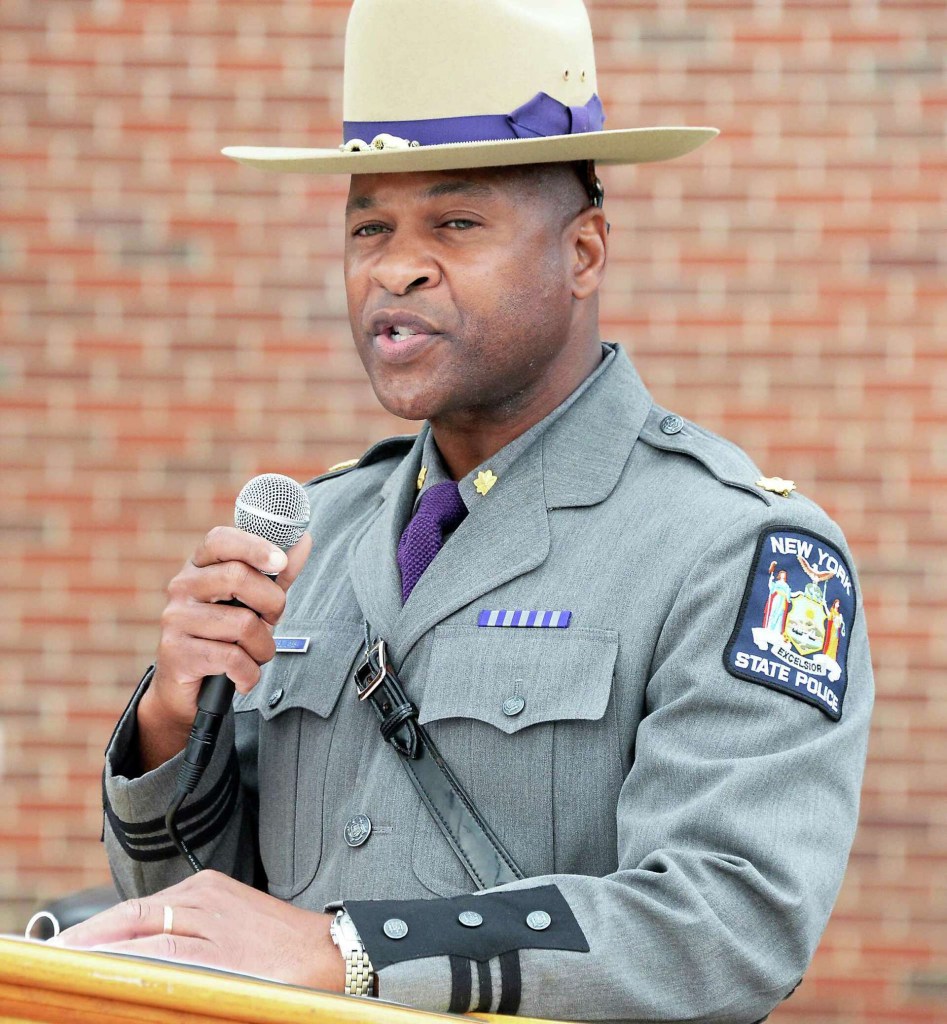
Later, Superintendent Steven James issued a statement.
“No organization of our size is immune to lapses in judgment or conduct,” James wrote. “When any member falls short of the standards we demand, we address it directly. We do not minimize misconduct, and we do not excuse it. Accountability within the New York State Police is not symbolic; it is decisive.”
That “decisive” action seems limited to one man: Michael Lin. The agency fired him in September 2025 after the investigation detailed above; a hearing board had determined that “to permit him to return to duty would send a message that his pattern of misconduct, neglect of duties and responsibilities, desertion and abandonment of his coworkers and rejection of our paramilitary chain-of-command structure would be acceptable.”
All the other officers found to have committed misconduct remain with the State Police. The highest punishment any of them received was Vixama’s 30-day unpaid suspension.
Seven other troopers implicated in the investigation served unpaid suspensions or vacations day penalties of less than seven days. One had a 15-day suspension.
All of them still work for the State Police under Gov. Hochul.
Through a spokesperson, Hochul said she retains her confidence in Superintendent James and that her administration “fully investigates any claims of wrongdoing and will continue to strengthen policies and procedures to ensure the State Police meets the highest ethical and professional standards.”
Streetsblog also sought comment from the eight troopers and two sergeants. None responded. The state police union, the Police Benevolent Association of the New York State Troopers, also declined to comment for this article.
Beau Duffy, a director of public information for the State Police, said the agency conducted a “thorough” disciplinary investigation following Lin’s arrest.
“The actions of these individuals are not reflective of the more than 5,000 sworn members of our agency who serve each day with integrity and professionalism,” Duffy said in a statement to Streetsblog.
He refused to clarify if the State Police took steps to recover money paid to troopers while they abandoned their duties, merely stating that they were “subject to the appropriate disciplinary process.”
He also said that the State Police “made changes to ensure all regulations and accountability are being enforced on overnight shifts in Troop NYC” and that “supervisory lapses … have been corrected.”
In previously confidential internal affairs interviews obtained by Streetsblog, some troopers cast blame on the State Police’s culture, claiming they were expected not to “snitch” on their partner.
But at least one trooper expressed remorse.
“I am sorry for my actions,” one trooper said. “If I could change everything back, I would.”
— Editorial assistance by Sanjana Bhambhani
After initial publication, the State Police updated its blotter page to include weekly updates from Troop NYC. (The page still does not break down the activity undertaken specifically by the bridges and tunnels unit, otherwise known as Troop NYC Zone 3.) The agency also provided overall ticket numbers from Troop NYC’s 2025 work to Streetsblog.

Read More:
Streetsblog has migrated to a new comment system. New commenters can register directly in the comments section of any article. Returning commenters: your previous comments and display name have been preserved, but you'll need to reclaim your account by clicking "Forgot your password?" on the sign-in form, entering your email, and following the verification link to set a new password — this is required because passwords could not be carried over during the migration. For questions, contact tips@streetsblog.org.