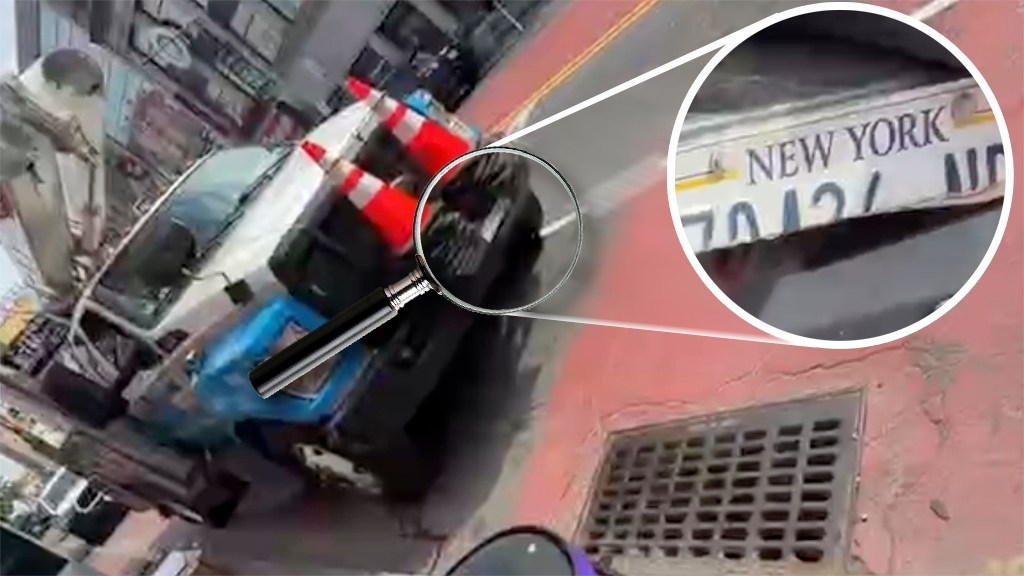
With Waymo Testing Halted, We Have A Rare Chance To Get Ahead of the ‘Driverless Revolution’
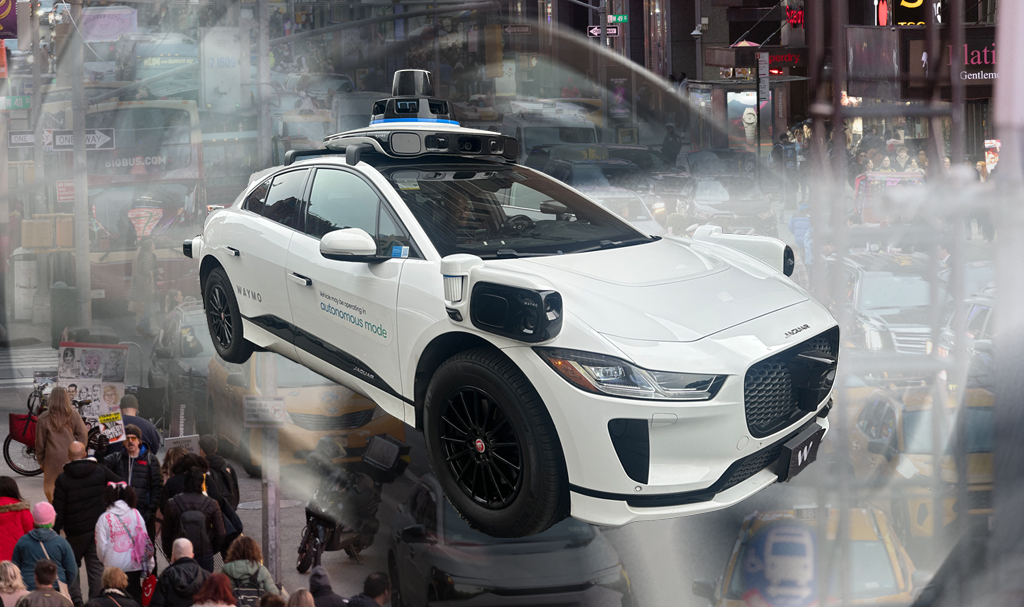
On March 31, city and state permits that allowed Waymo to test its driverless taxis in New York City expired. It’s unclear what will happen next. We’re all being told that autonomous vehicles are the “wave” of the “future,” but what will that future look like: safe and clean or crushed under the existing wave of congestion, road violence and misery? As the testing permit expired, we asked two experts to look ahead.
In the summer of 1925, a radio-controlled driverless car traveled down Broadway and Fifth Avenue through heavy traffic, turning corners, speeding up, slowing down, braking as warranted. The demonstration ended when this autonomous vehicle crashed into another vehicle full of photographers documenting the event.
A century later, Waymo’s eight AVs quietly stopped testing on those same streets when the city declined to renew their permit on March 31. Gov. Hochul has also hit pause on legislation that would have opened the rest of New York State to driverless vehicle services.
So what’s next? The question is not whether driverless cars will arrive. It’s what New York City must do to ensure that we are ready when they get here. Here, in short, is a primer on how we start the conversation:
This pause cannot be the plan
Waymo, Zoox, Tesla and others already operate in 10 U.S. cities and are expanding. Waymo alone has spent over $3 million lobbying city and state leaders. The last time a new mobility technology arrived in New York City without a previously established regulatory framework, we ended up with Uber and Lyft — companies that promised to reduce car ownership and congestion but instead unleashed 100,000 more vehicles clogging our streets.
Cities that don’t set the rules upfront end up living by someone else’s.
The safety argument is shakier than it looks
The industry’s foundational claim — that humans cause 94 percent of crashes — has long been debunked. National Transportation Safety Board Chair Jennifer Homendy herself called that claim “not accurate” and “often mis-cited” — and it’s so widely misused that the National Highway Traffic Safety Administration removed it from its own materials. But the claim lingers in the national mind because it sounds right and it absolves Big Car from culpability.
But even setting aside the flawed claim that human error causes virtually all crashes, the data meant to replace it can’t be trusted either; Waymo has declined to share any findings from its city testing with the public, and we argue we still do not have enough information to make decisions on safety.
The result is a data environment that is not just incomplete, but actively contradictory: Bloomberg Intelligence reported that Tesla is 10 times safer than Waymo, while recent reporting has found Tesla’s robotaxi performing four times worse than human drivers in Austin. Waymo says its studies show that its vehicles are at least 80 percent safer than the average driver, but a close look at the source reveals that all 10 authors work for Waymo! We are being asked to reshape New York City’s streets based on something we may not fully understand or trust just yet. Any future permit must require independent data disclosure as a baseline condition.
We already have a system that’s 95 percent safer than conventional cars
Here’s the comparison the industry never makes: even assuming Waymo’s and others’ best-case numbers — that robocars result in a 90-percent reduction in fatalities versus the average human driver — AVs would still produce roughly 65 crash deaths per 100 billion passenger miles. Transit produces just 30. Transit is 95 percent safer than cars today, without a single algorithm. If AVs pull riders off the subway and onto robotaxi apps, the safety math goes in the wrong direction. Switching passengers from cars to AVs may save lives, but taking them from transit will cost lives.
NYC is not Phoenix
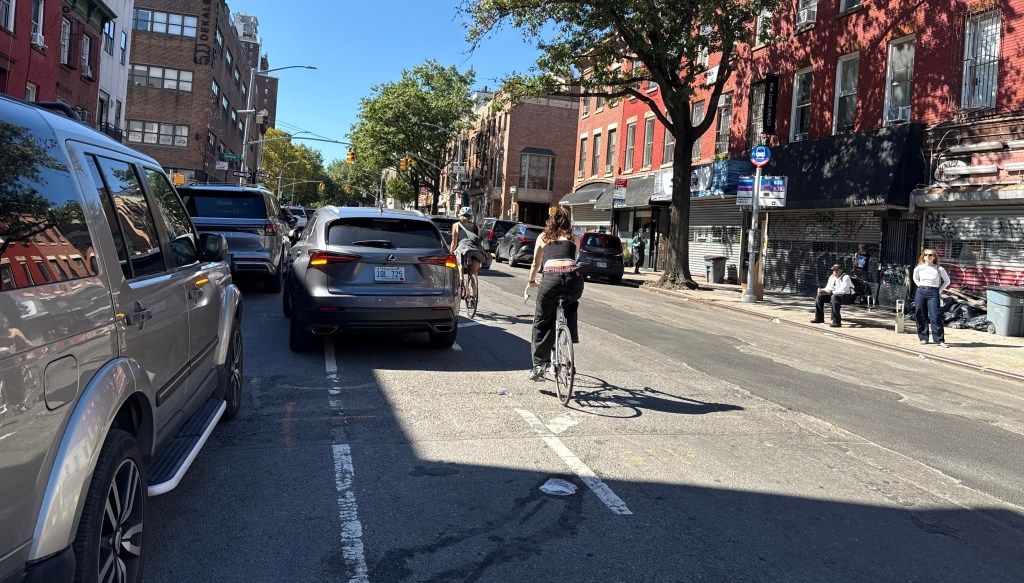
Existing robotaxi operations run under very specific conditions: good weather, well-defined roads, low density, few pedestrians and cyclists (other than San Francisco). New York City defies nearly every one. Our streets have some of the most-aggressive pedestrians in the world, a large senior population, cyclists ranging from five to 30 mph, snow, flooding, and a transit system that makes our street-level environment unlike anywhere AVs currently operate.
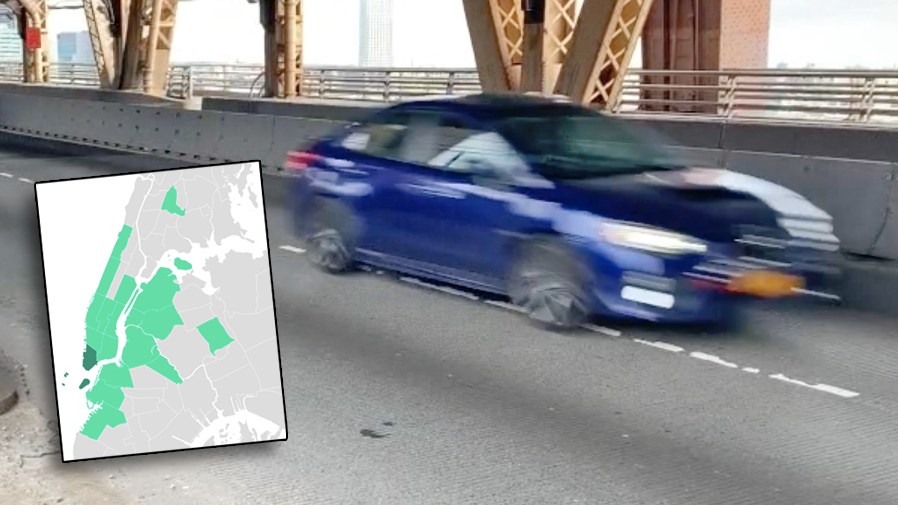
The industry’s safety record in Atlanta and Phoenix tells us very little about what will happen on Atlantic Avenue or the Queensboro Bridge.
There’s also the curb problem
Robotaxis can either cruise endlessly, or double-park and cause chaos, unless given dedicated space at the curb. And this space is hotly contested, from car parking to bike parking to open dining. One recent study found that excluding AVs from curb staging increases daily vehicle miles by nearly 60 percent compared to scenarios with staging. Another study found that shared driverless vehicles increase vehicle miles traveled by 5 percent.
At a moment when New York City has just won a generational battle for congestion pricing, surrendering that ground to an unregulated robotaxi fleet would be an act of self-sabotage.
AVs, like any other vehicles, will trigger additional costs to the city for road maintenance, emergency response, added unemployment, congestion, and more. We did, for a while, charge car and truck owners a significant fee for use of roadways by taxing gasoline and supporting the Highway Trust Fund. The United States hasn’t raised the gas tax in more than 30 years, which has drained the trust fund, forcing government to shift money from the general fund that could have funded other priorities. AVs are likely to be battery-powered and a new fee should be introduced. We propose a per-minute charge easily computed through current technology.
The good, the bad, the ugly of AVs
A good outcome is achievable, but only if we act now. AVs integrated with transit and aimed at solving the last-mile problem — focused on transit deserts, serving all New Yorkers, and prioritizing people with disabilities. AVs that operate as shared rides, governed by a street typology plan that sets different rules for car-free zones, slow streets, and arterials. That’s the path to fewer crashes, less congestion, and a smaller carbon footprint.
But if we get the rules wrong, we may get the bad outcome: shared AVs “stealing” riders from transit, profit as the sole criteria, vehicle miles traveled rising, pedestrians and cyclists squeezed off the road and curb, jobs eliminated, and the very New Yorkers who stand to benefit most from better first-and-last-mile connections priced out.
Get the rules really wrong, and the outcome turns ugly: Private driverless car ownership, AVs competing with transit rather than feeding it, unchecked VMT growth leading to gridlock, decimated public transportation, and the reversal of every urban mobility gain this city has fought for.
Any renewed permit or future deployment should require independent data disclosure as well as transparent and publicly accessible metrics on data ranging from the number of vehicles on the road, miles traveled, traffic incidents, miles spent parked or in motion, and more. In addition, policy can look towards VMT caps or congestion fees on for-hire AVs, transit integration requirements, labor transition funding, and preservation of city-level regulatory authority regardless of what Albany does.
The permit has expired, but the industry hasn’t gone away and has said explicitly it will return. Mayor Mamdani and the City Council have a window to build the framework before the next application lands at the Department of Transporatation. The American Wonder crashed on Fifth Avenue a century ago. Let’s not repeat the mistake.


Read More:
Streetsblog has migrated to a new comment system. New commenters can register directly in the comments section of any article. Returning commenters: your previous comments and display name have been preserved, but you'll need to reclaim your account by clicking "Forgot your password?" on the sign-in form, entering your email, and following the verification link to set a new password — this is required because passwords could not be carried over during the migration. For questions, contact tips@streetsblog.org.