MYTHS BUSTED: Five Lies From This Week’s Community Board Meetings
Folks will say anything to try to stop the city from installing a bike lane or making some other road improvement in their neighborhood — but that doesn’t mean they’re right.
More often than not, they’re dead wrong.
Streetsblog has sat through countless community meetings over the last 20 years where car-brained opponents of safer streets spewed bogus concerns while championing the supremacy of cars in a city where most people get around without one.
That tradition has continued even as the livable streets movement has grown and won more and more bike- and pedestrian-first redesigns. And it was on full display on Tuesday night in Central Brooklyn and on the Upper West Side.
Follow along as we run through five untruths we heard this week on the community board circuit — and explain exactly why these lies cannot be allowed to stand:
‘Everyone who lives east of Grand Army Plaza is essentially being punished’
In Brooklyn, Department of Transportation officials presented their plans to connect Grand Army Plaza to Prospect Park to community boards 6, 8 and 9. The long-overdue design will fix what today is a chaotic and dangerous experience for park-going pedestrians, particularly on the Flatbush Avenue (east) side of the park.
Some attendees saw a plan to improve pedestrian access to a park as a good thing, but others saw it as a ploy to make it more difficult for westbound drivers — even though the plan basically won’t change the route for those drivers.
“Everyone who lives east of Grand Army Plaza is essentially being punished,” one speaker remarked.
DOT’s surveys of the area in 2022, 2024 and 2026 show that “everyone”‘ is an extreme overstatement. Most people the agency surveyed complained of “too many interaction points with vehicles,” confusing traffic patterns and “long waits to cross the streets.” In 2024, 86 percent of DOT respondents wanted the agency to connect the plaza and park.
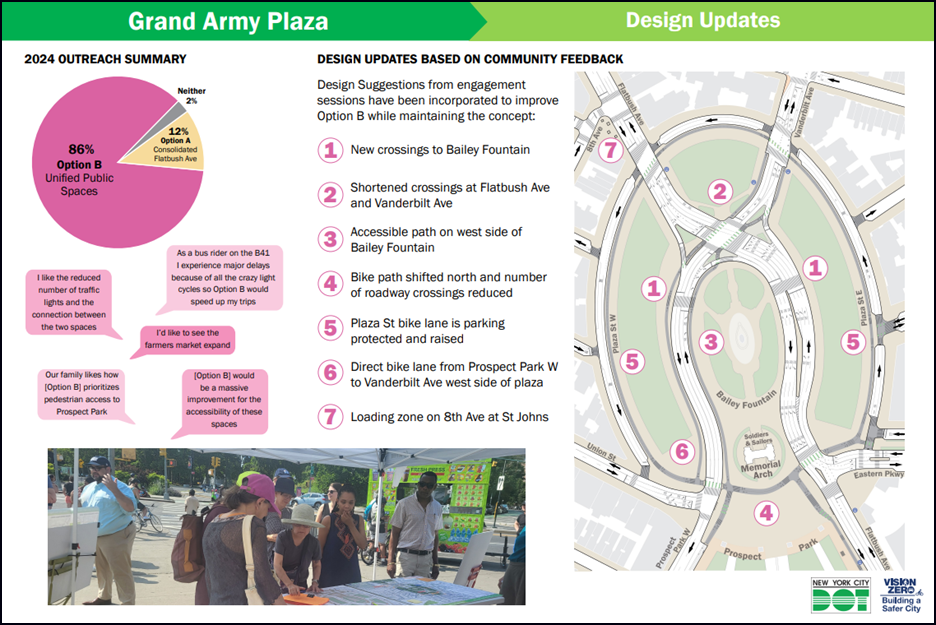
And the city’s design still leaves so much space for car drivers that it actually reduces the travel time by 45 percent for drivers headed between Flatbush Ave./Vanderbilt Ave. and Flatbush Ave./Eastern Parkway. Drivers headed from Union Street — from the west side to the east — are the ones who might be slowed down a bit, the DOT said.
It would be a stretch to call a slight drop in car speeds a “punishment” in any event, but it’s certainly not a punishment for those on the east side of the plaza.
In fact, it’s not a punishment at all! DOT surveys of park-goers show that they overwhelmingly want better pedestrian access to the area, which this plan provides.
‘It’s a conspiracy by TransAlt!’
At both Brooklyn and Manhattan meetings, we heard a lot of people alleging that the democratic process has been hijacked by activists (often inaccurately called “lobbyists”) who have overwhelmed city government with support for street redesigns that make space for pedestrians, cyclists and transit riders.
Let’s break down what is really being said here: Yes, the livable streets movement is organized and effective — as would be expected from a movement that’s spent more than a century of organizing and agitating against policymakers’ car-first approach to street design over the past 110 years.
But organizing is only as good as the popularity of the cause — and poll after poll has shown that stuff like pedestrian plazas and bike lanes is incredibly popular. That popularity is further buffeted by the fact that New Yorkers keep electing politicians committed to reducing car dependence. The Grand Army Plaza redesign — like the 31st Street bike lane in Queens that was also decried as a plot by “the bike lobby” — has the support of every area City Council member and, most important, the mayor.
Over the years, advocacy groups across all ends of the political spectrum have encouraged volunteers to devote their precious free time to thankless, unpaid community board roles. These volunteers serve in those roles at the discretion of elected officials who, again, are just doing what they know to be politically popular.
That’s not a conspiracy, that’s democracy. If the public didn’t want this stuff, they wouldn’t elect politicians who do.
A subset of these conspiracy theorists claims that monied interests such as Transportation Alternatives, Streetsblog, StreetsPAC and other street safety non-profits are colluding to get their members on community boards to advance what they describe as a corrupt street safety agenda that perverts democracy to line the pockets of Big Bike.
Except there’s one problem: No one at Transportation Alternatives or Streetsblog profits materially from the construction of a bike lane on W. 72nd Street, except — and we admit this is selfish — from the personal safety the bike lane will afford.
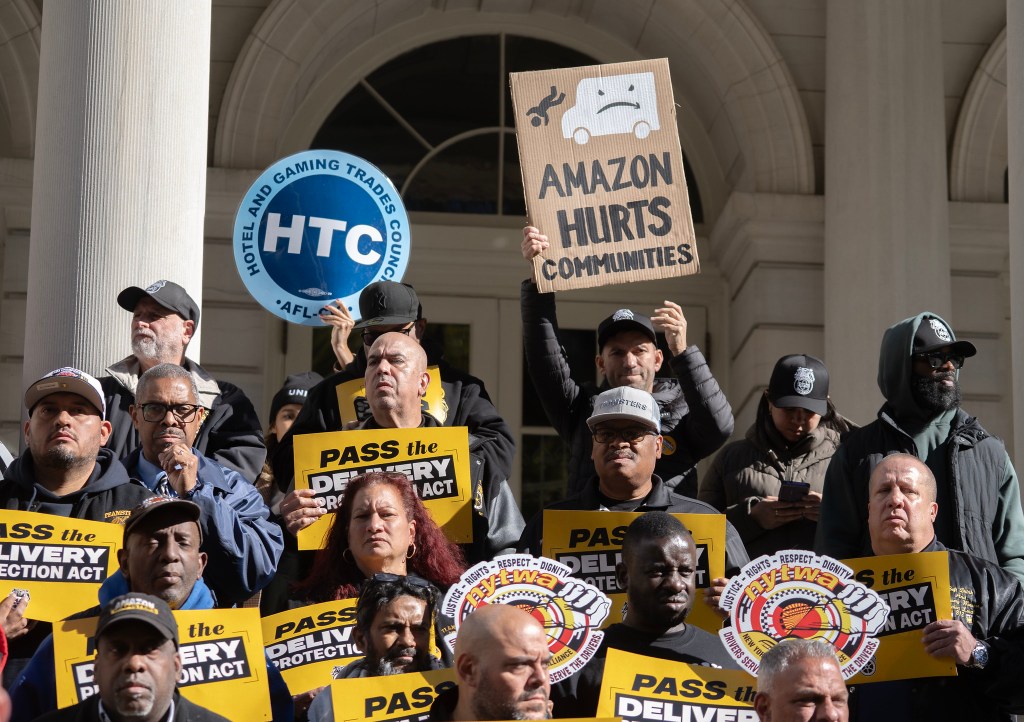
Genuine political corruption is when the wealthy or corporations — Amazon, Peter Thiel, Tesla — donate to politicians who later pervert the political system for the benefit of those donors. Uber’s $8-million campaign to get Gov. Hochul to reduce auto insurance premiums at the expense of crash victims is a prime example of the practice that street safety advocates are being accused of.
Dark, self-serving forces are, indeed, at work across our society — but people supporting a road redesign ain’t it.
‘This bike lane will shut my business down’
Lester Wasserman, the owner of Tip Top Shoes, has made himself the public face of opposition to the W. 72nd Street bike lane and has managed to convince several TV stations to take him seriously in the process.
On Tuesday, Wasserman told CB7 that the bike lane “will shut me down.”
“My customers come in in-person, they park, they walk through that front door. You’re physically placing a two-way high-speed traffic lane between my customers and my entrance,” Wasserman said. “The moment that feels unsafe, they go elsewhere and they do not come back.”
Setting aside the fact that the bike lane doesn’t exist yet, so no Tip Top customer has failed to come back because of it, Wasserman’s larger claim doesn’t match up with what experts have witnessed on streets where DOT installs bike lanes. Business owners similarly predicted retail armageddon when DOT installed a protected bike lane on Columbus Avenue back in 2011, only to see storefront occupancy hit 100 percent. On Skillman Avenue in Queens, another corridor where merchants opposed bike lanes, sales rose 12 percent post-bike lane implementation.
In fact, business owners often overestimate how many of their customers drive to their stores — especially in a neighborhood like the Upper West Side, where just 25 percent of households have access to a car. DOT Commissioner Mike Flynn has called merchants’ belief that their customers need parking one of the “biggest misconceptions” about transportation in the city.
“In most parts of New York, I’d say that’s not the case [that customers need parking], and there’s been a lot of research out there that proves that,” he said on DOT’s “Curb Enthusiasm” podcast in April. “But you even sometimes see things like, the business owners are the one parking out front and feeding the meter.”
Some business owners get it. Henry Rinehart owned the bar and restaurant Henry’s on Broadway that closed in 2018 after a good run, thanks to a customer base of pedestrians and cyclists.
“I endorse this as the best in class safety for all pedestrians, creating the lifeblood of our retail community, which is foot traffic,” Rinehart said.
‘You’re trying to run this city as if we’re all 20 years old’
The Upper West Side meeting was dominated by the idea that bike lanes inherently harm seniors and others with mobility challenges — even as one senior after another testified in favor of the DOT redesign.
“West 72nd is popular, in case you didn’t know, with Upper West Side cyclists like me because it is the best way to get across town,” said James, an Upper West Sider who told CB7 members he was 74-years-old. “We will continue to ride on 72nd whether or not there is a bike lane, but we want the street to be safe.”
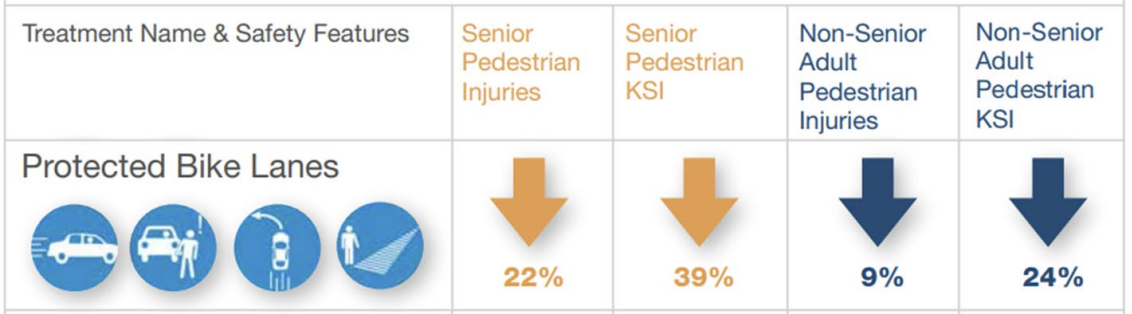
DOT officials also came prepared with stats showing that protected bike lanes have led to a 39-percent drop in seniors killed or severely injured and a 22-percent drop in overall senior injuries. Opponents can doubt those stats all they want, but they’re borne out over and over again on redesigned streets across the city, country and world.
Much of the crowd’s consternation focused on e-bikes, which bike lane supporters acknowledged as a problem — but not a reason to shelve the bike lane.
“I’ve lived on the Upper West Side for 40 years. I am clearly a senior. I use 72nd street nearly every day. I, like many here, do not love e-bikes, but tonight’s vote is not about e-bikes,” said Andy Rosenthal. “Senior pedestrians will benefit the most from this. When you don’t like the answer, you blame the stats, okay, there are 170 car lanes on the Upper West Side crosstown. We’re asking for one of those 170 lanes that are dedicated to cars.”
Bike opponents often call bike lanes “ableist” or “ageist,” but if that was true, the entire country of the Netherlands would be ableist or ageist. It’s also worth pointing out that not a single person under 17 can drive, so roadways without bike lanes are, in fact, ageist in that they discriminate against young people by reducing their ability to get around safely.
‘There’s never been a safety problem on the Upper West Side’
One idea that permeated both meetings was the argument that safety improvements are totally unnecessary. Pro-car gadfly Tag Gross went so far as to proclaime that “there’s never been a safety problem on the Upper West Side.”
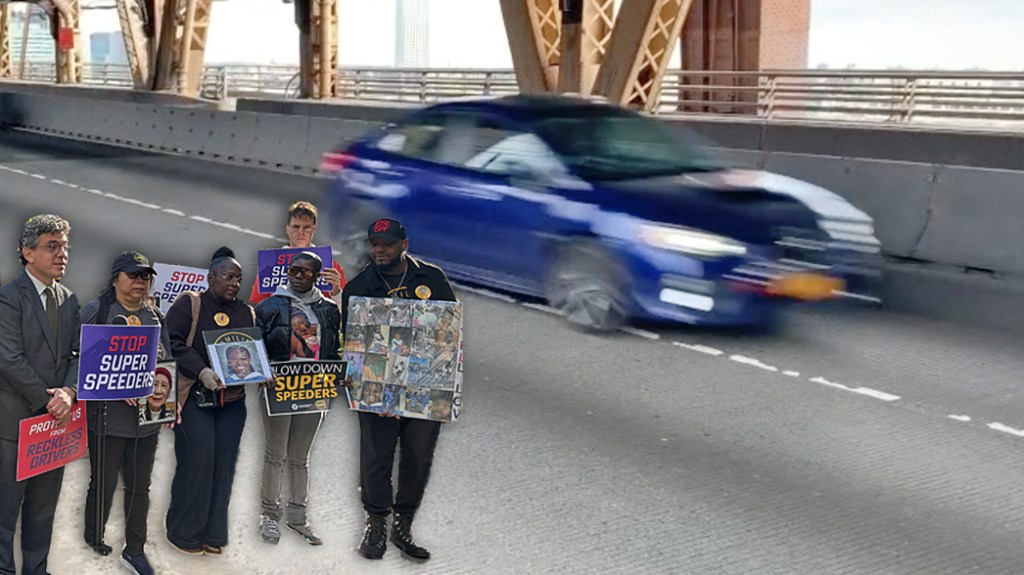
That could not be further from the truth: Since January 2020, 23 people — including four dead cyclists and 16 dead pedestrians — have been killed in crashes, according to city data compiled by Crashmapper. Over the same period, there have been 6,036 reported crashes, injuring 2,510 people, including 555 cyclists and 621 pedestrians. If that is not a “safety problem,” it is unclear what is.
One of the killed pedestrians — 89-year-old Leonard Sugin — was struck in 2023 by an SUV driver on the stretch of Riverside Boulevard that DOT plans to redesign as part of the W. 72nd Street project. Riverside Boulevard and W. 72nd Street together rank in the top 10 percent of Manhattan streets in terms of traffic crashes, according to DOT.
Protected bike lanes reduce injuries and fatalities for everyone. That might be tough to stomach for change-averse opponents of these proposed redesigns, but it’s the truth.
With Dave Colon and Sophia Lebowitz

Streetsblog has migrated to a new comment system. New commenters can register directly in the comments section of any article. Returning commenters: your previous comments and display name have been preserved, but you'll need to reclaim your account by clicking "Forgot your password?" on the sign-in form, entering your email, and following the verification link to set a new password — this is required because passwords could not be carried over during the migration. For questions, contact tips@streetsblog.org.