New MTA Accessibility Advisory Panel Guidelines Bar Members from ADA Lawsuits
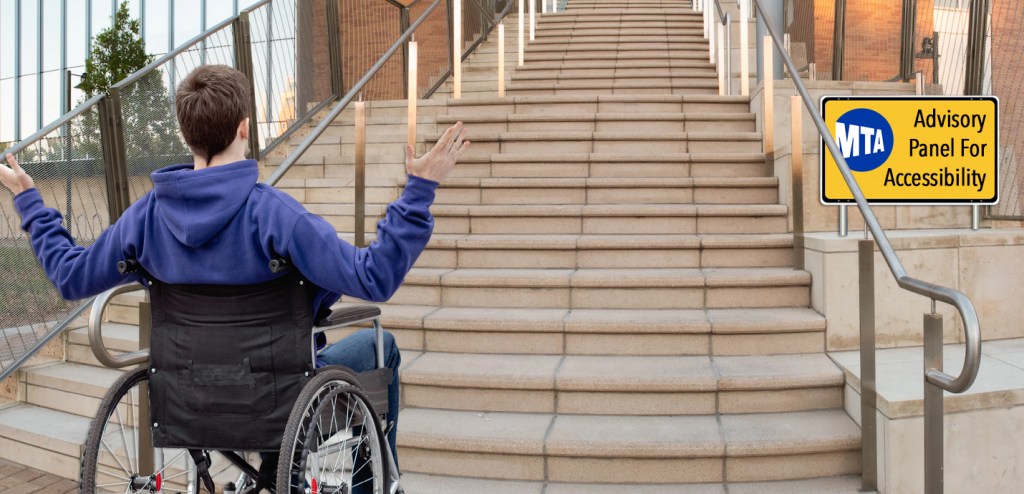
MTA relationship status: friends — with terms and conditions.
Disability advocates could find themselves shut out of a key transit advisory committee after the MTA instituted new guidelines prohibiting the participation of anyone affiliated with groups suing the agency over accessibility law violations.
The new guidelines released in February suggest that any member of the Advisory Committee for Transit Accessibility “employed by, or affiliated with, an organization that has filed a legal action against the MTA or its subsidiaries and affiliates” can be removed if the MTA determines that affiliation constitutes a conflict of interest.
At least two current committee members — the president and vice president of Disability in Action — may be removed from the committee as a result of the new guidelines, which advocates say the MTA crafted without their input; Disability in Action is a plaintiff in an ongoing lawsuit filed against the MTA in 2017 over elevator maintenance.
Jean Ryan, the group’s president, told Streetsblog the MTA told her she is “grandfathered in” and likely safe from removal because she joined the committee before discussions began about the new guidelines.
“Nothing about us, without us!” Ryan said. “We want to be involved in changes so that bad changes are not made that do not meet the needs of people with disabilities.”
Launched in 2019 by former MTA New York City Transit President Andy Byford as a way for the MTA and the disability community to work together outside the legal system, the committee has advised the MTA’s accessibility team on efforts to improve the experiences of riders with disabilities. Committee members have weighed in on such topics as boarding-area floor signage, announcements of elevator locations, a pilot program allowing strollers on buses, updates to the official subway map, OMNY tap-and-ride access at emergency gates, and technology features for sign language speakers.
Applications to join the committee, which lost several members to term limits at the end of 2025, went live three weeks ago — but prominent disability advocates said the new rules make it impossible for them to participate. Barely one-quarter of subway stations are fully accessible, and the MTA has faced litigation over its violations of the Americans with Disabilities Act for decades. But the MTA doesn’t want people suing them at the table.
“To me, they seem a bit sloppy and determined to make absolutely clear who is the boss: the MTA,” said Peggy Groce, a six-year committee member who was term-limited off the panel at the end of last year. “Change requires dissent, disagreement and compromise; the guidelines appear to discourage dissent and disagreement and encourage the compromise[s] sought by the MTA.”
The new guidelines come as participation on the committee has dwindled due what advocates charge is “waning” interest at the MTA. That lack of attention already prompted several advocates to resign from the panel last year, a group of term-limited committee members wrote in a letter to MTA leadership in December.
MTA spokesperson Kayla Shults described the new guidelines as “based on feedback from ACTA committee members.” Shults did not address Streetsblog’s questions about disability advocates’ claim that the MTA has effectively asked them to forfeit their ADA rights in order to participate in the panel.
“The ACTA guidelines are intended to clarify the committee’s advisory role and responsibilities, process and structure while ensuring alignment with the MTA’s governance and legal framework,” Shults said.
Committee members said they disagree with the MTA’s framing of the process that led to the changes. Several who spoke to Streetsblog expressed frustration with the committee’s own access issues: Ryan described being denied accommodations of an assistive listening device and being subjected to long waits by MTA security to get to the wheelchair accessible side of the headquarters building.
“The existence and structure of the ACTA makes it look like a real advisory committee, but with few exceptions, it does not function that way,” Groce said.
Advocates and committee members also expressed concerns about the new guidelines’ confidentiality rule, which states members must “keep information shared by MTA staff confidential.” But the MTA goes to great lengths not to share confidential information — to the extent that officials refused to disclose accessibility training for MTA workers with committee members, according to Jessica Murray, who chaired the committee from 2019 to 2023.
Murray challenged the MTA’s suggestion that disabled New Yorkers suing the MTA over Americans with Disabilities Act violations have a “conflict of interest.”
“They seem to misunderstand that plaintiffs don’t receive monetary awards,” Murray said. “At best, they get a promise for accessibility improvements that often take years to materialize. They spend considerable personal time in court and, coincidentally, are often the same people willing to serve on committees like ACTA.”
Before the committee’s formation, the MTA had a “Compliance Coordination Committee,” which advocates described as an inaccessible forum for updates on the MTA’s slow-rolling efforts to make its stations accessible. Advocates fear the Advisory Committee for Transit Accessibility is headed in that direction.
For many of the advocates and committee members still hopeful for better collaboration, it is vital for ACTA to stay alive to ensure the committee is effective in delivering any change for the greater community.
“The disability community is a large and diverse one with competing ways of meeting access needs in transportation,” Groce ended. “ACTA should be a place where these diverse ways of meeting transportation needs are freely, openly, thoughtfully brought out and discussed.”
Over 50 people have applied for the 10 open spots on the committee, the MTA said. Applications close on Saturday, March 14 Wednesday, March 11.

Read More:
Streetsblog has migrated to a new comment system. New commenters can register directly in the comments section of any article. Returning commenters: your previous comments and display name have been preserved, but you'll need to reclaim your account by clicking "Forgot your password?" on the sign-in form, entering your email, and following the verification link to set a new password — this is required because passwords could not be carried over during the migration. For questions, contact tips@streetsblog.org.