Judge Blocks City From Implementing 15 MPH Bike Speed Limit In Central Park
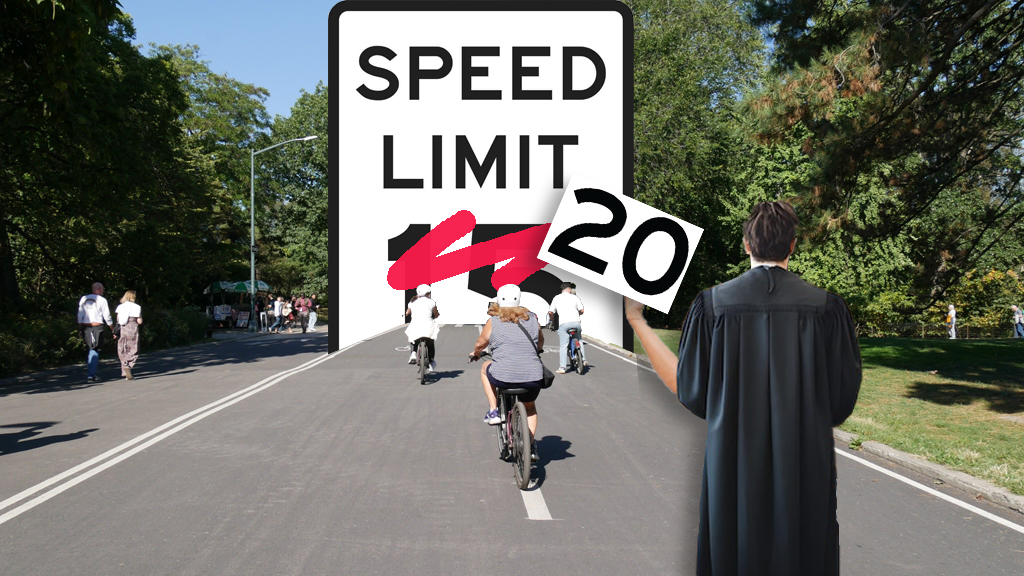
Not so slow.
A state Supreme Court judge will temporarily block the city from reducing the bike speed limit in Central Park to 15 miles per hour — an indication that the New York Cycle Club and other opponents of this “illegal application” of the so-called “Sammy’s Law” may prevail on the merits at an upcoming full hearing.
Judge Nicholas Moyne is expected to issue the formal temporary restraining order today, according to a source who confirming a Reddit post by a Cycle Club board. On Dec. 15, as one of the last actions of the Adams administration, the city gave local community boards 60-day notice of its decision to lower the speed limit; but it has not yet been enforced, though some signs have been changed.
In blocking the city, Moyne is indicating that the New York Cycle Club has a reasonable shot of winning its larger case against the Central Park speed limit, which the club argues is “illegal” because the state law that granted the city the right to lower its speed limit to 20 miles per hour — aka “Sammy’s Law” — does not authorize speed limits below 20 for non-motorized vehicles.
The club had also argued that a 15-mile-per-hour speed limit would make its members unsafe as they train and recreate because it would push bike racers to city streets, which are “busier [and] more dangerous.” The club’s lawyer, Peter Beadle, argued for the restraining order on the grounds that forcing cyclists into traffic would comprise “irreparable harms that cannot be addressed through monetary or other relief.”
The Cycle Club’s larger case is built on challenging two rationales for lowering the bike speed limit. Beyond the misapplication of Sammy’s Law, Beadle also claims that the city has offered “no objective study or data justifying why it is important to make this [speed limit] change now.” He cites a 2024 study of the Central Park Drives conducted by the Central Park Conservancy, and the city departments of Transportation and Parks that recommended “many safety recommendations, none of which involved changing the speed limit.”
The city has said it does have the right to lower the speed limit for bikes under Sammy’s Law, and that plaintiffs would not suffer irreparable harm if the 15-mile-per-hour cap was implemented.
Besides, the 15-mile-per-hour signs have already been installed, according to city lawyer Leah Reiss.
“DOT has broad authority to regulate traffic in the city based on both the New York State Vehicle and Traffic Law and the New York City Charter.
And the city believes it will ultimately succeed on the merits: “The reduced speed limit in Central Park, which is applicable to motor vehicles, e-mobility devices, and bicycles, indisputably enhances safety conditions for non-motorized street users.”
Under law, a judge can issue a temporary restraining order if plaintiffs are likely to win or if they will suffer “irreparable injury” if the action is carried out.

Read More:
Streetsblog has migrated to a new comment system. New commenters can register directly in the comments section of any article. Returning commenters: your previous comments and display name have been preserved, but you'll need to reclaim your account by clicking "Forgot your password?" on the sign-in form, entering your email, and following the verification link to set a new password — this is required because passwords could not be carried over during the migration. For questions, contact tips@streetsblog.org.