‘The Brake’ Podcast: The Electric Car is a ‘Wolf In Sheep’s Clothing’?
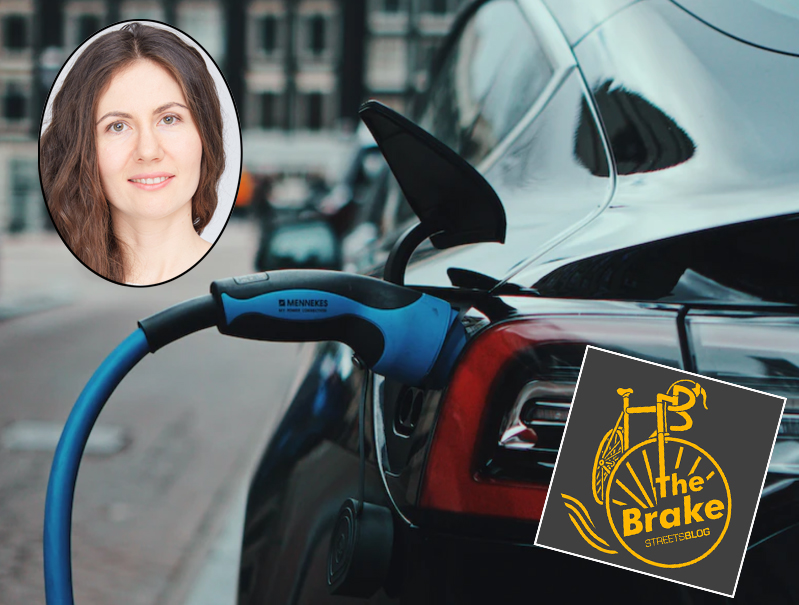
What is an electric car, really?
Is it a godsend that could save the planet from climate catastrophe by slashing emissions in the sector that contributes the most greenhouse gases in virtually every developed country in the world Is it an important tool for climate harm reduction that we have to invest in big, even if it doesn’t solve all of the problems of car dependent transportation systems? Or is it just a heavier and more heavily subsidized car that makes nearly all of the core problems of car dependency worse, while using its climate benefits as a screen to shield us from those harms?
On today’s episode of The Brake, we sit down with Agnieszka Stefaniec, co-author of the new paper “A Wolf in Sheep’s Clothing: Exposing the Structural Violence of Private Electric Automobility,” to get her take — and talk about why the EV debate is so polarizing.
Tune in below, on Apple Podcasts, Spotify, or anywhere else you listen.
( function() {
var func = function() {
var iframe = document.getElementById(‘wpcom-iframe-a9f4535955d10d794ff78b7df5b6c92e’)
if ( iframe ) {
iframe.onload = function() {
iframe.contentWindow.postMessage( {
‘msg_type’: ‘poll_size’,
‘frame_id’: ‘wpcom-iframe-a9f4535955d10d794ff78b7df5b6c92e’
}, “https://embeds.streetsblog.org” );
}
}
// Autosize iframe
var funcSizeResponse = function( e ) {
var origin = document.createElement( ‘a’ );
origin.href = e.origin;
// Verify message origin
if ( ’embeds.streetsblog.org’ !== origin.host )
return;
// Verify message is in a format we expect
if ( ‘object’ !== typeof e.data || undefined === e.data.msg_type )
return;
switch ( e.data.msg_type ) {
case ‘poll_size:response’:
var iframe = document.getElementById( e.data._request.frame_id );
if ( iframe && ” === iframe.width )
iframe.width = ‘100%’;
if ( iframe && ” === iframe.height )
iframe.height = parseInt( e.data.height );
return;
default:
return;
}
}
if ( ‘function’ === typeof window.addEventListener ) {
window.addEventListener( ‘message’, funcSizeResponse, false );
} else if ( ‘function’ === typeof window.attachEvent ) {
window.attachEvent( ‘onmessage’, funcSizeResponse );
}
}
if (document.readyState === ‘complete’) { func.apply(); /* compat for infinite scroll */ }
else if ( document.addEventListener ) { document.addEventListener( ‘DOMContentLoaded’, func, false ); }
else if ( document.attachEvent ) { document.attachEvent( ‘onreadystatechange’, func ); }
} )();
The following excerpt has been edited for clarity and length.
Kea Wilson: Tell me about the genesis of this paper and how it got this extremely incendiary title that maybe some of our readers are going to be a little bit challenged by.
Agnieszka Stefaniec: I agree, absolutely; the paper is controversial. We we’ve got a lot of media attention. And many of the comments were very critical … but it’s not that we can’t answer them. It’s that sometimes, we are a bit disappointed that people do not read the paper.
I guess our inspiration was [just] the realities of car-centric society. We live in the city which is car-oriented, we are pedestrians, we don’t have a car, we use the public transport to get around. And we also do research related to transport and climate change. And we found the solution of electrifying the private vehicles have lots of flows, and lots of negative externalities, even though it is claimed as a silver bullet to reduce emissions and to improve our lives.
We found that there is a growing body of research that explores these flaws, and we gathered all of these different ideas in one paper, adding also a concept of an ‘EV bubble’. Because many people are not aware of the externalities that are created by EVs, or how they [deepen] structures of violence.
KW: You argue in the paper that EVs won’t just fail to make the problems of automobility go away, that they may actually exacerbate some of the existing problems of aut mobility in ways that we might not expect. What do you mean by that?
AS: Basically, EVs maintain or reinforce the current car dependent system, and this system, in our view, is the problem here. So in reinforcing a car-oriented society, this system blocks certain sustainable transport choices of households, leaving households with only one way of traveling: that is, by private car. Active travel modes are forgotten, the public transport is not invested in enough.
And additionally, EVs make some of the problem[‘s of car dependency] worse. For example, we know that many households are buying an EV as a second car or third car for their households, and this intensifies traffic and congestion. And when we have more cars, we also have more car crashes, when we have more cars, we have more noise in the cities. Then, additionally, electric vehicles needs charging. So we need charging infrastructure and charging facilities, and these occupy a substantial amount of public space, which could have been be used for other purposes …
There are many other issues, but maybe what I want to highlight most is the relatively high cost of EVs. So right now, EVs are luxury goods, and only the wealthy households can afford them. This issue widens the divide between the rich and poorer parts of the society. So the rich can afford EVs and can enjoy using them, and the poorer households are under increasing pressure from ICE disincentives, like carbon taxes, and also from [the fact that] investments that would be better allocated to the active travel or public transport infrastructure are allocated to support the EV uptake… And then there are new inequalities that are being introduced by EVs that they relate mostly to pollution and to extraction of new materials that are needed for EV batteries.

Read More:
Streetsblog has migrated to a new comment system. New commenters can register directly in the comments section of any article. Returning commenters: your previous comments and display name have been preserved, but you'll need to reclaim your account by clicking "Forgot your password?" on the sign-in form, entering your email, and following the verification link to set a new password — this is required because passwords could not be carried over during the migration. For questions, contact tips@streetsblog.org.