Driving is Normalized Way More Than We Think — With Terrible Ramifications
People raised in a car-dominated culture are measurably more likely to accept the societal harms and inequities associated with driving than they do with other public health threats, a new study finds — and undoing those powerful double standards will require a profound rewiring of the way we think about … everything.
In a new paper published in the Journal of Environment and Health, a team of U.K.-based researchers asked half of a nationally representative sample of more than 2,000 British adults how strongly they agreed or disagreed with provocative statements aimed at better understanding their attitudes towards driving.
The other half was asked the exact same questions, but with the nouns related to automobiles subbed out for other public health concerns, like smoking, drinking, food sanitation, and workplace safety.
Those statements were:
- “Risk is a natural part of [driving/working], and anybody [driving/working] has to accept that they could be seriously injured.”
- “There is no point expecting people to [drive/drink alcohol] less, so society just needs to accept any negative consequences it causes.”
- “People shouldn’t [drive/smoke] in highly populated areas where other people have to breathe in the [car/cigarette] fumes.”
- “It’s OK for a [delivery driver/chef] to bend a few health and safety rules in order to keep their business profitable.”
The researchers also included a fifth question that’s less explicitly related to public health, but still demonstrates how wildly different our conversations about justice and public space tend to be when we’re talking about automobiles:
- “If somebody leaves their [car/belongings] in the street and [it gets/they get] stolen, it’s their own fault for leaving [it/them] there and the police shouldn’t be expected to act.”
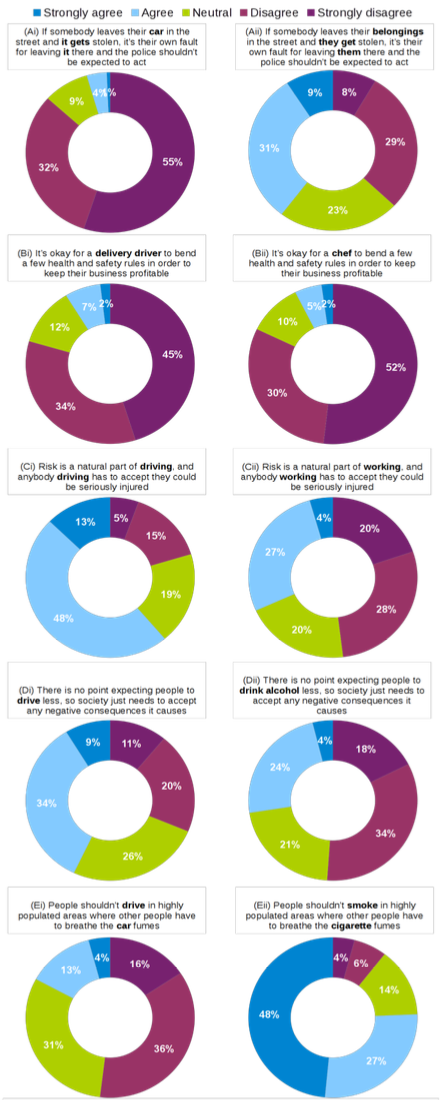
The results, as study author and environmental psychologist Ian Walker succinctly put it on Twitter, showed that “‘Car Brain’ — the cultural blind spot that makes people apply double standards when they think about driving — is real, measurable and pervasive.”
For instance, a whopping 61 percent of respondents either “agreed” or “strongly agreed” that safety risks were a natural part of driving, while roughly half as many people (31 percent) thought workplace hazards were to be expected and tolerated — despite the fact that for millions of people who work in transportation, driving is working, and those people need workplace protections, too.
When it came to air pollution, meanwhile, only 17 percent of respondents thought that non-consenting passerby shouldn’t be exposed to toxic fumes from tailpipes, while 75 percent said the same about fumes from cigarettes, which have been banned in many indoor and outdoor environments.
Those findings, unsurprisingly, prompted a flurry of conversation, particularly from those who questioned whether the hazards of car dependence are truly comparable with other hot-button societal issues. Take cigarettes, which offer no benefits to anyone besides the pleasure of the smoker herself and the profit margins of the tobacco company that feeds her habit; driving, by contrast, at least quickly transports goods and services that we all, theoretically consume. Or, as New York activist Doug Gordon once memorably put it, “no one drives a cigarette to the grocery store.”
Walker, though, says that “part of the point” of the study was to highlight the ways that pro-car bias — or, as he calls it, “motonormativity” — isn’t just a matter of individual preference, but the result of societally constructed asymmetries that make, say, forcing car exhaust on our neighbors feel like a defensible choice, while forcing cigarette fumes on those same neighbors is increasingly stigmatized and outlawed. (He also points out that truly necessary trips aside, a lot of driving doesn’t benefit society at large, and with good planning and policy, no one would need a car to get to a grocery store at all.)
Really interesting finding. I find it maddening at work where >1/3 of our major trauma is caused by motor vehicles no one speaks out about it https://t.co/p2CR9I1amP
— Cleo Kenington ? (@CleoKenington) January 18, 2023
More important, Walker stresses that the instinct to defend the car-dominated status quo isn’t only the result of bad policies that too often make driving the only realistic choice. It’s also a deep cultural and emotional value that’s systemically reinforced by our own families, our media landscape, and countless small, daily interactions that seem innocuous in the moment, but add up to powerful norms. He says the study was partly inspired by a recent visit to his doctor, who assumed he needed driving directions to the closest pharmacy to fill a prescription — even though it was less than a quarter-mile away.
“We like to think that we’re rational agents, and especially given the influence of economics in policymaking,” he adds. “We tend to think that people weigh out the pros and cons of everything they do. But they don’t. Because if they did, well, why doesn’t everyone just drive the most affordable car? Why does anybody worry about the color of their car? We are so, so influenced in our behavior by what we see other people do; it’s unconscious, but it happens all the time.”
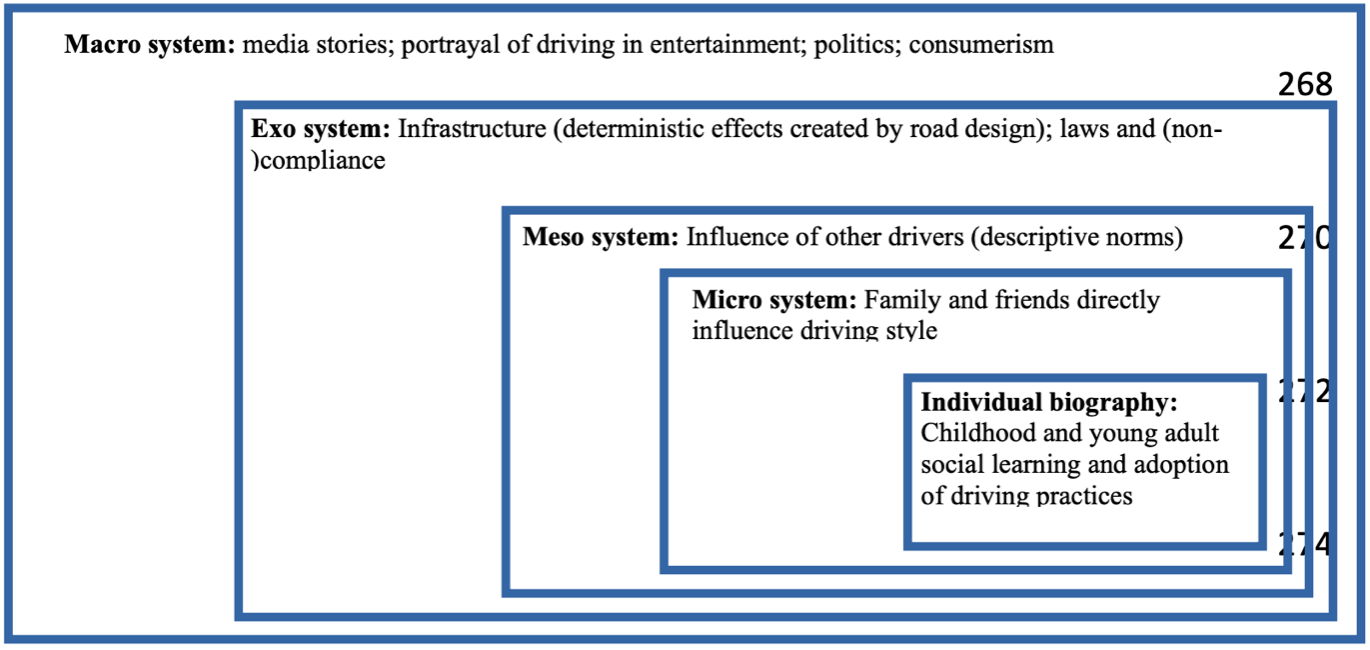
Critically, Walker says de-normalizing the harms and inequities of driving may not require advocates to penetrate every layer of systemic bias that’s made “motonormativity” the virtual default — even if nudging our friends and families to think beyond the windshield certainly can’t hurt.
“As an individual, the layers [of influence] closest to us are the most important,” he adds. “But those outer levels influence everybody — especially that exo-layer that policymakers can control. If I could wave a magic wand and change a single thing, it would be getting [transportation leaders] to agree to change planning laws, environmental laws, and policing standards … Build a street where people can’t speed, and there will be a brief period of moaning and complaining. But you won’t have speeding.”
Still, the new paper suggests that even with big policy reforms, overcoming “car brain” on a grand scale will take time — even though people are dying while we wait.
“As people who are trying to encourage mode shift to non-car modes, we are very aware of these obvious double standards,” Walker said. “So many people say things like, ‘oh, someone whizzed by me on a bicycle almost killed me the other day!’ Whereas cars do the same thing, and it barely gets a mention.”

Read More:
Streetsblog has migrated to a new comment system. New commenters can register directly in the comments section of any article. Returning commenters: your previous comments and display name have been preserved, but you'll need to reclaim your account by clicking "Forgot your password?" on the sign-in form, entering your email, and following the verification link to set a new password — this is required because passwords could not be carried over during the migration. For questions, contact tips@streetsblog.org.