CRASH IN FLATIRON: Vehicle-Into-Building Crashes 40% Higher Than Previously Thought
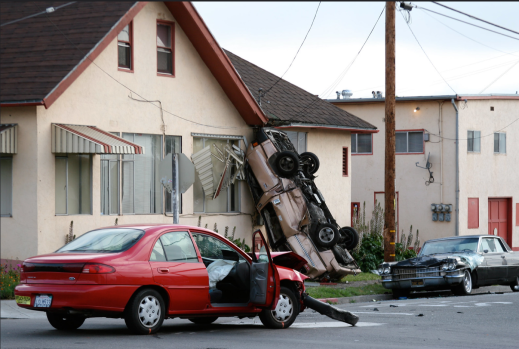
U.S. drivers ram their cars into buildings about 100 times every single day — 40 more daily collisions than previously thought, though some experts suspect it may still be an undercount.
Experts at the Storefront Safety Council reported that roughly 16,000 people are injured every year when drivers either deliberately or — more often — unintentionally careen into houses, apartment buildings, schools, stores, restaurants, offices, religious centers, laundromats, ice cream shops, pinball bars, and other occupied buildings, to cite just a handful of examples from the recent news. That’s four times higher than the number of people the group estimated were hurt in 2020 when Streetsblog first covered its data just two years ago.
Henry Grabar, who originally reported the new numbers for Slate, questioned the Council’s estimate that 2,500 people die in vehicle-into-building crashes ever year based on their public methodology, but acknowledged that it’s troubling how little the public knows about the impact of traffic violence outside of the traditional transportation realm.
“Maybe the broader lesson is simply to marvel at the fact that we don’t even know how many times a day a car smashes into a building in the United States,” Grabar wrote. “It’s just one of those things about car culture that goes uncounted, unthought of, until you’re the one waiting for the register when an SUV comes careening through the front window.”
Pedestrians Aren’t Even Safe From Car Crashes Inside Buildings
Another broad lesson might be just how incomplete even the most commonly cited government crash data can be, whether those collisions happen on or off the road — and how badly government leaders need to adopt better standards to understand America’s traffic violence crisis, and to craft data-informed strategies to address its root causes.
When it comes to vehicle-into-building crashes, it’s not even clear when law enforcement officers are supposed to report collisions to federal agencies, and when they do, that data isn’t always made available to the public at large in any legible way. The National Highway Traffic Safety Administration has long maintained a policy of excluding “crashes that occurred on private property, including parking lots and driveways” from year-end fatality and injury totals — a statement which also implies that when drivers kill someone after plowing past a parking spot wheel-stop and into a privately owned structure, those deaths don’t count.
The Insurance Institute for Highway Safety, however, says the agency does record vehicle-into-building crashes, but only when they were deemed the “most harmful events” compared to the other objects, vehicles and people the driver might have struck over the course of a single traffic violence vent. That means that when, for instance, a driver leaves the public right-of-way and crashes into a preschool, as one in California did in March, the vehicle-into-building crash probably does count — but if the same driver strikes another motorist first, it might not be counted, at least if more people were hurt during the initial impact. Based on that confusing standard, NHTSA reported just 210 vehicle-into-building crashes in all of 2020.
The Storefront Safety Council, though, adds between 200 and 250 crashes to its database every month, based on “anecdotal and media reports, court records, fire department run records, and published studies.” And even that number might be a significant undercount; for instance, the organization the Council hired to audit its records found that a single Las Vegas bus stop was struck 27 times in a single year, but just two of those crashes made their way into the database.
And that doesn’t even include crashes that occur on land without anything built on it, like beaches where people are picnicking and parks where children are playing.
To at the very least keep drivers from busting through building walls like the Kool-Aid Man, experts at the Storefront Safety Council recommend common-sense infrastructure improvements like putting concrete bollards in front of buildings, patios, lawns, and other places where people might congregate, as well as redesigning parking lots to discourage higher speeds and adding anti-collision technology to vehicles themselves.
Perhaps an even better strategy, though, would be simply building a world where fewer people felt compelled to drive at all — and had fewer chances to ram their vehicles into public or private spaces where cars don’t belong.

Read More:
Streetsblog has migrated to a new comment system. New commenters can register directly in the comments section of any article. Returning commenters: your previous comments and display name have been preserved, but you'll need to reclaim your account by clicking "Forgot your password?" on the sign-in form, entering your email, and following the verification link to set a new password — this is required because passwords could not be carried over during the migration. For questions, contact tips@streetsblog.org.