Houston’s Getting Ready for a Flurry of Bike Lane Expansion

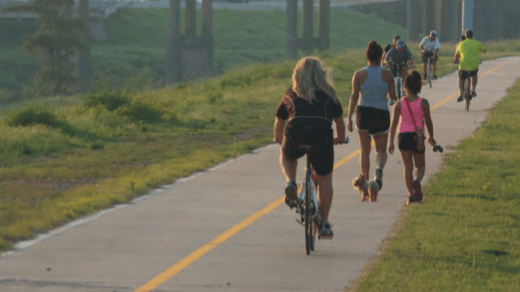
Last year, the Houston City Council approved an ambitious bike plan that aims to build a network of comfortable bikeways, with 700 miles of on-street bike lanes and 450 miles of off-street trails [PDF].
It was a good vision statement, but there was no funding attached.
Now the bike plan is in line for real resources, and advocates are optimistic that big things will start happening quickly. Last week, the city received a $10 million commitment from Harris County for on-street bike infrastructure, enough to build 50 miles of protected bike lanes, according to the Houston Chronicle.
Right now Houston has just a handful of bike lanes, and only one — on Lamar Street — is protected. Bicycling rates are low, even compared to other car-centric American cities. In Houston, only 0.5 percent of workers commute by bike, about one-third the rate in Atlanta [PDF].
![Houston's bike plan calls for almost 1,500 miles of on- and off-street bikeways. Maps: Houston Bike Plan [PDF]](http://usa.streetsblog.org/wp-content/uploads/sites/5/2018/04/houston-bike-plan.gif)
If implemented, the bike plan could lead many more people to opt for biking. Houston Bikes Executive Director Jessica Wiggins says that by next April, the city should build out 50 miles of “high comfort” bikeways, meaning either trails at least 10 feet wide or bike lanes with a three-foot buffer or some physical barrier.
All of the projects Houston Bikes is recommending are considered “short-term opportunities,” Wiggins said, meaning they can easily be carved out of the city’s overly wide streets. For example, an eight-lane road might be reconfigured to add a parking-protected bike lane.
“In Houston, we have quite a bit of right of way,” Wiggins said. “We overbuilt several hundred miles of our streets. We have five-, six-, eight-lane roads that simply just don’t need to be that wide.“
One of the more exciting aspects of the $10 million in county funding is that it comes from a fund that has mainly supported sprawl infrastructure. County Commissioner Rodney Ellis directed the funding to the City of Houston from a pot that generally goes toward road projects in unincorporated areas of Harris County.
Ellis said allocating the money to the bike plan made sense, given the makeup of his district, 70 percent of which lies within Houston proper.
“We are ready to get started on projects that residents can start using soon so they have more opportunities to safely depend on bicycles or walking for everyday transportation,” Ellis told Streetsblog. “We cannot continue to be a region defined by cars and highways. It will set us back when we need to be leading the way on urban mobility.”
Jay Crossley, the founder of the nonprofit Farm and City and long-time smart growth advocate from Houston, says the total cost for the Houston Bike Plan is probably around $550 million. The city, still struggling to recover from Hurricane Harvey, has only been dedicating about $1.1 million annually to bike infrastructure, despite Mayor Sylvester Turner’s expressed support for alternatives to driving.
But recent history suggests there’s a public appetite for investment in biking and walking infrastructure. In 2012, city voters approved a $166 million bond issue to build paths along the city’s nine major bayous, which run north and south to the gulf of Mexico. The Bayou Greenways bond issue passed with 68 percent support — the best performance of any bond issue in the city’s history.
Since then, the city has received permission to use rights-of-way under power lines to build a network of east-west trails that would help make the bayou trails part of a more useful network.
The $10 million from the county will be a test for Houston. Can the city put it to good use and implement bike projects that people will use? Any funding that isn’t spent by next April will be returned to the county.
If it does produce good projects, this round of funding could create more momentum to pay for the rest of the bike plan.
“We may be moving into a new era in Houston where there are serious conversations about the real need,” Crossley said.

Streetsblog has migrated to a new comment system. New commenters can register directly in the comments section of any article. Returning commenters: your previous comments and display name have been preserved, but you'll need to reclaim your account by clicking "Forgot your password?" on the sign-in form, entering your email, and following the verification link to set a new password — this is required because passwords could not be carried over during the migration. For questions, contact tips@streetsblog.org.